
Five senior officers transferred after Khao San bar crackdown
On the night of 10 October 2026, a routine patrol near the bustling Khao San Road turned into a stark reminder of the challenges facing Bangkok’s law‑enforcement agencies.
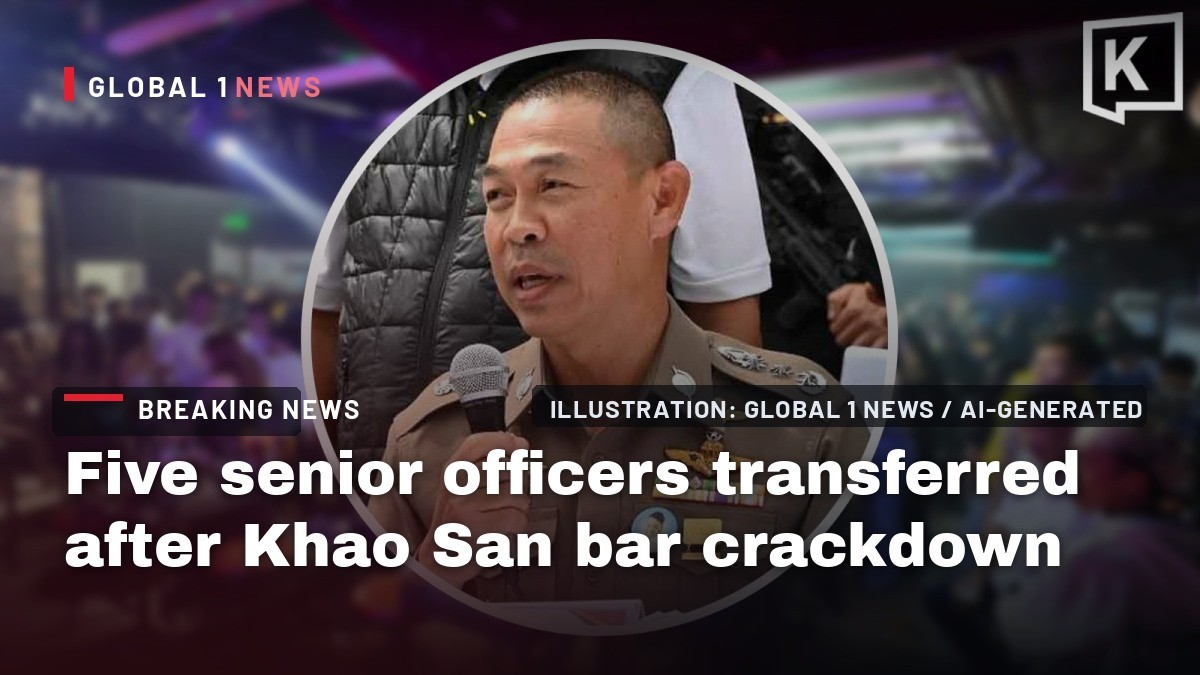
On the night of 10 October 2026, a routine patrol near the bustling Khao San Road turned into a stark reminder of the challenges facing Bangkok’s law‑enforcement agencies. Interior Ministry officials raided a popular nightclub just a few hundred metres from the Chana Songkhram Police Station, uncovering drugs and other violations. The incident prompted Metropolitan Police Bureau chief Pol. Lt. Gen. Siam Boonsom to relocate five senior officers from the station to an operations centre while a thorough investigation unfolds. This move, while procedural, resonates deeply with the community’s expectations of transparency and accountability, values rooted in Thai cultural and Buddhist principles of right conduct.
Background to the raid
The raid, carried out by the Department of Provincial Administration at around 03:00 local time, resulted in the immediate closure of the nightclub. According to Pol. Lt. Gen. Siam, the venue’s proximity to Chana Songkhram Police Station—only a few hundred metres away—raised questions about why earlier inspections had not flagged any irregularities. Earlier that night, at around 01:00, officers from the station had conducted a routine sweep of the area but reported finding nothing amiss.
This discrepancy between the two inspections has become the focal point of the ongoing inquiry. The senior officers, collectively known as the station’s “five tigers,” now face scrutiny not only for their operational decisions but also for the broader implications of how information flows within police hierarchies. In Thai culture, the concept of “khun‑kha‑khun” (mutual respect and responsibility) underscores the expectation that leaders ensure the well‑being and safety of the community they serve.
The transfer of the “five tigers”
In response to the raid’s findings, Pol. Lt. Gen. Siam ordered the five senior officers to report to the Operations Centre of Metropolitan Police Division 1. This relocation is intended to guarantee a fair and impartial investigation, removing the officers from their usual environment where local pressures might influence outcomes. The move reflects a procedural safeguard, akin to the Buddhist principle of “sacca” (truth), ensuring that facts are examined without bias.
The officers have not been publicly accused of misconduct at this stage; rather, they are awaiting a committee’s review of how the 01:00 inspection was conducted. If the committee determines that lapses occurred, the officers could face both criminal and disciplinary actions. Such potential consequences underscore the seriousness with which the Metropolitan Police Bureau treats any failure to detect illegal activity, especially in a district as internationally recognised as Khao San.
Investigative committee and its mandate
The committee, appointed by Pol. Lt. Gen. Siam, will assess the inspection procedures, the communication channels among officers, and the possible concealment of information. The chief emphasized that he would need to investigate whether the station chief might have been misled by subordinates. This careful phrasing mirrors the Buddhist practice of “right inquiry,” where conclusions are drawn only after thorough examination.
In Thai administrative tradition, such committees serve as a check against both negligence and intentional cover‑ups. By placing the five senior officers under the oversight of Division 1’s Operations Centre, the bureau aims to prevent any perception of favoritism and to reinforce public confidence that the law applies equally to all, regardless of rank.
Community impact and local sentiment
The Khao San area, a magnet for tourists and backpackers, is also home to many local vendors, street performers, and small businesses that rely on the steady flow of visitors. The sudden closure of a nightclub—especially one implicated in drug activity—has ripple effects on livelihoods and the neighbourhood’s reputation. Residents, who often look to the police for protection, may feel a mixture of relief that illegal activities are being addressed and anxiety over the potential for increased police presence.
Thai society places high value on “sang‑khwan” (social harmony). When law‑enforcement actions appear swift and transparent, they help maintain that harmony. The ongoing investigation, therefore, is not just a procedural matter but a test of how well the authorities balance enforcement with community trust, a balance that is central to Buddhist teachings on compassion and non‑violence.
Parallel operation in Don Mueang
While the Khao San raid captured headlines, Pol. Lt. Gen. Siam also addressed a separate operation targeting an illegal gambling den in Don Mueang. This raid, conducted by officers from Don Mueang Police Station and Metropolitan Police Division 2, was the result of tips from local residents and required several days of planning due to the den’s location inside a large, upscale housing estate.
The mention of this operation highlights a broader pattern: police efforts are increasingly relying on community intelligence. In both cases, residents played a pivotal role in alerting authorities to illicit activities. This collaboration aligns with the Buddhist principle of “mettā” (loving‑kindness), encouraging citizens to look out for one another and support the common good.
Political implications and accountability
When questioned about the possible involvement of a local politician from Nonthaburi in the Don Mueang gambling case, Pol. Lt. Gen. Siam affirmed that any individual implicated would be pursued according to the law and available evidence, regardless of position. This stance reinforces the principle of “khwam‑phak‑phat” (equality before the law), a cornerstone of democratic governance in Thailand.
In a region where political patronage can sometimes blur the lines of accountability, the chief’s unequivocal statement serves as a reminder that law‑enforcement agencies are expected to act without fear or favour. It also reflects the broader Southeast Asian geopolitical climate, where governments are under increasing scrutiny to demonstrate transparency and uphold the rule of law, especially in areas frequented by international visitors.
Looking ahead: lessons for policing and society
The unfolding investigation into the “five tigers” will likely set a precedent for how similar lapses are addressed in the future. If the committee finds that procedural failures contributed to the nightclub’s illegal activities going undetected, it may prompt a review of inspection protocols across Bangkok’s police stations. Such reforms could include enhanced training on drug detection, improved communication channels, and stronger mechanisms for whistle‑blowing within the force.
Beyond procedural adjustments, the episode underscores the enduring relevance of Thai cultural values—respect, community responsibility, and moral integrity—in shaping public safety. As Bangkok continues to attract global attention, the ability of its police to act transparently and responsibly will remain a vital indicator of the city’s commitment to both its residents and its visitors. The hope, echoing the gentle wisdom of Buddhism, is that through careful reflection and decisive action, the city can maintain its vibrant spirit while safeguarding the well‑being of all who call it home.
This article was produced with AI-assisted research and editorial support. Reporting is based on the source material cited below. Sources: Khaosod English; khaosodenglish.com; Global1.News (10 October 2026).
By Ann Srisawat, Staff Writer
What's Your Reaction?
 Like
0
Like
0
 Dislike
0
Dislike
0
 Love
0
Love
0
 Funny
0
Funny
0
 Wow
0
Wow
0
 Sad
0
Sad
0
 Angry
0
Angry
0

Southeast Asia Correspondent at Global1.News. Based in Bangkok, covering Thai and Southeast Asian politics, economy, technology, and culture. Deep regional perspective on one of the world's most dynamic regions.














Comments (0)