
Employees at AT&T fiber subsidiary could strike if contract agreement isn't reached
AT&T’s newest fiber venture, Forged Fiber 37, is on the brink of a labor showdown that could reverberate through the whole telecom infrastructure market.
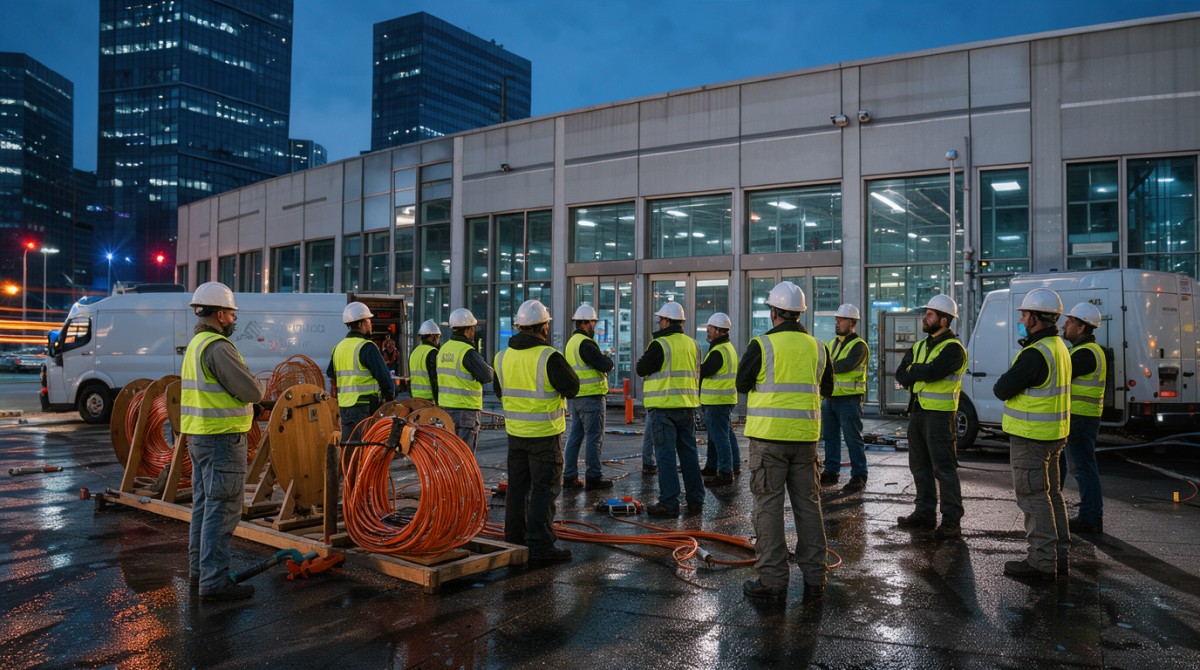
AT&T’s newest fiber venture, Forged Fiber 37, is on the brink of a labor showdown that could reverberate through the whole telecom infrastructure market. The Communications Workers of America (CWA) says its members have “overwhelmingly voted to authorize a strike if necessary,” a move that puts pressure on a joint‑venture already under fire for its reliance on contractors and its aggressive rollout schedule. As a founder who’s been wiring up data centers and running fiber networks for a decade, I see this as a classic case of a hyperscaler‑style rollout colliding with the hard‑won realities of on‑the‑ground labor.
Why the strike vote matters for anyone with a fiber network
The CWA’s vote isn’t just a union‑centric drama; it’s a warning bell for any provider that depends on a skilled workforce to lay and maintain fiber. Forged Fiber 37 employs more than 1,300 workers across the United States, handling the installation, maintenance, and support of AT&T’s expanding fiber footprint. When those hands are threatened with a walk‑out, the network’s reliability and the carrier’s rollout timelines are instantly at risk.
What’s striking is the union’s focus on basic protections—job security, reasonable time off, and wages that reflect the value of the work. Those aren’t lofty demands; they’re the minimum you need to keep a technically proficient crew on the job. In my own shop, we’ve seen turnover skyrocket when crews feel disposable, and the resulting “quick‑fix” fixes from low‑cost contractors end up costing far more in re‑work and outages.
The back‑story: a tentative deal ripped out
Negotiations between AT&T and the CWA began in May, with the union pushing for a first contract that would lock in job security and fair compensation. At some point, the parties reached a tentative agreement, only for AT&T to withdraw it. The union responded by filing an unfair labor practice charge with the National Labor Relations Board (NLRB), accusing the carrier of back‑pedalling on its own promises.
This withdrawal isn’t just a bargaining tactic; it signals a deeper strategic shift. AT&T, alongside BlackRock’s Global Infrastructure Partners (GIP) and the Canada Pension Plan Investment Board (CPP Investments), recently merged Forged Fiber 37 with Gigapower into a wholesale fiber open‑access company. The merger was meant to accelerate AT&T’s fiber rollout, but it also introduced a new layer of corporate pressure to keep costs low—often at the expense of the workforce.
Contractors vs. union techs: a quality battle
Union technicians like Richard Castillo, a Fiber Tech II in Utah, argue that the influx of contractors is eroding service quality. Castillo points to “shoddy, and even dangerous, work done by contractors with no ties to the community.” In my own experience, when you replace seasoned union techs with a revolving door of subcontractors, you lose institutional knowledge. That translates into longer repair times, higher fault rates, and ultimately, dissatisfied customers.
The CWA’s criticism of Gigapower mirrors this concern. The union has previously accused Gigapower of building its network through a web of subcontractors, with minimal direct employment of technicians. When a carrier’s own labor force is sidelined, the risk of network fragility rises sharply—a risk that independent hosting providers feel acutely because we can’t afford massive outages.
Historical context: AT&T’s past labor battles
This isn’t AT&T’s first brush with the CWA. In 2024, more than 17,000 AT&T workers across nine southeastern states staged a 30‑day strike—the longest in the carrier’s history—over a contract dispute. The protracted action forced AT&T to the negotiating table after a month of service disruptions. That episode shows AT&T’s willingness to push hard on labor costs, but also its vulnerability when a large, coordinated workforce walks off the job.
For independent providers, the lesson is clear: you can’t afford to ignore the human element of network infrastructure. When you rely on a single vendor’s labor pool, any disruption at that vendor ripples straight to your customers. Diversifying labor sources, or at least maintaining strong relationships with skilled local crews, becomes a strategic imperative.
Business‑risk implications for independent hosting firms
The potential strike at Forged Fiber 37 raises a red flag for anyone leasing wholesale fiber. If the union calls a strike, the immediate impact would be delayed installations and slower maintenance response times. For hosting providers that depend on tight SLAs, that translates into missed delivery windows and possible penalties.
Moreover, the strike could force ATAT&T to lean even harder on contractors, amplifying the quality concerns the union has already highlighted. That scenario could lead to a cascade of network faults, which independent providers would have to manage in real time—often without the deep technical staff that larger carriers have.
What the union is demanding—and why it matters
The CWA’s core demands—job security, reasonable time off, and wages that reflect the workers’ value—are fundamentally about ensuring a stable, competent workforce. When you have a crew that knows the network inside out, you reduce the need for costly emergency repairs and can plan upgrades with confidence. In my own data center operations, a stable crew has saved us countless hours of troubleshooting and has kept our uptime figures high.
From a risk‑management perspective, a fair contract is not a cost center; it’s an investment in reliability. The union’s threat to “take our labor off the job at a day and time of our choosing” is a lever that could be used to force AT&T to reconsider its labor strategy—if AT&T values the continuity of its rollout over short‑term cost savings.
Actionable advice for founders and hosting providers
First, diversify your fiber sources. Relying on a single wholesale provider—especially one entangled in labor disputes—exposes you to unnecessary risk. Look for alternative carriers or regional fiber owners who maintain a stable, union‑friendly workforce.
Second, build relationships with local contractor pools that have proven track records. In the Caribbean, we’ve learned that a trusted local crew can often out‑perform a distant contractor in both speed and quality, precisely because they have a stake in the community’s connectivity.
Third, embed labor risk into your procurement contracts. Include clauses that require providers to maintain a minimum level of skilled, full‑time technicians, and that trigger penalties if service levels dip due to labor shortages.
Finally, keep an eye on the CWA’s next moves. If the strike authorization turns into an actual walk‑out, AT&T’s rollout will stall, and the market will open up for providers who can step in with reliable, locally‑sourced fiber. That’s an opportunity for nimble, independent players to grab market share while the giants are busy sorting out their labor woes.
In short, the Forged Fiber 37 dispute is a textbook example of why the “hyperscaler” approach—pushing massive rollout speeds while skimping on the human side—can backfire spectacularly. The union’s vote to strike is not just a headline; it’s a signal that the backbone of the network—its people—are demanding the respect and security they deserve. For anyone running a hosting business, that’s a risk you can’t afford to ignore.
— Allan Ali, Founder
This article was produced with AI-assisted research and editorial support. Reporting is based on the source material cited below. Sources: Data Center Dynamics; datacenterdynamics.com; Global1.News (19 November 2026).
By Allan Ali, Global1.News
What's Your Reaction?
 Like
0
 Dislike
0
 Love
0
 Funny
0
 Wow
0
 Sad
0
 Angry
0

Publisher of Global1.News. Automation architect, systems builder, and the guy making sure the truth gets published.















Comments (0)