
China Hits Out at 'Illegal' New US Sanctions on Iran and Trading Partners
Beijing has issued a stark warning to Washington, vowing to protect its national interests "by all necessary measures" following the announcement of a sweeping new US sanctions package targeting Iran and any nation that continues to trade with Tehran.
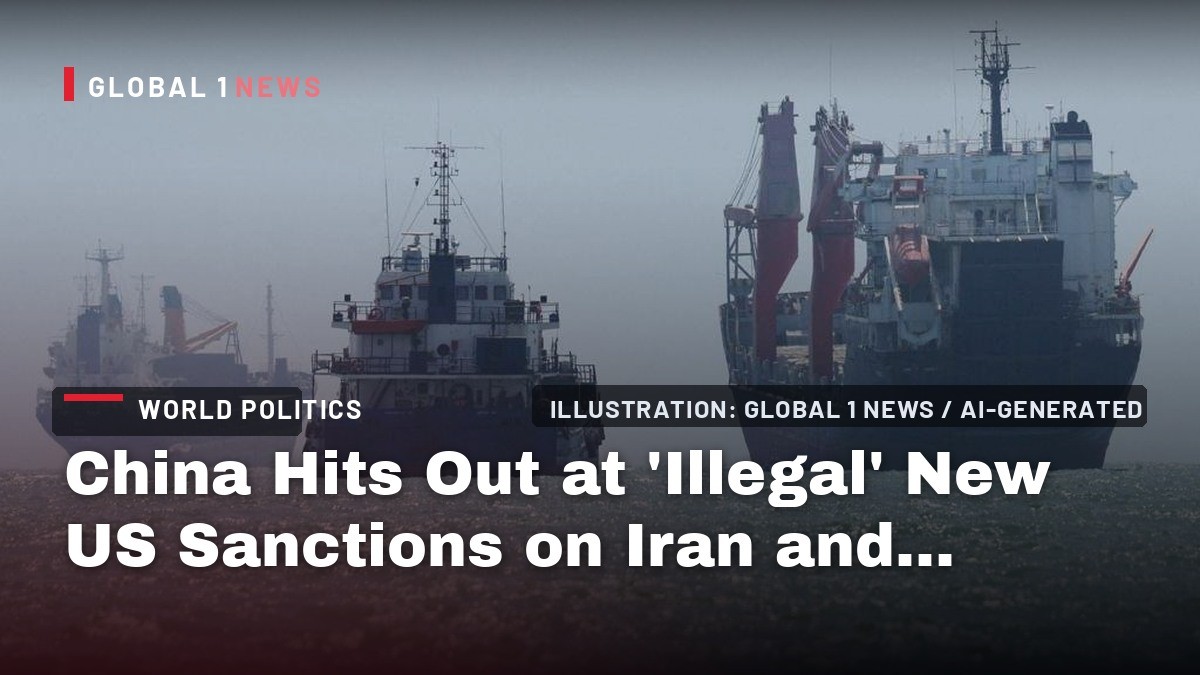
Beijing has issued a stark warning to Washington, vowing to protect its national interests "by all necessary measures" following the announcement of a sweeping new US sanctions package targeting Iran and any nation that continues to trade with Tehran. The sharp rebuke, delivered by Chinese Foreign Ministry spokesman Lin Jian, signals a potential escalation in great-power tensions just weeks before a planned summit between President Xi Jinping and US President Donald Trump.
Speaking at a regular press briefing, Lin Jian condemned the measures as "illegal unilateral sanctions," asserting that cooperation between China and Iran is conducted "within the framework of international law and should not be interfered with or disrupted." The statement marks Beijing's most direct response to the US Treasury's "Operation Economic Outcast," a package that US Treasury Secretary Scott Bessent described as "the single greatest financial offensive ever" against the Islamic Republic.
The Scope of 'Operation Economic Outcast'
The new sanctions, unveiled by Secretary Bessent on Monday, represent a significant broadening of the US campaign against Tehran. The Treasury has mapped financial channels, facilitators, and networks used by Iran to evade existing sanctions, imposing penalties on nearly 60 entities, individuals, and vessels. Bessent framed the initiative as an "economic D-Day," declaring that America is "no longer managing the Iranian threat, we are ending it."
The Treasury Secretary warned that any nation, bank, or business financially partnering with Iran would share in its isolation. "No one was above the reach of US sanctions," Bessent said in response to a direct question about Chinese banks. He added that President Trump would be phoning world leaders "with specific requests to cease their interactions with the regime," though he declined to single out specific nations during the announcement.
China's Strategic Calculus on Iranian Oil
At the heart of the confrontation lies energy security. China is the largest buyer of Iranian crude, absorbing roughly 90% of Tehran's oil exports, according to analysts cited in the report. While trade volumes have declined under the existing US naval blockade of Iranian ports, the flow has remained a critical lifeline for both economies. For Beijing, Iranian oil represents a reliable, discounted source of energy that bypasses Western-controlled supply chains.
Lin Jian's insistence on the legality of Sino-Iranian cooperation reflects a long-standing Chinese doctrine: opposition to extraterritorial sanctions. Ali Vaez, deputy director of the Middle East and North Africa Program at the International Crisis Group, noted that Beijing "generally... are against unilateral sanctions. They would comply with multilateral or international sanctions, but unilateral sanctions just imposed by the US - they have always seen that as illegitimate." This position aligns with China's broader foreign policy emphasis on sovereignty and non-interference in the internal affairs of states.
Rare Earths and the Leverage of Retaliation
Washington's aggressive posture carries inherent risks, particularly given Beijing's dominance in critical mineral supply chains. China processes the majority of the world's rare earths and other critical minerals essential for high-tech manufacturing, from smartphones to defense systems. Beijing has already tightened export controls on rare earths during previous trade negotiations with the US, demonstrating a willingness to weaponize its market position.
The timing of the sanctions announcement is particularly delicate, coming ahead of planned talks between President Trump and President Xi next month. Washington is likely wary of potential retaliation from Beijing, which could disrupt global supply chains far beyond the energy sector. The strategic interdependence between the world's two largest economies creates a complex bargaining environment where financial sanctions on Iran intersect with technological competition and trade imbalances.
Iran's Defiant Posture
Tehran has responded to the new measures with characteristic defiance. Iranian Economy Minister Ali Madanizadeh stated that the government was "fully prepared" for wider sanctions, which he predicted would lead to "another defeat" for the US. "The government is and was ready and has a two-year plan to manage these events," he told state television. "We also have our own tools and know how to play the game," he added, noting Tehran had been "waiting for these plans for a long time."
This resilience reflects a regime that has weathered decades of economic isolation. The Iranian leadership has consistently demonstrated a willingness to "absorb any pain" and pass the costs onto its population, as Vaez observed. This dynamic undermines the efficacy of economic pressure as a tool for behavioral change, a lesson Washington has repeatedly encountered since the 1979 revolution.
Regional and Global Ramifications
The sanctions extend far beyond the US-Iran bilateral relationship, creating difficult choices for nations across the Middle East and Asia. Iran's neighbours, including Pakistan, Turkey, and Iraq, maintain complex relationships with Tehran that cannot be easily severed despite their desire to preserve good ties with Washington. As Vaez noted, these countries "can't really afford to cut off ties with Iran," creating a diplomatic minefield for US policymakers.
India and Russia, both significant trade partners with Iran, have yet to respond to the announcement. Their eventual positions will be crucial in determining whether the sanctions achieve their stated objectives or merely accelerate the formation of alternative financial and trade mechanisms outside the US-dominated system. The conflict has already led to hikes in oil prices worldwide, with Tehran, according to BBC reporting, effectively blocking exports through the Strait of Hormuz, a waterway vital to global energy flows.
Questioning the Effectiveness of Economic Warfare
Despite the Trump administration's bombastic rhetoric, analysts have cast doubt on the likely impact of the new measures. David Oxley, chief climate and commodities economist at Capital Economics, told the BBC that the direct impact on Iran's energy revenues would be "somewhat of a damp squib." He suggested the new package would have "only a limited direct impact on Iranian energy flows in the short term," largely because China "has not recognised US sanctions in the past and is unlikely to be cowed this time either."
This assessment underscores a fundamental challenge for US sanctions policy: effectiveness requires cooperation from nations that have little incentive to comply. The Chinese position, rooted in both legal principle and practical self-interest, suggests that Beijing will continue purchasing Iranian oil through whatever financial channels can be maintained, potentially accelerating the development of payment systems that bypass the US dollar.
Historical Context and the Path Forward
The current crisis emerges almost six months after the start of the Iran war, according to BBC reporting — a conflict that has defied diplomatic resolution. Recent attempts to end the fighting have failed, and a 60-day ceasefire formally expired last week with no sign of a settlement. The sanctions announcement represents Washington's pivot from military to economic pressure, though the two approaches are deeply intertwined.
UK Chancellor John Healey expressed British support for "US work to secure a diplomatic solution and welcome efforts to increase pressure," indicating continued Western alignment on the Iran question. However, the broader international consensus that Beijing represents — favouring multilateral frameworks over unilateral action — suggests the sanctions may deepen divisions between the US-led order and emerging powers.
Strategic Implications for Beijing
For China, the confrontation over Iran sanctions intersects with multiple strategic priorities. Energy security demands reliable access to oil imports, and Iran has proven a dependable supplier despite geopolitical turbulence. Simultaneously, Beijing's opposition to extraterritorial sanctions reinforces its broader narrative of a multipolar world order, challenging what it views as US hegemonic overreach.
The upcoming Trump-Xi meeting will now carry additional weight, with the Iran sanctions likely featuring prominently alongside trade, technology, and regional security discussions. Beijing's response to this pressure will signal its willingness to absorb economic costs in pursuit of strategic autonomy, a calculation that will shape not only US-China relations but the future architecture of global governance.
As the situation develops, the world watches whether Washington's "economic D-Day" will achieve its objectives or founder on the rocks of Chinese resolve and Iranian resilience. The coming weeks will reveal whether the United States can enforce its will through financial power alone, or whether the multipolar era demands a more nuanced approach to international pressure.
This article was produced with AI-assisted research and editorial support. Sources: BBC News.
By Prof. Marcus Chen, Staff Writer
What's Your Reaction?
 Like
0
Like
0
 Dislike
0
Dislike
0
 Love
0
Love
0
 Funny
0
Funny
0
 Wow
0
Wow
0
 Sad
0
Sad
0
 Angry
0
Angry
0

World Politics Analyst at Global1.News. Based in Beijing, covering US-China relations, global trade, and geopolitical strategy. Brings deep analytical perspective to the power dynamics shaping international affairs.












Comments (0)