
Nobel Prize in Medicine Goes to the Three Scientists Who Put a Light Switch in the Brain
The 2026 Nobel Prize in Physiology or Medicine has gone to Karl Deisseroth, Peter Hegemann and Georg Nagel for optogenetics, the method that lets researchers switch individual nerve cells on and off with light.
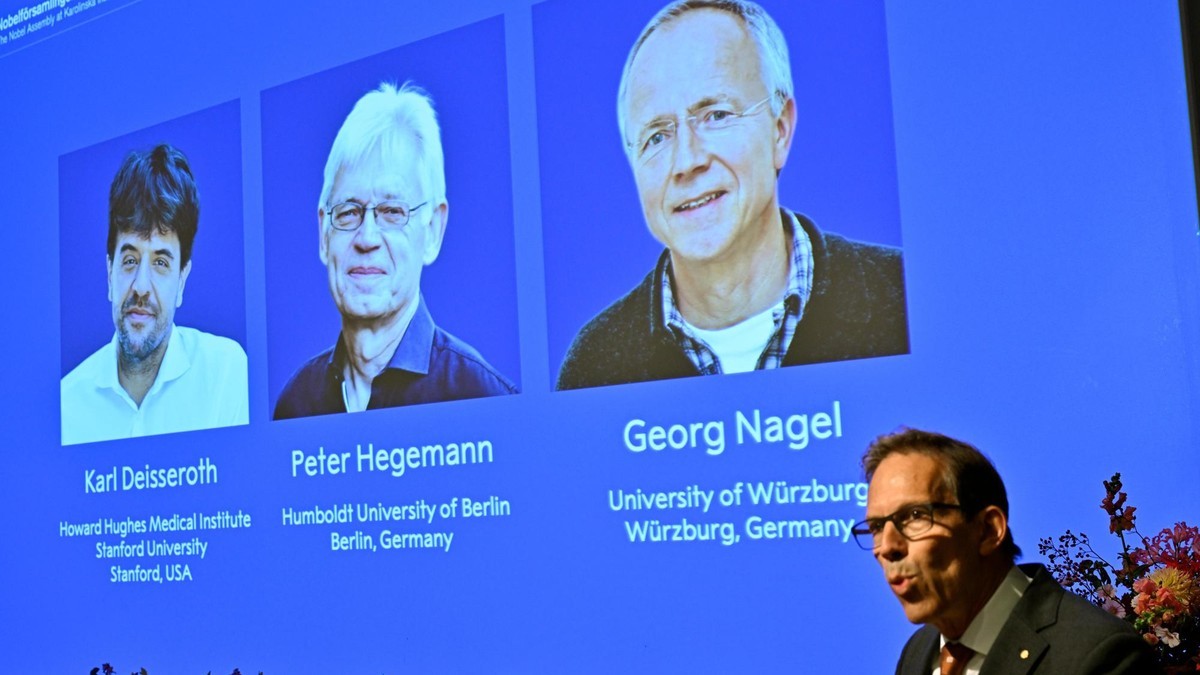
Somewhere in Northern California, a man who had just gone to bed got a phone call from Stockholm and never got back to sleep. Somewhere in Berlin and Würzburg, two other scientists were reached by the same voice with the same news. The 2026 Nobel Prize in Physiology or Medicine has gone to the three people who figured out how to put a light switch inside a living brain — and then handed that switch to the rest of us.
Nobel Prize in Medicine Goes to the Three Scientists Who Put a Light Switch in the Brain
Stockholm, Sweden — The Nobel Assembly at Karolinska Institutet announced on Monday 5 October 2026 that the prize is awarded jointly to Karl Deisseroth of the Howard Hughes Medical Institute and Stanford University, Peter Hegemann of Humboldt University of Berlin, and Georg Nagel of the University of Würzburg. The citation is "for their discoveries concerning light-gated ion channels and optogenetics." It is the first of this year's Nobel announcements, and it honours a technique that lets researchers turn individual nerve cells on and off with a beam of light.
The Call That Came Just as He Lay Down
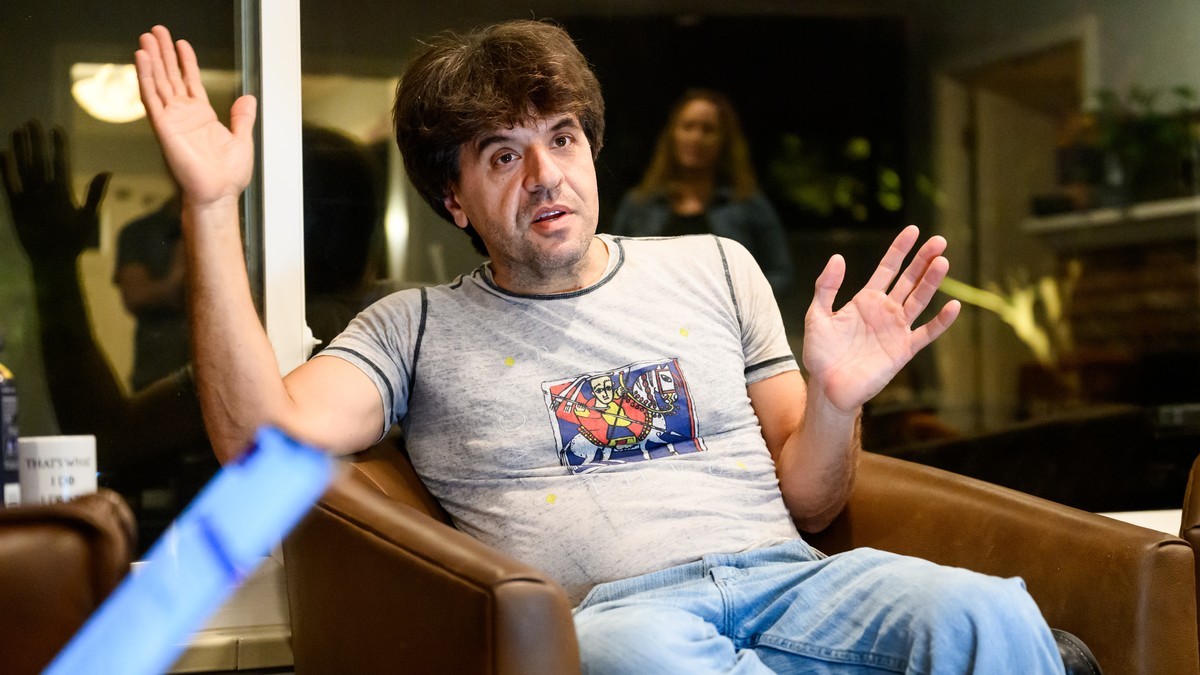
Here is what matters about how this news landed: Deisseroth told the Associated Press, by phone an hour after the announcement, that he is a self-described night owl. He was up late at his Northern California home working on papers and emailing his students. He had just gone to lie down when the call came through from the Nobel assembly. "No real sleep was achieved," he said. And then he noted the next item on his to-do list: packing school lunches for his children, who were still asleep. "That's my one obligation I have in the next few hours, to make sure I make their sandwiches." Thomas Perlmann, Secretary-General of the Nobel Assembly, said he was able to reach all three winners by phone on Monday. The AP noted its own efforts to reach Hegemann and Nagel were not immediately successful, so the only account of how the other two took it comes from Perlmann.
What the Nobel Assembly Actually Rewarded
Read the citation slowly, folks, because it names two things and only one of them is famous. "Light-gated ion channels" is the biology. "Optogenetics" is the method built on top of it. The Nobel Assembly's own summary is blunt about the scale: "The Nobel Prize in Physiology or Medicine 2026 is awarded for optogenetics — a method that makes it possible to show how nerve cells shape memories, feelings and behaviours in the living brain." It goes further: "The Laureates have laid the foundation of a new era in neuroscience." That is not a small sentence from a body that does not usually write small sentences. The prize money is 12 million Swedish kronor, shared equally — one third each — which Reuters rendered as "12 million Swedish crowns ($1.2 million)," the AP as "about $1.2 million," and PA as "about £900,000." Same money, three currencies, one Monday morning in Stockholm.
From a Swimming Alga to a Firing Neuron
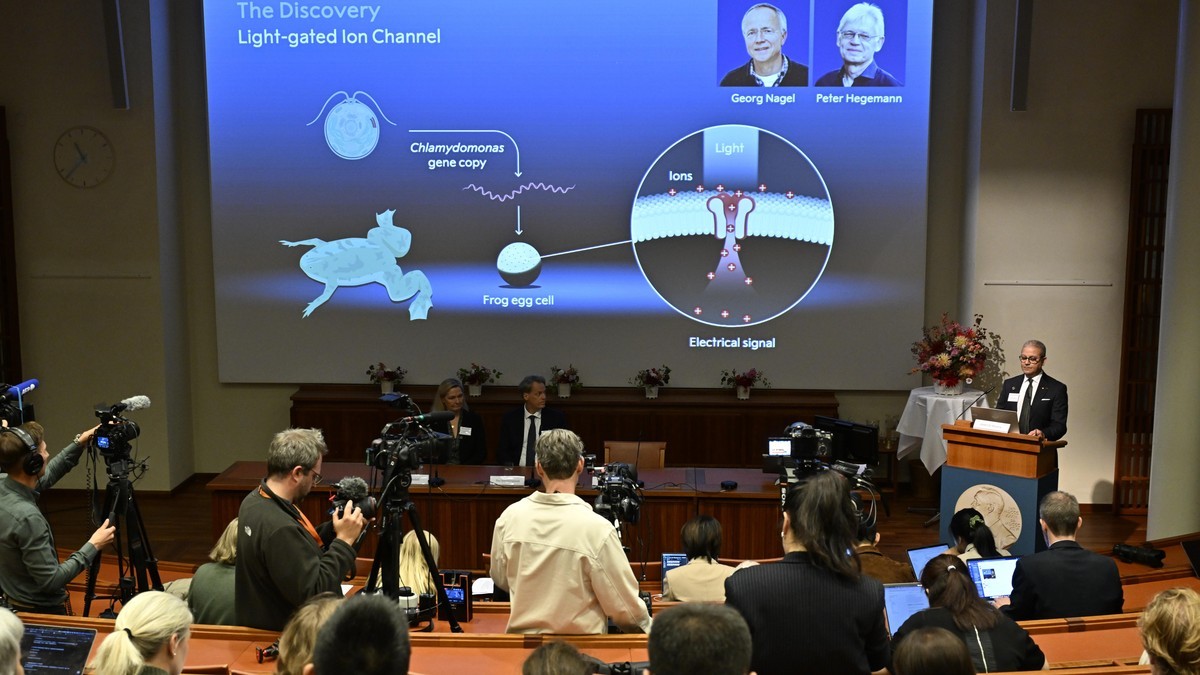
The story starts with a pond organism. Hegemann wanted to know how Chlamydomonas, a single-celled alga, swims toward a light source. In the early 2000s, according to the Nobel Assembly, he and Nagel discovered channelrhodopsin — an algal protein sitting on the surface of the cell. Shine blue light on it and a channel opens through the protein. Charged ions flow in, and that flow creates an electrical impulse. Crucially, they found that no matter which cell they put the protein into, that cell became light sensitive. Reuters dates Hegemann's first investigations of the alga to the early 1990s, when he studied how it reacts to light in half a millisecond, and STAT News also places the start then, at the Max Planck Institute. The Nobel Assembly, by contrast, dates the channelrhodopsin discovery itself to the early 2000s. Nagel tested the hypothesis by injecting Chlamydomonas genes into frog eggs and found channelrhodopsin-2. In 2003 they published that the protein could be introduced into human and hamster cells to generate electrical impulses using light. Both accounts are on the record, and the gap between them is a reminder that discovery rarely has one timestamp.
What Optogenetics Is, in Plain English
Strip away the jargon and it is this: you take a gene for a light-sensitive protein, you deliver it into nerve cells, and you gain a switch. Blue light on, the cell fires. Light off, it stops. Perlmann described it as a method that "makes it possible to switch on, or off, the activity of individual nerve cells in a living brain," and added: "This method is now being used in laboratories around the world to reveal the brain's mysteries." That is the whole trick, and it is why the tool spread. Before this, twentieth-century neuroscience could map which brain areas seemed tied to which functions, but the methods could not prove cause and effect. The Nobel Assembly's own image for that older science is memorable: "The image they developed of the brain was like a sketch map, full of question marks and unknowns." Optogenetics turned the sketch into something you can test. You do not have to guess whether a circuit matters. You switch it and watch.
Where the Prize-Winning Work Was Done
The geography matters here, because this is a prize with three home countries in it. Hegemann, born 1954, took his PhD in 1984 at the Max-Planck-Institute for Biochemistry in Martinsried, Germany, and is now Hertie Senior Professor of Neuroscience at Humboldt University of Berlin. The Nobel Assembly states that his prize-awarded discoveries were made at the Max Planck Institute for Biochemistry in Martinsried. Nagel, born 1953, took his PhD in 1988 at the University of Frankfurt and is Professor of Molecular Plant Physiology at the University of Würzburg. His prize-awarded discoveries, the Assembly says, were made at the Max Planck Institute for Biophysics in Frankfurt. Deisseroth, born 1971, earned his PhD in 1998 and his MD in 2000 from Stanford University, and is the D.H. Chen Professor of Bioengineering and of Psychiatry and Behavioral Sciences at Stanford and the Howard Hughes Medical Institute. He put the channelrhodopsin gene into rat nerve cells, triggered a nerve signal with blue light, and published that breakthrough in 2005; two years later the switch worked in living mice, and the method was named optogenetics a year after the paper.
The Clinical Promise: Restoring Sight and Beyond
Now the part that will matter most to families. Reuters reports that in clinical trials, researchers are restoring vision to people blinded by a condition called retinitis pigmentosa by inserting a light-sensitive protein in the retina. Reuters also reports that researchers hope optogenetics could improve cochlea implants, allowing more precise stimulation of the auditory nerve than current electrical devices allow. DW reports that in clinical medicine, researchers are using the method in attempts to restore sight in people with visual impairment, and that researchers hope the field could lead to treatments for neurological and sensory disorders such as Parkinson's disease and epilepsy. And Abdel El Manira, a Nobel committee member and professor of neuroscience, said after the announcement: "The impact of optogenetics extends far beyond understanding the healthy brain, it has also helped reveal how brain circuits are disrupted, with implications for conditions such as blindness, depression, addiction and dementia." Notice the verb. Helped reveal. Not cured.
A Tool, Not Yet a Cure
Here is where I slow the music down. Times Now is direct about it: "This technology, however, is still primarily a research tool, rather than being established as a treatment for neurological disorders." That sentence should travel alongside every headline about blindness and Parkinson's this week. The Nobel Assembly frames the medical relevance just as carefully — optogenetics has revealed neural circuits governing specific memories, feelings and behaviours relevant for neurological and psychiatric disorders. Relevant for. Not proven to treat. We have no figures in hand on how many patients have received optogenetic interventions, no trial results, no efficacy numbers, no regulatory approvals. If you see those numbers somewhere this week, ask where they came from. What we do have is a tool so precise that Jeremy Berg of the University of Pittsburgh told the AP: "It's a very precise set of tools for doing experiments about how the brain works that are pretty hard to do any other way." Berg was at the National Institutes of Health in the early 2000s when it awarded Deisseroth major funding for what he called "this vision of optogenetics that was pretty much spot-on the way it played out."
Three Men Who Called Each Other 'My Friends'
We have no statement from Hegemann or Nagel in hand. What we have is Perlmann's account of the calls, and it is worth quoting in full: "All three said the same thing, that they thought it was absolutely wonderful to receive the prize with the other two and they call them my friends. That it's such an honour to receive them together. So that's something they conveyed." Three scientists, three countries, one shared citation, and the same word for each other. Svenningsson, chair of the Nobel Committee for Physiology or Medicine, framed the science this way: "Optogenetics provides opportunities for mapping the brain in a way that we could once only dream of." The wire services disagree on ages — Reuters, AP and PA report Deisseroth at 54, Hegemann at 71 and Nagel at 73, while STAT News reports Deisseroth at 55 and Hegemann at 72, with Nagel at 73. The Nobel Assembly gives birth years: 1971, 1954, 1953. Do the arithmetic and you will see why the wires differ.
The Week Ahead: Physics, Chemistry, Literature, Peace
Medicine is only the opening act. Physics follows on Tuesday 6 October, chemistry on Wednesday 7 October, literature on Thursday 8 October, and peace on Friday 9 October, with the Nobel Memorial Prize in Economic Sciences on 12 October. The prizes are presented at ceremonies in Stockholm on 10 December. For context: the 2025 medicine prize went jointly to Mary Brunkow and Fred Ramsdell of the United States and Shimon Sakaguchi of Japan for discoveries concerning peripheral immune tolerance. The medicine prize has also honoured Alexander Fleming's work on penicillin in 1945 and Karl Landsteiner's discovery of human blood groups in 1930. The five original Nobel Prizes were created under Alfred Nobel's will and awarded since 1901, with only limited interruptions, chiefly in the two world wars; the economics prize was added in 1968 by Sweden's central bank.
The Questions the Prize Leaves Open
So what do we still not know? Plenty. We do not know how many patients, if any, have benefited from optogenetic therapy at scale. We do not know which trials will report next, or whether the cochlea implant hope becomes a device or stays a hope. We do not know what Hegemann and Nagel said in their own words on Monday, only what Perlmann relayed. And we do not know which circuits behind memory, craving, fear or grief the next generation will finally make testable rather than merely theorised. What we do know is that a question about a swimming alga, asked decades ago, ended up as a switch inside a mouse brain, and then inside laboratories around the world. That is the arc. The rest is work.
By Jessica Ali, Staff Writer
This article was produced with AI-assisted research and editorial support. Sources: Reuters, the Associated Press, DW, STAT News, the Nobel Assembly at Karolinska Institutet, Times Now, PA News Agency.
What's Your Reaction?
 Like
0
Like
0
 Dislike
0
Dislike
0
 Love
0
Love
0
 Funny
0
Funny
0
 Wow
0
Wow
0
 Sad
0
Sad
0
 Angry
0
Angry
0

Editor-in-Chief at Global1.News. Atlanta-based journalist who cuts through the BS and tells it like it is. Lead anchor, host, and the voice you hear when the spin stops and the truth starts.















Comments (0)