
Tianjin Summit Reshapes Eurasian Order: SCO's Ten-Member Expansion and the 2035 Strategy Signal a New Model of Multipolar Governance
In a recent CGTN report, the Shanghai Cooperation Organization (SCO) was showcased not merely as a regional talking shop, but as a substantive counterweight to Western-led institutional frameworks.
In a recent CGTN report, the Shanghai Cooperation Organization (SCO) was showcased not merely as a regional talking shop, but as a substantive counterweight to Western-led institutional frameworks. The video highlights how Beijing frames the SCO's evolution as a "model of global governance," a narrative that carries significant weight as the bloc convenes its largest-ever gathering. The footage underscores a pivotal shift: an organization born from post-Soviet border demarcation talks has matured into a ten-member Eurasian heavyweight, positioning itself as the diplomatic and security architecture of choice for a significant portion of the Global South.
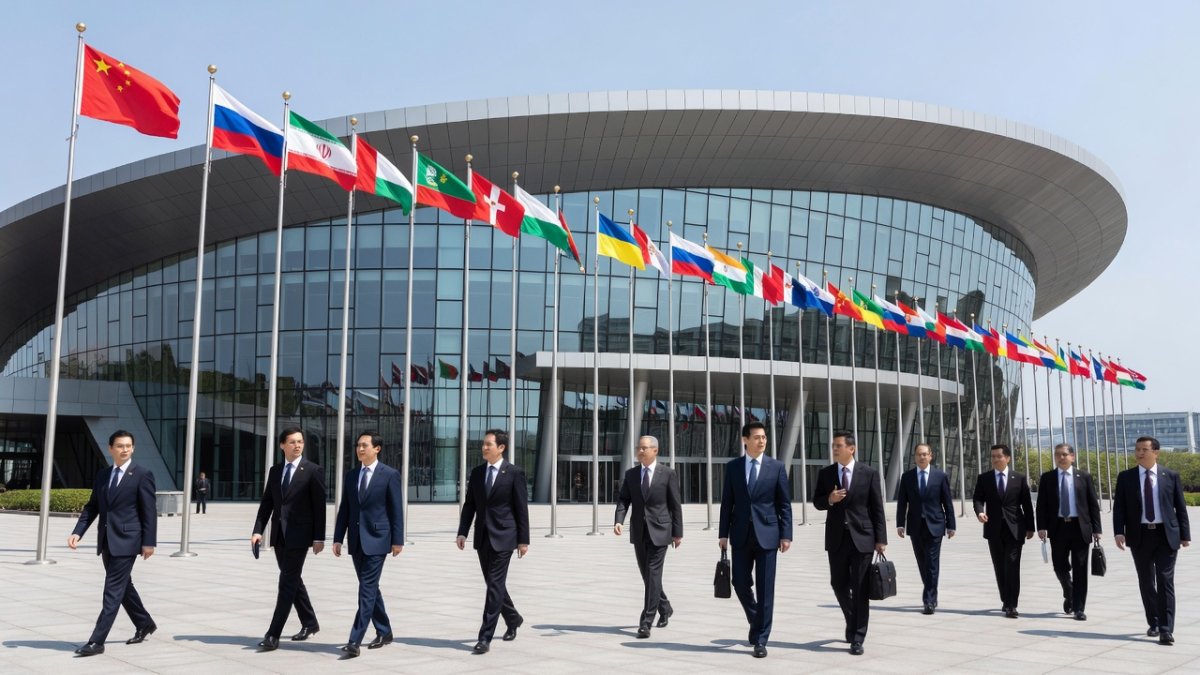
The strategic stakes of this evolution were on full display at the 25th Council of Heads of State meeting, held from August 31 to September 1, 2025, in Tianjin, China. With leaders from more than 20 countries and heads of 10 international organizations in attendance, the summit was a declaration of intent. For Beijing, the SCO represents a tangible vehicle for advancing a vision of international relations that prioritizes sovereignty, non-interference, and development over the conditionalities often attached to Western aid and alliances.
From Shanghai Five to a Ten-Member Eurasian Institution
The historical lineage of the SCO is critical to understanding its current geopolitical weight. The organization traces its roots to the "Shanghai Five" mechanism established in 1996, a forum initially designed to resolve border disputes and build confidence-building measures between China, Russia, Kazakhstan, Kyrgyzstan, and Tajikistan. The formal establishment of the SCO in 2001 marked a transition from a bilateral security dialogue to a multilateral institution with a broader mandate. The addition of Uzbekistan at its founding signaled an ambition to encompass the entirety of Central Asia.
The subsequent expansion has been nothing short of transformative. The induction of India and Pakistan in 2017 brought the organization into South Asia, creating a unique platform where nuclear-armed rivals sit at the same table. The admission of Iran in 2023 and Belarus in 2024-the latter becoming the tenth full member at the 24th summit in Astana-extended the SCO's reach into the Middle East and Europe's eastern frontier. This expansion is not merely symbolic; it represents a deliberate strategy by Beijing and Moscow to create a "community of shared destiny" that spans the Eurasian landmass. For China, this institutional breadth provides a diplomatic counterbalance to the US-led "Indo-Pacific" strategy, offering an alternative geographic and conceptual framework for regional cooperation.
Tianjin 2025: The Largest Summit in SCO History
Held at the Meijiang Convention and Exhibition Center, the Tianjin summit was a logistical and diplomatic tour de force: the fifth time China has hosted the gathering and the largest in the organization's history. The approval of 24 documents, including the pivotal Tianjin Declaration and the SCO Development Strategy until 2035, provides a concrete roadmap for the next decade. The Development Strategy is particularly significant; it outlines specific goals for economic integration, digital transformation, and security coordination.
Chinese Foreign Minister Wang Yi, a member of the Political Bureau of the CPC Central Committee, characterized the outcomes as "fruitful," emphasizing that the Development Strategy "sets the tone and direction for the organization's growth in the next decade." This is a clear signal that Beijing intends to use the SCO as a primary vehicle for its connectivity and infrastructure initiatives. The summit also issued a statement marking the 80th anniversary of the end of World War II and the formation of the United Nations-a pointed reminder of the SCO's commitment to a UN-centric international order, in contrast to what Beijing views as the erosion of multilateralism by unilateral Western actions.
The Shanghai Spirit as an Alternative Governance Model
At the doctrinal heart of the SCO lies the "Shanghai Spirit," a set of principles that Beijing actively promotes as a superior alternative to what it characterizes as hegemonic governance models. The Spirit encompasses mutual trust, mutual benefit, equality, consultation, respect for cultural diversity, and the pursuit of common development. In practice, this translates into a non-interference policy that is highly attractive to authoritarian and developing regimes alike. Unlike Western institutions that often tie membership or aid to human rights and democratic governance benchmarks, the SCO offers a framework based on absolute sovereignty and non-conditionality.
This approach has profound geopolitical implications. It creates a "big tent" that can accommodate vastly different political systems-from the democratic republic of India to the theocratic state of Iran-under a shared umbrella of strategic autonomy. For China, the Shanghai Spirit is a soft-power tool that legitimizes its model of state-led development. It positions Beijing as a leader of the Global South, offering a governance philosophy that prioritizes stability and economic growth over political liberalization. The CGTN report highlights this as the core of the SCO's appeal: it is a model that does not seek to change the internal dynamics of its members but rather to facilitate cooperation despite them. This stands in stark contrast to the EU's enlargement policy or NATO's collective defense obligations, which often require deep institutional and political alignment. The Shanghai Spirit, therefore, is not just a diplomatic slogan; it is a functional mechanism for managing diversity in a multipolar world.
Security, Connectivity and the Global South
The SCO's strategic value extends far beyond diplomatic declarations, touching on the hard realities of security and economic connectivity. The organization's Regional Anti-Terrorist Structure (RATS) provides a framework for intelligence sharing and counterterrorism operations, addressing a shared concern among member states regarding extremism in Central Asia and beyond. This security cooperation is intrinsically linked to economic development, particularly through the alignment of the SCO with China's Belt and Road Initiative (BRI). The Development Strategy until 2035 is expected to deepen the synergy between SCO infrastructure projects and BRI corridors, facilitating trade routes that bypass traditional maritime chokepoints controlled by the US Navy.
For the Global South, the SCO offers a tangible alternative to Western-dominated financial institutions. While the New Development Bank (BRICS) handles large-scale financing, the SCO provides the political cover and security guarantees necessary for large infrastructure projects to proceed. The second-order effects for ASEAN and the EU are significant. For ASEAN, the SCO's expansion into a broader Eurasian framework presents both a model for its own non-aligned posture and a potential competitor for Chinese investment and attention. For the EU, the SCO represents a strategic challenge: a bloc that explicitly rejects European normative influence in its neighborhood, particularly in Central Asia and the Caucasus. The EU's "Global Gateway" initiative is, in part, a response to the SCO-BRI nexus, but it lacks the security dimension and political cohesion that the SCO offers. The Tianjin summit's emphasis on connectivity signals Beijing's intent to weave a web of interdependence that makes external sanctions or decoupling strategies increasingly costly.
Strategic Implications: What to Watch in 2026
As the baton of leadership passes to the Kyrgyz Republic for the 2025-2026 chairmanship, the SCO enters a new phase of institutional consolidation. Bishkek is likely to prioritize digitalization, energy cooperation and regional tourism, but the primary challenge will be managing the divergent interests of India and Pakistan and the delicate China-Russia balance. The "SCO Plus" format, which has been used to invite non-member states and international organizations to summits, is expected to expand, potentially bringing in observers like Afghanistan, Mongolia, and various ASEAN states.
The key strategic variable for 2026 will be the implementation of the 2035 Development Strategy. Will it remain a declarative document, or will it evolve into a binding framework with specific investment targets? China will push for the latter, seeking to institutionalize its leadership role. Observers should watch for the establishment of an SCO development bank or a specialized financing mechanism, which would be a major step toward financial autonomy from the IMF and World Bank. Furthermore, the interaction between the SCO and the expanded BRICS bloc will be crucial; if these two entities begin to coordinate their agendas, they could form a formidable counter-hegemonic coalition.
The Tianjin summit has firmly established the SCO as a central pillar of China's strategy to reshape global governance. By coupling the Shanghai Spirit with a concrete development agenda, Beijing is offering a coherent alternative to the Western-led order-one based on sovereignty, connectivity, and mutual benefit. The organization's expansion to ten members, spanning from the borders of Europe to the Indian Ocean, is a testament to its appeal. As the world moves toward a more fragmented and multipolar structure, the SCO's model of consensus-based, non-interventionist cooperation is likely to become increasingly influential, not just in Eurasia, but as a template for other regional groupings in the Global South. The next decade will determine whether this model can deliver tangible results, but the political will and institutional architecture are now firmly in place.
By Prof. Marcus Chen, Staff Writer
This article was produced with AI-assisted research and editorial support. Reporting is based on sources cited in the article.
What's Your Reaction?
 Like
0
Like
0
 Dislike
0
Dislike
0
 Love
0
Love
0
 Funny
0
Funny
0
 Wow
0
Wow
0
 Sad
0
Sad
0
 Angry
0
Angry
0

World Politics Analyst at Global1.News. Based in Beijing, covering US-China relations, global trade, and geopolitical strategy. Brings deep analytical perspective to the power dynamics shaping international affairs.












Comments (0)