
1 in 5 Filipino Families Experienced Hunger in Q2 2026, SWS Survey Shows
SWS Q2 2026 survey shows 20.3% of Filipino families experienced involuntary hunger, down from 23.2% in March. Hunger rose in Mindanao to 24%, while severe hunger spiked in Metro Manila. The poor remain most affected, with rates near pandemic peaks.
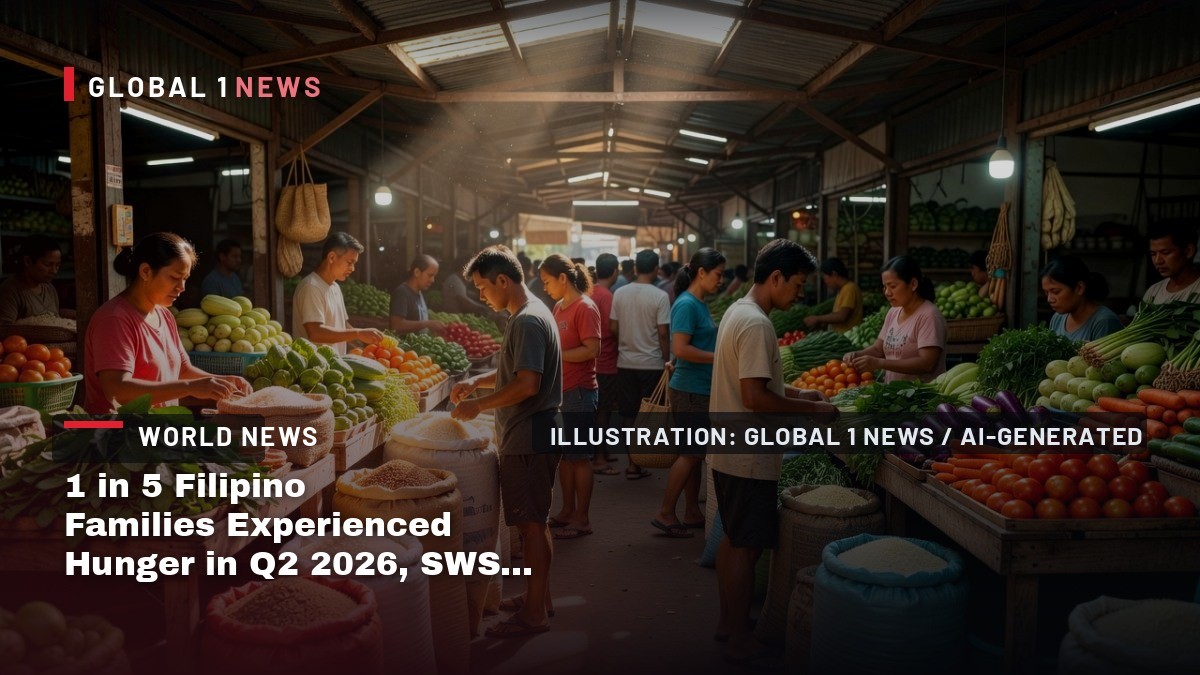
The specter of an empty table remains a stark reality for millions of Filipino households. According to the latest Social Weather Stations (SWS) survey, one in every five Filipino families experienced involuntary hunger—being hungry and having nothing to eat—at least once in the past three months. The Second Quarter 2026 Social Weather Survey, conducted from June 20 to 29, 2026, found that 20.3 percent of respondents faced this grim circumstance, a slight but welcome dip from the 23.2 percent recorded in March 2026.
While the national figure shows a 2.9-point improvement, the data reveals a deeply uneven recovery across the archipelago. For every family in Metro Manila that can now afford a slightly more comfortable meal, there is a family in Mindanao whose situation has worsened. This is not just a statistic; it is the sound of a mother dividing a small can of sardines among five children, or a jeepney driver skipping lunch so his family can eat dinner. The numbers tell a story of resilience, but also of persistent and painful inequality.
Breaking Down the National Hunger Numbers
The SWS report, released on August 24, 2026, classifies involuntary hunger into two categories: moderate and severe. Moderate hunger, defined as experiencing hunger "only once" or "a few times" in the last three months, was reported by 15.8 percent of families. This is a decrease from the 17.7 percent recorded in March. Severe hunger, which refers to those who experienced it "often" or "always" in the previous three months, was reported by 4.5 percent of families, down from 5.5 percent in the previous quarter.
While any decline is a positive sign, the current rate remains alarmingly high. The June 2026 figure of 20.3 percent is 0.1 point above the 20.2 percent average for the entire year of 2025. More tellingly, it is only 0.8 point below the record-high 21.1 percent average recorded during the height of the COVID-19 pandemic in 2020. This suggests that while we have moved past the worst of the health crisis, the economic scars remain deep, and the struggle for food security is as intense as it was during the global lockdowns.
The survey, which involved 1,200 adult respondents nationwide through face-to-face interviews, paints a picture of a nation still grappling with the cost of living. The slight improvement from March to June offers a glimmer of hope, but the comparison to the pandemic era serves as a sobering reminder of how far we still have to go in ensuring no Filipino goes to bed hungry.
Regional Disparities: Mindanao's Alarming Rise and Metro Manila's Severe Hunger
The national average masks significant regional variations that are crucial for policymakers to address. The highest hunger rate in June 2026 was recorded in Mindanao, where 24.0 percent of families experienced involuntary hunger. This represents a 2.3-point increase from the 21.7 percent recorded in March, making it the only region where hunger rose significantly. This is a stark reversal of the national trend and points to specific, localized economic pressures affecting the southern island.
In contrast, the Visayas saw the most significant improvement, with hunger falling by 5.7 points from 28.0 percent to 22.3 percent. Balance Luzon also saw a substantial decline of 5.1 points, from 22.4 percent to 17.3 percent. Metro Manila's overall hunger rate dipped slightly by 1.0 point, from 22.0 percent to 21.0 percent. However, a deeper look into the capital region reveals a troubling trend: while moderate hunger fell by 2.6 points to 12.7 percent, severe hunger actually rose by 1.6 points to 8.3 percent. This means that while fewer families in Metro Manila are experiencing occasional hunger, more are facing the chronic, debilitating reality of not knowing where their next meal will come from on a regular basis.
This divergence is critical. The rise in severe hunger in the capital, often seen as the land of opportunity, suggests that the urban poor are being left behind. It speaks to the challenges of rising rents, transportation costs, and the daily struggle of informal settlers and minimum-wage earners who find their paychecks shrinking against inflation. For a family in a cramped barangay in Tondo or Payatas, the "improvement" in the national average means little when their own situation has become more desperate.
The Burden on the Poor: A Tale of Two Filipinos
The SWS data underscores a fundamental truth: hunger is a class-based phenomenon. The survey found that involuntary hunger is significantly higher among households that identify themselves as poor. Among self-rated poor families, the hunger rate was 24.5 percent in June, down from 27.5 percent in March. For those who consider themselves non-poor or borderline poor, the rate was much lower at 16.2 percent, down from 18.5 percent.
This gap highlights the widening chasm between the haves and the have-nots. The survey also revealed that 49 percent of Filipino families consider themselves "Mahirap" (Poor), while 37 percent rate their families as "Not Poor," and the remaining 14 percent are in the borderline category. Furthermore, the SWS measured Self-Rated Food Poverty, finding that 36 percent of families consider themselves "Food-Poor," 15 percent are "Food Borderline," and 49 percent are "Food-Not-Poor."
Among those who consider themselves Food-Poor, total hunger fell from 32.6 percent to 29.9 percent. For those who are Food-Not-Poor or Food Borderline, hunger fell from 16.4 percent to 14.7 percent. The SWS noted that the overall fall in hunger was due both to a decline in Self-Rated Poverty and Self-Rated Food Poverty between March and June, and to the fact that hunger also fell among the Poor and the Food-Poor themselves. This suggests that some economic relief is reaching the most vulnerable, but the sheer scale of the problem remains immense. For a farmer in Isabela whose harvest was bought at a low price, or an OFW's family in Pampanga waiting for a remittance that has been delayed, the label of "poor" is not a statistic—it is a daily lived experience.
Human Impact: The Daily Struggle in Our Barangays
Behind the percentages are the faces of our kapitbahay, our neighbors. Involuntary hunger is not just about skipping a meal; it is the anxiety that grips a parent when the sari-sari store's ledger shows more utang (debt) than sales. It is the decision to serve instant noodles instead of rice because the price of a kilo of rice has gone up again. It is the quiet sacrifice of a mother who claims she is "not hungry" so her children can have the last piece of fried fish.
In many barangays, the spirit of bayanihan is the only safety net. When one family has nothing, a neighbor might share a plate of food, but this communal support is being stretched thin. The data shows that even with these informal support systems, many families are falling through the cracks. The rise in hunger in Mindanao, for instance, could be linked to conflict, weather disturbances affecting agricultural output, or the high cost of transporting goods to remote areas. For a tricycle driver in Davao City, a 24 percent hunger rate means more of his passengers are choosing to walk to save a few pesos, reducing his income and making it harder for him to feed his own family.
The psychological toll is just as heavy as the physical one. The shame of not being able to provide, the stress of budgeting for a family of six on a daily wage of 500 pesos, and the hopelessness that comes with seeing no end in sight—these are the invisible wounds of involuntary hunger. It affects children's ability to concentrate in school, workers' productivity, and the overall peace of a community. When a family is hungry, the entire barangay feels the tension.
Government Response and the Road Ahead
As the nation processes these figures, the spotlight turns to government agencies tasked with ensuring food security. The Department of Social Welfare and Development (DSWD) remains the primary agency for emergency food assistance and runs the Pantawid Pamilyang Pilipino Program (4Ps), the conditional cash transfer program that provides subsidies to the poorest households. Meanwhile, the Department of Agriculture (DA) is responsible for stabilizing the supply and price of rice and other food staples.
However, the SWS report does not provide specific data on the effectiveness of these programs. The question that hangs in the air is whether these interventions are reaching the right people at the right time. Are the 4Ps grants enough to keep up with the rising cost of goods? Is the DA's effort to import rice and support local farmers translating to lower prices at the palengke (market)? These are questions that Congress and the Senate must urgently address in their oversight functions. The data suggests that while some progress has been made, the programs are not a silver bullet, especially in regions like Mindanao where hunger is rising.
Furthermore, the survey was conducted before the release of the latest inflation data, and analysts are watching food prices closely as a key driver of hunger trends. The government's economic managers, including the Department of Budget and Management, must consider these hunger statistics as a primary indicator of economic health, not just GDP growth. The focus must be on creating jobs that pay living wages, investing in agricultural infrastructure to reduce post-harvest losses, and ensuring that the supply chain from farm to market is efficient and free from hoarding and price manipulation.
Analysis: What the Numbers Mean for the Future
The slight decline in national hunger is a positive development, but it is fragile. The fact that the rate is still nearly at the pandemic peak is a cause for serious concern. The rise in severe hunger in Metro Manila is a red flag that cannot be ignored, as it indicates a deepening of poverty in the urban core. Similarly, the increase in Mindanao suggests that regional economic development is not keeping pace with the rest of the country, potentially fueling further discontent and instability.
The SWS data serves as a crucial barometer for the nation's well-being. It reminds us that economic recovery is not uniform and that the most vulnerable sectors are often the last to feel the benefits of growth. For ordinary Filipinos, this report is a call to action. It is a reminder to support local farmers, to be mindful of our consumption, and to extend a helping hand to our neighbors in need. The fight against hunger is not just a government mandate; it is a collective national duty. As we look towards the next quarter, the hope is that these numbers will continue to fall, but the work to ensure that every Filipino family has food on the table is far from over.
This article was produced with AI-assisted research and editorial support. Sources: Social Weather Stations (SWS) Second Quarter 2026 Social Weather Survey, The Philippine Star, Philstar.com.
By Bella Reyes, Staff Writer
What's Your Reaction?
 Like
0
Like
0
 Dislike
0
Dislike
0
 Love
0
Love
0
 Funny
0
Funny
0
 Wow
0
Wow
0
 Sad
0
Sad
0
 Angry
0
Angry
0

Philippines/Southeast Asia Correspondent at Global1.News. Manila-based journalist covering Philippine politics, environment, maritime security, and social issues. Passionate about marine conservation and the communities protecting the Philippines' natural heritage.













Comments (0)