
Brazil Election 2026: Lula vs Flavio Bolsonaro Dead Heat
For the first time in this campaign, a major poll has put Flavio Bolsonaro ahead of President Luiz Inacio Lula da Silva in a simulated second-round runoff. The survey, conducted by Nexus for the investment bank BTG Pactual and reported by Reuters on 8 September 2026, shows the right-wing senator ...
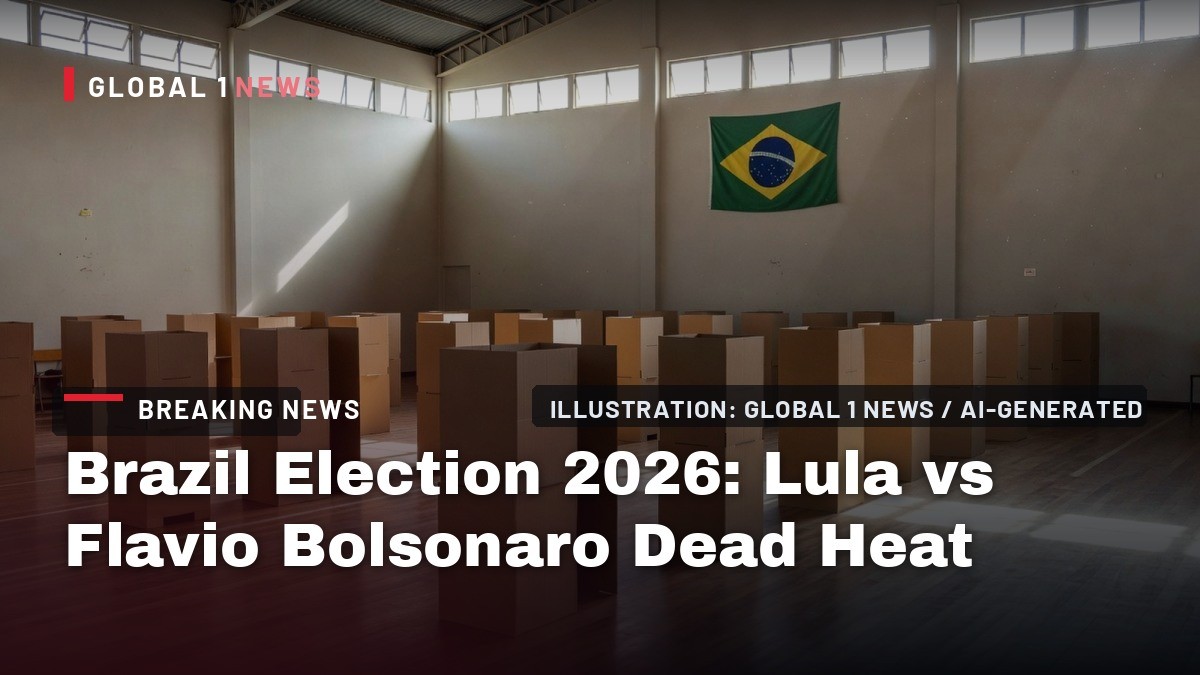
For the first time in this campaign, a major poll has put Flavio Bolsonaro ahead of President Luiz Inacio Lula da Silva in a simulated second-round runoff. The survey, conducted by Nexus for the investment bank BTG Pactual and reported by Reuters on 8 September 2026, shows the right-wing senator at 46 percent to Lula's 45 percent. That is a one-point gap in a poll whose margin of error is 2 percentage points. It is not a lead. It is a coin flip.
Here is why that distinction matters. Brazil votes in the first round on 4 October 2026, three weeks from now, with a runoff scheduled for 25 October if no candidate clears more than 50 percent of valid votes. Thirteen candidates are on the ballot. The Nexus survey of 2,002 people, taken from 4 to 7 September, still has Lula ahead in the first-round scenario, 39 percent to Flavio Bolsonaro's 35 percent. But the runoff number is the one Brazilian markets and Washington are watching, because it confirms what a string of other surveys has been signalling for weeks: this race is now a genuine dead heat.
Both men carry heavy baggage into the final stretch. Federal investigators are examining Lula's eldest son over alleged influence peddling. Flavio Bolsonaro is himself the subject of a Supreme Court-authorised probe into his ties to a figure at the centre of a bank fraud case. The outcome will turn on three things: crime, the economy, and women, who make up nearly 53 percent of Brazil's 158 million eligible voters.
The Calendar and What Is at Stake
The campaign officially began on Sunday 16 August 2026, according to Agencia Brasil. Free campaign advertising on radio and television runs from 28 August to 1 October. Rallies are authorised from 8am to midnight through 1 October, and all campaign activity ends on 3 October, the day before Brazilians vote.
Lula, 80, of the Workers' Party, is seeking a fourth non-consecutive term. He launched at a rally in Sao Bernardo do Campo in Sao Paulo state, the ABC region metalworkers' stronghold where he rose to prominence during the 1979 strikes. The Associated Press noted he wore a hat at the launch following a skin cancer diagnosis.
Flavio Bolsonaro, 45, a federal senator for the Liberal Party, is the eldest son of former president Jair Bolsonaro. He launched at Copacabana Beach in Rio de Janeiro. His father, sentenced by Brazil's Supreme Court to 27 years in prison for plotting a coup, is under house arrest and did not attend. That absence hangs over the campaign. In 2022, Lula beat the elder Bolsonaro with 50.9 percent of the vote.
The Two Frontrunners and Their Damage
Lula's campaign is built on sovereignty and social programmes. AFP notes his current term has been credited with expanding social programmes, overhauling the tax system and reducing deforestation in the Amazon. He has warned US President Donald Trump not to "meddle in Brazil's affairs, especially regarding the election." On Brazil's rare minerals, he said: "no one (abroad) will tap our minerals. We are going to tap them for the benefit of the Brazilian people."
Flavio Bolsonaro has styled himself as the law-and-order candidate. At a rally built around "God, country, family and freedom," AFP reports he vowed to "rescue" Brazil from corruption, crime, high food prices and soaring public debt. He has praised the security policies of El Salvador's Nayib Bukele and said he wants to build many more prisons.
But neither frontrunner is clean. Lula's eldest son, Fabio Luis Lula da Silva, known as Lulinha, faces three lines of federal inquiry over alleged lobbying and improper access granted to health officials. Flavio Bolsonaro faces his own probe into ties to Daniel Vorcaro, a figure at the centre of a major bank fraud investigation. Both deny wrongdoing, and both denials are now being tested in court in the middle of a presidential campaign.
What the Polls Actually Say
Let's be honest about the spread, because it is wide. The Nexus/BTG Pactual poll reported by Reuters on 8 September has Flavio at 46 percent to Lula's 45 percent in a runoff. In the same survey's first-round scenario, Lula leads 39 percent to 35 percent, with Augusto Cury, a self-help author, at 9 percent, Ronaldo Caiado at 4 percent and Renan Santos at 4 percent.
Anadolu Agency, citing an AtlasIntel/Bloomberg survey released on Monday 31 August, tells a different story. That poll has Lula leading Flavio 47.1 percent to 42.6 percent in a potential runoff, a margin of 4.5 percentage points, narrowed from 49.2 to 42.9 percent in July. AtlasIntel surveyed 5,014 people between 25 and 30 August, with a margin of error of one percentage point. In the multi-candidate first round, it has Lula at 43.4 percent, Flavio at 33.7 percent, Cury at 7.8 percent and Caiado at 3.3 percent.
A Quaest poll released on 14 August, reported by AFP, showed Lula at 43 percent to Flavio's 40 percent in an expected runoff. The honest read: Lula leads in most national head-to-heads, but the trend line is moving toward Flavio, and at least one pollster now has him ahead. That is what a technical tie looks like.
The Lulinha Investigation
Federal authorities are examining allegations of influence peddling and lobbying linked to medical cannabis programmes and procurement attempts within the Health Ministry, according to Anadolu. Lulinha faces three lines of inquiry over alleged lobbying and improper access granted to health officials.
The political damage is measurable. Roughly 53 percent of respondents believe Lulinha attempted to improperly influence government decisions to benefit business associates, while 55 percent say the investigations directly affect the credibility of Lula's administration.
Lulinha's defence attorneys strongly deny wrongdoing, maintain he acted legally and call the accusations politically motivated. Lula has defended his son's right to the presumption of innocence and pledged not to interfere in law enforcement. That defence may hold in court. Whether it holds with voters on 4 October is a different question.
The Vorcaro Investigation Into Flavio
Flavio Bolsonaro is not running as a clean-hands candidate either. Federal authorities are examining his ties to Daniel Vorcaro, a figure at the centre of a major bank fraud investigation. The Supreme Court authorised an investigation into allegations that Bolsonaro sought funding from Vorcaro for a biographical film about his father.
Bolsonaro has consistently denied wrongdoing. But the probe gives Lula's camp a ready-made counterpunch every time the Lulinha story surfaces. Two frontrunners, each with a family member under federal scrutiny. That is the dynamic that will define the final three weeks.
The Economy: Growth Without Feel-Good
The picture is mixed, and households feel the difference. Brazil's second-quarter gross domestic product grew 0.5 percent quarter on quarter, slightly above the 0.4 percent forecast by analysts, according to an Estadao analysis cited by Anadolu. But household consumption fell 0.4 percent over the same period.
That gap between headline growth and what families actually feel is political dynamite. Flavio has campaigned hard on high food prices and soaring public debt. Lula's record includes a tax overhaul and expanded social programmes, but the consumption dip gives the opposition a concrete number to point at.
Crime Is the Top Concern
Polls show crime is voters' main concern in this election. That is a structural advantage for Flavio Bolsonaro, who has built his campaign around it. His praise for Nayib Bukele's security policies in El Salvador and his promise to build many more prisons are aimed directly at that anxiety.
The numbers behind the anxiety are stark. Brazil registered nearly 400 femicides in the first quarter of 2026, the highest for the period since the country began tracking the crime 11 years ago, according to Brazil's Justice and Public Security Ministry database cited by the AP. That is not a talking point. That is a crisis.
Lula's campaign has to answer on crime without abandoning its human rights base. Flavio's has to convert fear into votes without appearing to exploit tragedy. Both will be tested in the final advertising blitz before 1 October.
Sovereignty, Tariffs and the Trump Factor
Lula's campaign is focusing on Brazilian sovereignty in the face of US tariffs and pressure from US President Donald Trump, who has openly backed conservative candidates in recent Latin American elections. Lula's allies have accused the US government of seeking to boost Flavio's bid with measures such as raising tariffs on Brazilian exports and revoking the visa of Brazil's ambassador to Washington, according to the AP.
This is a gamble. If Brazilian voters see the tariff fight as foreign interference, it helps Lula. If they see it as a cost-of-living problem caused by a diplomatic spat, it helps Flavio. The rare minerals line is designed to frame the election as a choice between national control and outside influence.
The Women's Vote
Women account for nearly 53 percent of Brazil's 158 million eligible voters, according to the country's electoral court. Both candidates courted them at their launches, the AP reported. Neither can win without them.
For Lula, the pitch is social programmes and stability. For Flavio, it is security, framed around protecting families. The femicide figures sit at the centre of that contest. Flavio's tough-on-crime message speaks to women who fear violence; Lula's speaks to women who fear a rollback of protections and social support.
With the race this tight, a small shift among women voters in Sao Paulo, Minas Gerais and the Northeast could decide the presidency. Both campaigns know it, which is why both launches put women front and centre.
What to Watch Before 4 October
Three weeks is a long time in a race this close. Watch the trend, not the single poll. The Nexus survey has Flavio ahead by one point in a runoff. AtlasIntel has Lula ahead by 4.5 points. Quaest has Lula ahead by three. The average still favours Lula, but the direction of travel favours Flavio.
Watch Sao Paulo, Brazil's most populous and economically critical state. An AtlasIntel survey published on 3 September, reported by The Rio Times, has Flavio at 46.8 percent to Lula's 43.3 percent in a second-round matchup, based on 1,810 registered voters surveyed between 26 and 31 August, with a margin of error of one percentage point. In the Sao Paulo governor's race, an Atlas poll for Estadao has Governor Tarcisio de Freitas at 51.1 percent to former mayor Fernando Haddad's 39.9 percent, a gap large enough for an outright first-round win.
Watch the regional pattern. In Mato Grosso, Real Time Big Data has Flavio at 52 percent to Lula's 37 percent. In Espirito Santo it is 48 percent to 42 percent, according to The Rio Times. If those margins hold and turnout in the Northeast holds for Lula, the runoff maths gets very tight.
Watch the investigations, because any new development in the Lulinha case or the Vorcaro probe could move the numbers. Watch the economy, because fresh data on consumption before 4 October will be read as a verdict on Lula's stewardship. And watch the women's vote, because with 158 million eligible voters and a gap this small, that is where this election will be decided.
This article was produced with AI-assisted research and editorial support. Sources: Reuters; Anadolu Agency; Associated Press; Agence France-Presse; Agencia Brasil; The Rio Times; BBC; Estadao.
By Jessica Ali, Staff Writer
What's Your Reaction?
 Like
0
Like
0
 Dislike
0
Dislike
0
 Love
0
Love
0
 Funny
0
Funny
0
 Wow
0
Wow
0
 Sad
0
Sad
0
 Angry
0
Angry
0

Editor-in-Chief at Global1.News. Atlanta-based journalist who cuts through the BS and tells it like it is. Lead anchor, host, and the voice you hear when the spin stops and the truth starts.









Comments (0)