
Why a Democrat-Held Congress in Washington Could Be Bad News for Modi’s India
In the wake of the United States mid‑term elections of November 2026, the composition of Congress shifted dramatically toward Democratic control, a development that has been met with cautious optimism in New Delhi.
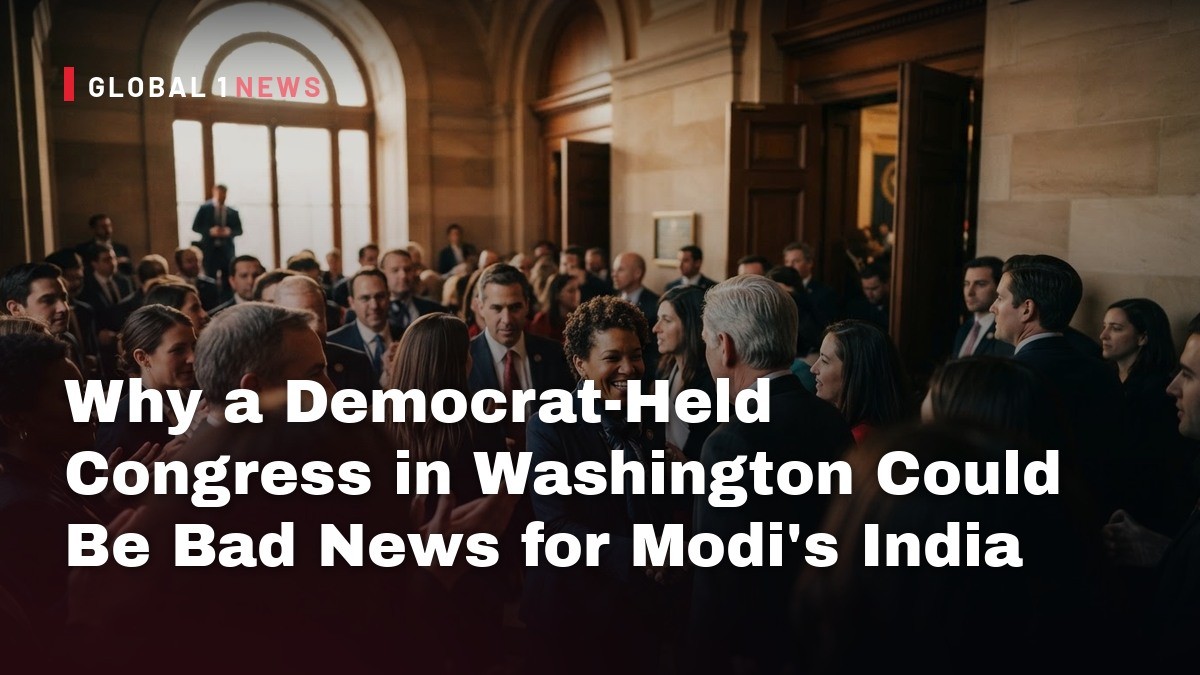
In the wake of the United States mid‑term elections of November 2026, the composition of Congress shifted dramatically toward Democratic control, a development that has been met with cautious optimism in New Delhi. The Indian Ministry of Foreign Affairs (MOFA) has signaled that the new balance of power could afford India greater “manoeuvring space” on key issues such as immigration, trade and energy, as reported by Business Standard. Yet, the same diplomatic overtures are tempered by concerns that a Democrat‑led legislature may intensify scrutiny of New Delhi’s democratic practices, potentially reshaping the bilateral relationship in ways that extend beyond the immediate interests of Indian Americans.
Electoral Outcomes and Immediate Diplomatic Reactions
The Democratic Party’s sweep in the House and Senate has been interpreted in Indian media as a “collective sigh of relief in Delhi,” according to the Indian Express, with hopes that the new Congress will restore “checks and balances” within the American political system. This sentiment reflects a broader expectation that a more pluralistic U.S. legislature will be less prone to unilateral executive actions that have previously unsettled Indian interests, such as the suspension of the Program Electronic Review Management (PERM) applications that halted employment‑based green‑card pathways for H‑1B holders from major Indian IT firms.
At the same time, the Business Standard notes that Indian officials view the Democratic victory as an opportunity to expand diplomatic flexibility. The ministry’s cautious optimism hinges on the prospect that a Congress dominated by Democrats—who traditionally champion legal immigration—may reverse or mitigate policies that have constrained Indian professionals abroad, thereby reinforcing the human capital pipeline that undergirds India’s technology sector.
Indian American Lawmakers: A New Leverage Point
Following the mid‑term results, the number of Indian American members of Congress rose to six, a figure highlighted by the Indian Express. Among them, Representative Pramila Jayapal secured a sixth term and has emerged as a vocal critic of the Modi government’s recent “Special Intensive Revision” (SIR) of voter rolls, which she alleges could purge up to 130 million citizens from the electoral register. Jayapal’s public statements on X, juxtaposing India’s voter‑roll purge with the Trump administration’s challenges to voting rights in the United States, underscore a growing willingness among Indian American legislators to scrutinize New Delhi’s democratic credentials.
Jayapal, together with five other Democratic lawmakers, dispatched a letter to Secretary of State Marco Rubio on 16 October 2026, urging him to raise democratic‑freedom concerns with Indian officials during his upcoming visit. This diplomatic outreach signals that the United States may leverage its legislative branch to press New Delhi on governance issues, adding a new dimension to the bilateral agenda that extends beyond immigration and trade.
Legislative Constraints on Executive Power
Although Democrats now control both chambers, the source material emphasizes structural limits that could blunt their ability to shape U.S. policy toward India. President Donald Trump, despite his electoral setbacks, retains the constitutional veto power, and has publicly warned of becoming “Mr. Veto” should Democrats attempt to overturn his agenda. Overriding a presidential veto requires a two‑thirds supermajority—290 votes in the House and 67 in the Senate—thresholds that Democrats are unlikely to achieve without bipartisan cooperation.
This dynamic is evident in the context of tariff legislation. While Democrats could theoretically pass bills to repeal tariffs imposed on partner countries, Trump’s veto threat remains a potent deterrent. Consequently, any legislative effort to modify trade terms with India may encounter a stalemate, compelling New Delhi to adopt a “wait‑and‑watch” posture as it navigates the uncertain policy environment.
Implications for India’s Energy Strategy
The potential for a Democratic Congress to override a presidential veto on matters related to Russia carries significant ramifications for India’s energy imports. The source notes that Congress, buoyed by bipartisan support for Ukraine, could muster the supermajority needed to block legislation that facilitates discounted Russian oil purchases. As a Quad partner, India may face heightened pressure to condemn Moscow’s actions in Ukraine, thereby jeopardizing its access to lower‑priced Russian energy.
Should Congress succeed in curbing the United States’ waiver of Russia sanctions—a move that the Trump administration has recently pursued—India could confront higher energy costs and diplomatic friction. This scenario illustrates how a shift in U.S. legislative dynamics can indirectly affect India’s strategic energy calculations, compelling New Delhi to balance its Quad commitments against its domestic energy security needs.
Security Calculus and the Iran Question
Beyond the Russia‑Ukraine theater, the source material highlights uncertainty surrounding U.S. policy toward Iran. Reports indicate that President Trump, as a lame‑duck, has prepared for a possible military campaign against Iran, including potential strikes on nuclear facilities and civilian infrastructure. While Trump has publicly claimed the United States has “no immediate plans to strike Iran,” his recent hints at renewed military action suggest a volatile security environment.
For India, a Democratic Congress that may prioritize diplomatic avenues over executive‑driven military escalations could be advantageous, given New Delhi’s delicate balancing act between Iran, Saudi Arabia, and the United States. However, the source cautions that any abrupt shift in U.S. policy—whether toward sanctions, military action, or diplomatic engagement—could reverberate through regional security calculations, compelling India to reassess its strategic posture in the Middle East.
Strategic Outlook: Navigating a Complex Transition
In sum, the Democratic takeover of Congress offers both opportunities and challenges for India’s foreign policy. On the one hand, a more collaborative legislative environment may ease immigration hurdles for Indian professionals and provide a platform for Indian American lawmakers to advocate for stronger democratic norms in New Delhi. On the other hand, heightened congressional scrutiny of India’s internal democratic practices, coupled with the potential for legislative overrides of executive actions on sanctions and energy, introduces new variables into the bilateral equation.
Given these dynamics, the prudent course for the Ministry of Foreign Affairs, as articulated in Business Standard, is to adopt a “wait‑and‑watch” stance while maintaining robust engagement with influential congressional figures—such as New York Democrat Gregory Meeks, a likely future chair of the House Foreign Affairs Committee. By leveraging long‑standing bipartisan ties and cultivating relationships across both chambers, India can preserve strategic flexibility amid the evolving U.S. political landscape, ensuring that short‑term electoral shifts do not destabilize the broader trajectory of Indo‑U.S. partnership.
This article was produced with AI-assisted research and editorial support. Reporting is based on the source material cited below. Sources: The Diplomat; thediplomat.com; Global1.News (10 November 2026).
By Prof. David Park, Staff Writer
What's Your Reaction?
 Like
0
 Dislike
0
 Love
0
 Funny
0
 Wow
0
 Sad
0
 Angry
0

East Asia/Technology Correspondent at Global1.News. Seoul-based voice covering Korean politics, technology, business, and culture. Analyzes how technology and geopolitics intersect across East Asia.









Comments (0)