
Drone footage shows Black Cat roundabout progress
The latest drone footage released by National Highways offers a rare glimpse of the sprawling works that will soon reshape the transport link between Bedfordshire and Cambridgeshire.
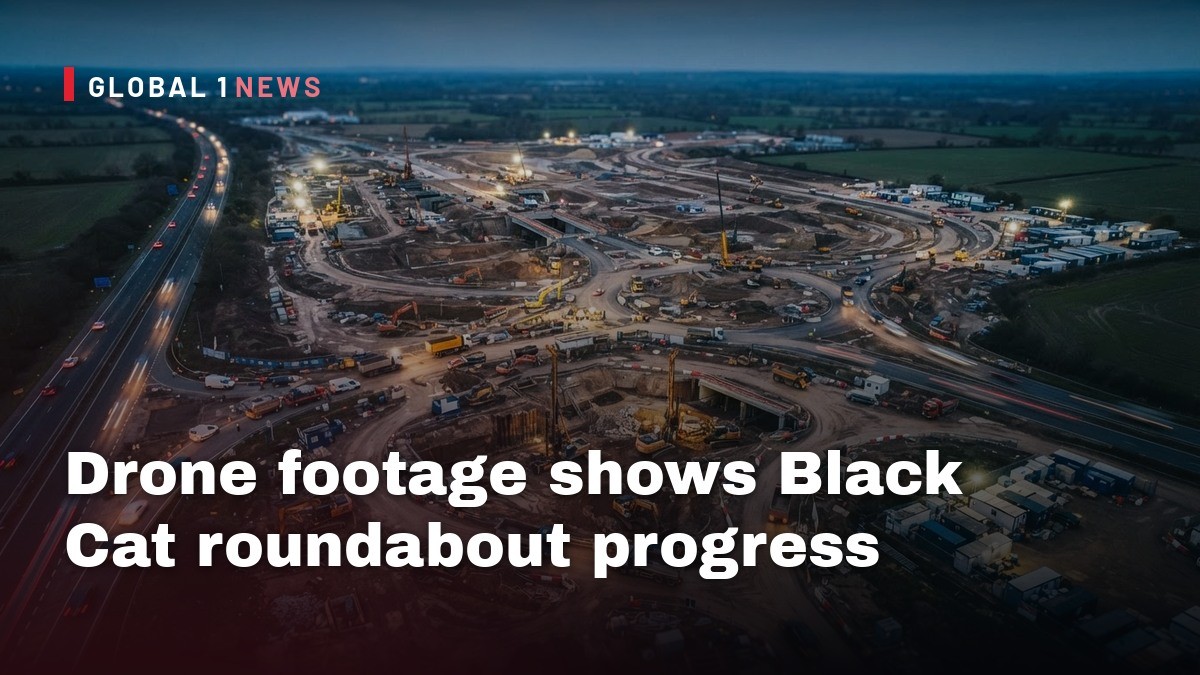
The latest drone footage released by National Highways offers a rare glimpse of the sprawling works that will soon reshape the transport link between Bedfordshire and Cambridgeshire. The images, captured from a low-flying aircraft, trace the progress of a ten-mile dual carriageway that is set to become a pivotal east‑west conduit across the heart of the East of England. While the visual evidence is striking, the underlying narrative is equally compelling: a £1bn infrastructure programme that, despite encountering unforeseen underground obstacles, remains on schedule and is poised to deliver its first operational sections within months.
From aerial view to on‑the‑ground reality
The drone footage, released on 8 November, showcases the scale of earth‑moving and the emergence of concrete structures that will soon carry thousands of vehicles daily. The camera sweeps past the nascent Black Cat roundabout on the A1, a critical junction that will serve as the western gateway to the new route. Further along, the footage passes the Caxton Gibbet roundabout on the A428, marking the eastern terminus of the scheme. The visual continuity between these points underscores the ambition of the project: a seamless, high‑capacity dual carriageway that will bypass congested town centres and provide a faster, more reliable link for commuters, freight operators and regional economies.
What is striking is the level of detail captured: newly laid foundations for permanent bridges, the alignment of future carriageways, and the intricate network of temporary access roads that support construction crews. The images also reveal the phased approach adopted by National Highways, with certain sections already open to traffic while work continues elsewhere. This staged delivery is intended to mitigate disruption and deliver early benefits, a strategy that aligns with the agency’s broader commitment to incremental progress on large‑scale schemes.
Financial heft and political context
At a headline cost of £1bn, the dual carriageway represents one of the most significant transport investments in the region for the past decade. While the source material does not break down the budget, the figure alone signals the scale of public funds being allocated to improve connectivity between Bedfordshire and Cambridgeshire. Such an outlay inevitably attracts scrutiny from both local authorities and national policymakers, who must balance the promise of economic uplift against the imperative of fiscal prudence.
In the political arena, the project sits at the intersection of regional development plans and national transport policy. The A421 corridor, as it is now known, dovetails with broader ambitions to enhance the east‑west axis across the Midlands, linking the A1 and the A14 and supporting the movement of goods between the South East and the North. The continuation of the scheme, despite the minor setbacks reported, signals a sustained commitment from the Department for Transport and the current administration to deliver on long‑standing infrastructure promises.
Technical challenges beneath the surface
One of the most notable setbacks highlighted in the briefing concerns the A1 underpass, which has been delayed due to “unforeseen issues discovered underground”. While the footage does not reveal the nature of these issues, the statement from National Highways indicates that the underpass will now open in late next summer rather than the earlier target. Such geological surprises are not uncommon in large civil engineering projects, where subsurface conditions can vary dramatically over short distances.
The delay, however, appears to be contained within the broader timetable. National Highways has reassured stakeholders that the overall project remains on track, suggesting that contingency measures and robust risk‑management frameworks are in place. The ability to absorb such disruptions without derailing the entire programme reflects a mature project governance structure, one that can adapt to the unpredictable realities of large‑scale construction.
Phased openings and immediate benefits
According to the release, the new A421 dual carriageway is slated to open in late spring, a timeline that anticipates the first tranche of the route becoming operational before the A1 underpass is completed. This phased approach means that drivers will soon experience reduced journey times on the newly opened sections, even as work continues elsewhere. Early utilisation of permanent bridges and road alignments is already underway, indicating that parts of the scheme are functional and serving traffic.
The incremental opening strategy offers tangible benefits to local communities. By providing alternative routes around congested town centres, the bypass is expected to ease pressure on existing roads, improve air quality, and enhance safety for both motorists and pedestrians. While the source material does not quantify these impacts, the very act of opening new road capacity typically yields measurable improvements in travel reliability and economic efficiency.
Regional connectivity and economic implications
The Black Cat to Caxton Gibbet corridor will knit together a patchwork of towns and rural districts that have long relied on secondary roads for east‑west travel. By delivering a high‑specification dual carriageway, the project promises to bolster regional connectivity, facilitating smoother freight movements and supporting the logistics sector that underpins much of the East of England’s economy.
Beyond freight, the route is likely to stimulate investment in adjacent areas, attracting businesses that value rapid road access to major motorways such as the A1 and the A14. The improved transport link may also encourage residential development, as commuters seek homes within reach of both Bedfordshire’s market towns and Cambridgeshire’s growing employment hubs. While these outcomes remain speculative, they align with the typical ripple effects observed after the completion of major infrastructure projects.
Stakeholder engagement and public communication
National Highways’ decision to release drone footage reflects a proactive approach to public communication. By providing visual evidence of progress, the agency seeks to maintain transparency and build public confidence in the project's delivery. The footage, shared across multiple platforms—including BBC Sounds, Facebook, Instagram and X—ensures broad reach, catering to diverse audience preferences.
Such engagement is crucial, particularly when large projects intersect with local concerns about environmental impact, noise, and land use. While the source material does not detail specific community consultations, the emphasis on phased openings and the acknowledgement of delays suggest an awareness of the need to manage expectations and keep stakeholders informed throughout the construction lifecycle.
Looking ahead: timelines and expectations
With the drone footage confirming that substantial work is already in place, the outlook for the Black Cat roundabout bypass appears optimistic. The anticipated late‑spring opening of the A421 dual carriageway will mark the first major milestone, followed by the late‑summer completion of the A1 underpass. Assuming no further unforeseen complications, the full ten‑mile route should be operational by the end of the next calendar year.
For motorists, freight operators and local residents, the promise of a modern, high‑capacity link is a welcome development. The visual narrative captured from the sky not only showcases engineering progress but also symbolises the broader ambition to modernise the nation’s transport network. As the project moves from construction to operation, its impact will be measured not just in miles of tarmac, but in the economic vitality and improved quality of life it delivers to the communities it serves.
This article was produced with AI-assisted research and editorial support. Reporting is based on the source material cited below. Sources: BBC News UK; bbc.co.uk; Global1.News (09 November 2026).
By Erica Thornton, Staff Writer
What's Your Reaction?
 Like
0
 Dislike
0
 Love
0
 Funny
0
 Wow
0
 Sad
0
 Angry
0

US Politics and Policy Correspondent at Global1.News. Based in Washington DC, covering American politics, policy, elections, and the courts. Knows how the system works and tells you what it actually means.














Comments (0)