
Thailand Just Stopped 166 Data Centers. The Philippines Just Bet $34 Billion. Same Week.
Thailand froze 166 data centre projects in one meeting and admitted it lacks the legal power to enforce the pause. Two days later the Philippines launched a $34.4 billion plan to grow AI capacity thirty-fold. A hosting founder on Asia's split decision.
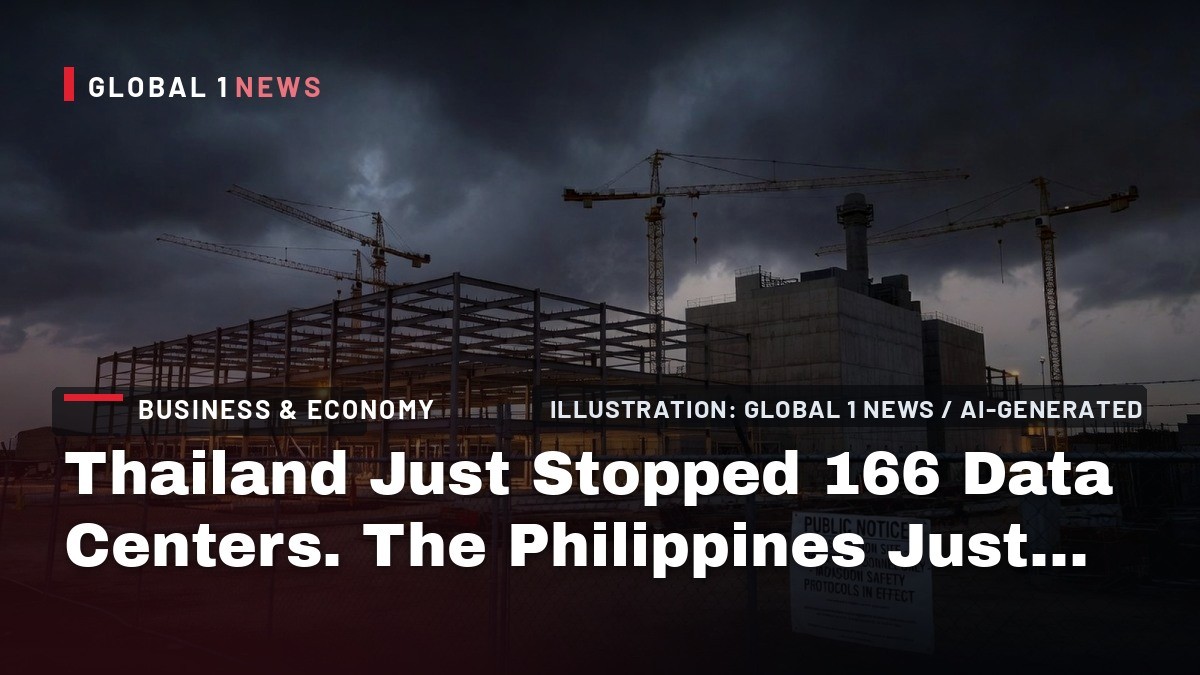
Thailand Just Stopped 166 Data Centers. The Philippines Just Bet $34 Billion. Same Week.
I have been running hosting infrastructure for over a decade, and I have never seen two governments in the same region look at the same industry in the same seven days and reach completely opposite conclusions. Last week, Thailand's data centre policy board sat down for the first time, and when its members got up, 166 projects were frozen. Two days ago, the Philippines held a launch in Quezon City and put a $34.4 billion price tag on a plan to grow its AI data centre capacity thirty times over.
One country hit the brakes. One country floored it. Both are in Southeast Asia, and both just watched the same hyperscaler money walk through the door. If you are an operator, or renting space from one, you need to understand why they made opposite calls.
Thailand: 166 Projects Stopped By a Commission That Can't Legally Stop Them
On September 4, Thailand's data centre supervision commission met for the first time, chaired by Finance Minister Ekniti Nitithanprapas. When the meeting ended, the board paused construction on 49 data centres already under way and froze approval decisions on 117 more projects still waiting on permits. Four subcommittees were given one month to draft national standards covering water, electricity, site selection, safety, and what Thailand actually gets out of these projects besides server racks.
Here is the part that stopped me cold. The government does not actually have the authority to order those 49 projects to stop. NESDC secretary-general Danucha Pichayanan told AFP as much. Developers have been asked to cooperate voluntarily while the framework gets drafted.
Read that again. A country just froze 166 projects with a request. Nobody signed anything. That is not regulation, that is a memo, and the entire Thai data centre pipeline is now sitting on a foundation of voluntary cooperation.
The trigger was concrete. Bangkok authorities halted approvals for three more projects after a facility went up next to a hospital and exposed a gap that lets data centres get permitted as warehouses. Governor Chadchart Sittipunt said there should be environmental impact reviews. He is right, and the fact that it took a hospital to surface it tells you how fast this sector moved. Worse, the government found 35 operating data centre projects and admitted its own records "lacked enough detail for effective regulation and monitoring." They did not know what they already had running.
Thailand is not closing the door. Ekniti said the industry is "critical to the country's competitiveness," they just want clear and consistent standards. They are also weighing higher electricity rates for large operators, on the principle that households and small businesses should not be subsidizing the power bill of a hyperscaler. No argument from me on that one.
Now the money context, because this is the detail that makes the pause so telling. Thailand approved 88 AI and data centre projects worth 886 billion baht, about $34.1 billion, in the first six months of this year. That already beats the 623 billion baht approved in all of 2025. The brakes went on at the exact moment the pipeline hit its highest gear ever.
The Philippines: $34.4 Billion, 30x the Capacity, Two Hyperscalers Circling
Two days after Thailand's freeze, the Philippines did the opposite. On September 8, the Department of Information and Communications Technology launched the final Philippines AI+ Infrastructure Masterplan 2026-2033 at the Crowne Plaza Manila Galleria, developed with the Asian Development Bank.
The numbers: $34.4 billion total. $13.5 billion from public sources, 39 percent, and $21 billion from private investors. The target is to take AI data centre capacity from roughly 50 megawatts today to 1.5 gigawatts by 2033. That is thirty times. Phase one wants 400 megawatts live by 2030, and phase two adds another 1,100 megawatts through 2033. The flagship is a public-private AI compute and data hub carrying a $14.65 billion price tag.
They have interest, not commitments, from two US hyperscalers evaluating sites. Each is talking about 200 megawatts over five years, with development possibly starting next year. That is the softest part of the plan and the part everyone will quote. Two site evaluations is not two contracts.
Here is the reality check sitting inside the document itself. The Philippines currently has exactly one data centre that qualifies as genuinely AI-oriented. Out of roughly 200 megawatts of total capacity, about 50 megawatts is AI-grade, and market maps track just three facilities with 410 megawatts in various stages of planning. They are going from one actual AI facility to a national network in seven years.
Patrick Signo from DCAP reckons they could hit 1.5 gigawatts as early as 2028 with support from neighbours, because Singapore and Malaysia are already running into power constraints. That is the pitch to the hyperscalers: everyone else is full, come to us.
The Conspicuous Absence — Neither Government Is Saying the Same Thing
Thailand paused 166 projects and still has not published the rules that decide whether any of them restart. The Philippines published a $34.4 billion plan whose own text warns that the country's power system could approach its limits by 2027 unless more generation gets built, and that a 1.5 gigawatt AI industry would consume a substantial portion of the available power reserve while pushing up electricity prices.
So one country stopped building because it does not trust its own regulatory picture, and the other is planning a thirty-fold buildout on a grid its own document says is tightening. Both are betting the same thing: that the capital keeps showing up. Neither has answered the only question that matters to the people living next to these sites. Who pays for the wires, and who eats the water bill.
DEPDev Undersecretary Rosemarie Edillon has already said the government must fold these demands into its upcoming AI Governance Framework, and BusinessWorld reported the AI boom may force revisions to long-term energy and water plans. That is officials in Manila admitting on the record that the masterplan and the resource plan have not met each other yet.
The Bigger Pattern — Consent Is Now a Line Item on the P&L
This is not an Asia story. It is the same fight that has been running in the United States for eighteen months, and Asia is simply getting its turn.
Data Center Watch counted at least 75 projects worth roughly $130 billion blocked or delayed in the first three months of 2026 alone. That is the largest single-quarter concentration on record, and it roughly matches the whole of 2025. Active opposition groups went from 396 at the end of last year to 833 by March, spread across 49 states. Polling put opposition to local data centres at 71 percent.
Dan Ives at Yorkville Ives told CNBC that political backlash is the single biggest threat to the tech revolution, and floated a base case where 10 to 15 percent of proposed US data centres get cut. Protesters in Austin are demanding moratoriums. A $100 billion Virginia project was scrapped.
Now watch it happen in Asia in real time. Thailand's own loophole that let a data centre file for permits as a warehouse is exactly the kind of gap American communities have been closing for two years. The Bangkok hospital complaint is the same fight as a Virginia school board meeting, just with different weather and a different flag.
The industry knows it. At the Fortune Leaders Forum in Macau on September 8, Bridge Data Centres chief investment officer Kevin Guan said flat out there are physical limits to how quickly you can build data centres at scale, and that they are seeing significant delays and challenges with delivery. Gensler's John Taylor said the quiet part with the lights on: data centres need to move from being perceived as industrial infrastructure to being something that is part of the civic infrastructure, which serves a community.
He is also building them ten and eleven stories tall in land-constrained Asian cities, close to homes, while roughly 56 percent of the energy data centres consume worldwide still comes from coal and natural gas, per the International Energy Agency. Gensler committed to zero carbon by 2030, and Taylor admitted the AI boom is making that extremely challenging.
The engineering workarounds are real. Recycle municipal wastewater on campus, like Bridge did in Johor, Malaysia. Build modular so you can swap hardware like Lego bricks, because the building is designed to last 20 years and the latest AI chips may last less than five. All of it matters. None of it changes the arithmetic: consent is now the fourth input, alongside chips, power, and capital. Unlike the other three, you cannot buy consent with a purchase order.
What This Means for Independent Hosting Providers
First, stop reading "pipeline" as "capacity." Thailand's 166 projects are paused with no legal basis for the pause. The Philippines' 1.5 gigawatts is a 2033 target with zero committed hyperscalers and a grid warning inside its own document. Announced capacity is a marketing number. Energized capacity is the only number you can sell.
Second, put a political risk line in your colocation model. If you are renting space in a market where 833 opposition groups are organizing and seven in ten people do not want the facility near them, your lease carries a risk premium your provider has not priced into your rate. Ask the operator what their community engagement actually looks like.
Third, trade the regulatory calendar, not the news cycle. Thailand's four subcommittees have one month to submit criteria, so the rules land in early October. The Philippines is drafting its AI Governance Framework now with energy and water impacts on the table. Capacity permitted before rules tighten clears faster and cheaper than capacity that has to comply after.
Fourth, remember that being courted is not a contract. Thailand handed out tax breaks, discounted land, and easy access to power and water to pull this industry in, then froze 166 projects in a single meeting. The courting was a sales pitch. The rules are the actual deal.
Fifth, use the arbitrage while it still exists. When Tier-1 markets get expensive and political, workloads flow to whoever can genuinely deliver power and permits. If you hold capacity in a jurisdiction with available power and a planning department that answers the phone, you are holding something scarce. Price it like it.
The Bottom Line
Two countries, seven days, opposite decisions, and the same problem underneath both. Thailand does not trust its own regulatory picture enough to keep building. The Philippines trusts its growth story enough to build anyway, with a plan that admits the grid gets tight in 2027.
Neither is wrong. But both just proved the same thing. The AI buildout's binding constraint is no longer silicon, and it has not been capital for a while. It is whether the people who have to live next to the thing will let you switch it on.
Thailand just found out it does not own the legal tools to make that call. The Philippines is about to find out how expensive it gets when the power runs short. If you are building in either market, or in any market about to have this same fight, plan for both. The meters and the neighbours will tell the truth eventually. They always do. Ent?
— Allan Ali, Founder
This article was produced with AI-assisted research and editorial support. Sources: Bloomberg ("Thailand Puts 49 Data Centers on Hold Over Resource Strain," September 4, 2026), The Straits Times, The Nation Thailand, TechRepublic, Philippine News Agency, BusinessWorld Online, newsbytes.ph, Nikkei Asia, Fortune ("Developers are rethinking data center design as the AI backlash makes its way to Asia," September 9, 2026), NBC News, Data Center Watch Q1 2026 report, Benzinga/CNBC (Dan Ives), International Energy Agency.
What's Your Reaction?
 Like
0
Like
0
 Dislike
0
Dislike
0
 Love
0
Love
0
 Funny
0
Funny
0
 Wow
0
Wow
0
 Sad
0
Sad
0
 Angry
0
Angry
0

Publisher of Global1.News. Automation architect, systems builder, and the guy making sure the truth gets published.











Comments (0)