
Australia Just Wrote Rules for the AI Buildout — and Every Developer Is Racing to Beat Them
Australia agreed national rules for AI data centres as emails revealed Anthropic sought 5GW in one state. A hosting founder on the renewables guarantee, the grandfathering rush, and what additionality means for independent providers.
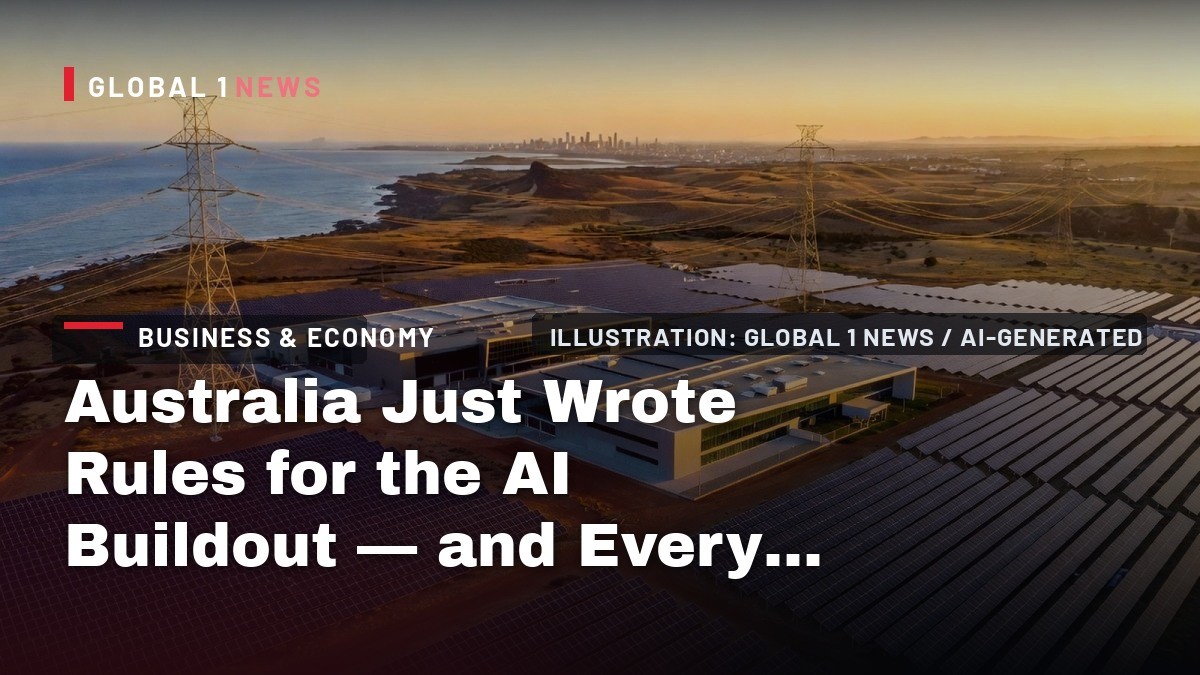
Australia Just Wrote Rules for the AI Buildout — and Every Developer Is Racing to Beat Them
I've been running hosting infrastructure for over a decade, and I can tell you the exact moment a boom changes shape: the day the government starts writing rules. On the other side of the planet, that moment just landed. While the whole world stared at Nvidia's earnings calendar, Australia quietly did something no major economy has managed yet — it sat down with its states and agreed to write national rules for AI data centres. And the same week, internal government emails revealed that one American lab quietly asked for five gigawatts of capacity in a single Australian state. That's more than three times the entire country's current data centre capacity. One company. One state.
Three stories hit the Australian news cycle in 48 hours, all symptoms of one shift: the buildout has outrun national planning, and Canberra is the first government trying to catch up. Here's what happened, what the rules say, and why the loophole matters for anyone running a hosting business.
The Demand Nobody Planned For — Anthropic Asked NSW for 5 Gigawatts
The ABC revealed this week that internal New South Wales government emails show Anthropic, the company behind Claude, wanted to talk to state officials about locating up to 5GW of AI training capacity in NSW. In a March 18 email, Dena Jacobs, executive director of Infrastructure NSW, wrote to colleagues: "The context is that the CEO of Anthropic is visiting Sydney and would like to speak to NSW government about the opportunities to locate up to 5GW of AI training capacity in NSW. i.e. there's an opportunity to locate this outside Sydney." Two weeks later, CEO Dario Amodei was in the country, meeting the prime minister and treasurer and signing an MOU to expand Anthropic's presence in Australia.
Put that number in perspective. The lobby group Data Centre Australia released a report the same day calculating the entire country has 1.6GW of computing capacity in operation today, projected to grow to 3.9GW by 2030. One company's ask in one state is bigger than the whole country's projected buildout at the end of the decade. The ABC reported in June that Anthropic wanted 5GW of new Australian capacity by 2030 with a longer-term goal of 20GW, and the Australian Financial Review reported in July that the company sent builders a confidential tender for 1.4GW valued at more than $20 billion. "That is a massive amount," Olivia Shen, director of the Strategic Technologies Program at the University of Sydney's United States Studies Centre, told the ABC. Ent?
Why Australia? Lots of land, enormous renewable capacity — particularly solar — and a stable democracy. Australians are among the world's most distrustful of AI yet its fastest adopters — first globally for Claude usage per capita, per Anthropic's own data. Add it up — more than $150 billion in data centre investment already lined up, the US having scuppered or delayed $200 billion worth of projects last year on community opposition — and you see the play. Australia wants the buildout. It just doesn't want the buildout to own the country.
The Forecast That Doubled in a Year — AEMO Now Says 13% by 2036
Here's the forecast that should terrify every grid operator. The Australian Energy Market Operator reported Tuesday that 225 data centres are now in development across the national electricity market — more than double the 97 known projects a year ago — on top of 165 already operating. Data centres draw about 3% of grid electricity today; in ten years AEMO expects 13% — 34 terawatt-hours by 2036, almost as much as every home in New South Wales and Victoria consumes today, combined. A year ago, AEMO thought that level wouldn't arrive until after 2050.
Before you roll your eyes at another doom forecast — the sceptics are already out. Tony Wood from the Grattan Institute noted 40% of the data centres talked about twelve months ago have been cancelled or postponed. Fair point, and it's baked in: AEMO's projection already accounts for heavy cancellations and still lands at 13%. Even so, the grid gets a demand shock it has never planned for — concentrated in NSW and Victoria, where the backlash is already hottest.
The Rules — What National Cabinet Agreed in Perth
So the federal government moved — at a national cabinet meeting in Perth on Wednesday, Prime Minister Anthony Albanese secured agreement to press on with new national rules for data centre energy use, with legislation to follow next year. The core proposal: new data centres must guarantee that new renewable energy comes onto the grid to cover their electricity demand — backed by gas firming, in Energy Minister Chris Bowen's words — plus pay their own connection costs and minimise water use. Sites must be appropriately sized and located away from schools, homes, potential housing, and prime agricultural land. Albanese's framing at a Business Council dinner was social licence: "Australia is in a strong position to attract investment in data centres, but maintaining social licence will be essential. That means ensuring energy bills do not rise, water security is maintained, and locations are appropriate."
It was not unanimous love. Queensland's Premier David Crisafulli wants a technology-neutral approach — coal and gas on the table — and the Northern Territory wants a carve-out. The federal government is threatening "guarantee of origin" legislation to override Queensland, with Bowen warning: "We're not going to let Queensland run a race to the bottom." The Coalition's shadow energy minister Dan Tehan called it an "ideologically-driven renewables only approach." Bloomberg reported Albanese even secured Queensland's buy-in to keep working toward rules by next year — but the renewables-guarantee fight is alive. Resources Minister Madeleine King said it plainly: without community acceptance, "we'll find this a very short-term boom where no-one's really happy with it at all."
The Two Readings — Governing the Boom, or Rules With a Door in Them
Read it two ways — both true.
Reading one: this is a government actually governing. Australia watched the American buildout eat $200 billion in project cancellations on community opposition and decided to get ahead of it. The renewables guarantee is genuine policy innovation — it turns the data centre boom into the financing engine for renewable projects stuck in the pipeline because they couldn't prove customer demand to get a loan. A country that writes additionality rules before the gigawatts land might just avoid the consent war consuming the US and Europe.
Reading two: the rules come with a door in them. The deal is not retrospective — projects approved before the legislation passes next year keep the old state and territory laws. So the immediate effect isn't to slow the buildout. It's to accelerate it. Urban planning researcher Crystal Legacy told the Guardian that developers will want to get in "before the new regulatory levers come into play," and states which fast-track applications before the rules bite do so "at your political peril." Already queued: Goodman Group is proposing a 90MW data centre nine kilometres from Sydney's CBD, where five data centres are approved or proposed. The rush to beat the rules is the rules' first product.
The Secondary Bottleneck Nobody's Talking About — the Renewables Guarantee Is a Scale Test
Here's the part I keep coming back to as a hosting guy, and nobody in the Australian coverage is saying it out loud: the renewables guarantee is a scale test dressed up as an environmental policy. To connect a new data centre to the grid under these rules, you have to sign power purchase agreements with new renewable projects — enough new generation to cover your load. A hyperscaler building 500MW can write a PPA with a new solar farm and barely feel it. A colo operator building 5MW — or a hosting provider leasing a hall in someone else's building — cannot. The compliance cost per megawatt is brutally regressive. Additionality rules don't just push the buildout green. They push it big.
That's the quiet irony. The rules written to protect communities from the giants end up structurally favouring the giants — the same giants who asked a single state for five gigawatts. Bowen's "causer pays" principle for connection costs has the same shape. Every regulatory regime creates winners and losers. This one's winners are already in the room.
What This Means for Independent Hosting Providers
First — treat additionality as the template, not the exception. Australia is the first mover on "bring your own renewables" as a connection condition, but it will not be the last. If you host where interconnection queues are long, start modelling what PPA-credentialed power would do to your cost base before your regulator makes the decision for you.
Second — policy cliffs create permit scarcity. When rules land with a grandfathering window, approved sites become the most valuable real estate on the market. If you've been sitting on a zoning approval or a grid application, the window before the levers come into play is when that paper is worth something.
Third — never build capacity on announcements. Australia has 225 data centres "in development" and 1.6GW actually running; 40% of last year's pipeline evaporated. Lease commitments against projected demand are how independents die. Build against contracted load, not press releases.
Fourth — power is becoming a partnership business. If additionality-style rules reach your market, small players need access to contracted green generation they can't sign alone. That means power purchase aggregators, co-location with campuses that carry the PPA load, or locking green contracts now while the market is loose.
Fifth — small footprint is now a political asset. Social licence has moved from a community-relations nicety to a national policy input. Australia's rules push new builds away from residential and agricultural land — bigger greenfield sites, longer timelines, more scrutiny for the giants. A modest, efficient facility in an already-industrialised zone faces a fraction of that surface area. In a buildout governed by consent, the little guy's scale is finally an advantage.
The Bottom Line
Australia did the thing every government has been afraid to do: it put rules on the table before the gigawatts landed. But the rules have a door in them, the clock on that door is running, and the only people guaranteed to walk through it are the ones big enough to sign the PPAs and buy the permits. If you run hosting infrastructure anywhere, you just watched your future market take shape: additionality, grandfathering, and a race against the clock where scale wins. Plan for the rules. Don't plan on the loophole lasting.
This article was produced with AI-assisted research and editorial support. Sources: ABC News, The Guardian, Bloomberg, 7NEWS, Australian Energy Market Operator, Data Centre Australia.
— Allan Ali, Founder
What's Your Reaction?
 Like
0
Like
0
 Dislike
0
Dislike
0
 Love
0
Love
0
 Funny
0
Funny
0
 Wow
0
Wow
0
 Sad
0
Sad
0
 Angry
0
Angry
0

Publisher of Global1.News. Automation architect, systems builder, and the guy making sure the truth gets published.














Comments (0)