
Army Secretary Dan Driscoll Resigns Amid Hegseth Tension
The U.S. Army’s top civilian leader is out. Army Secretary Dan Driscoll submitted his resignation to President Donald Trump on Sunday, August 31, 2026, according to multiple reports, ending a tenure marked by historic youth, a high-profile role in Ukraine peace efforts, and a bitter, months-long feud with Defense Secretary Pete Hegseth that gutted the service’s senior officer corps. CNN, citing three sources familiar with the matter, broke the news of Driscoll’s resignation.
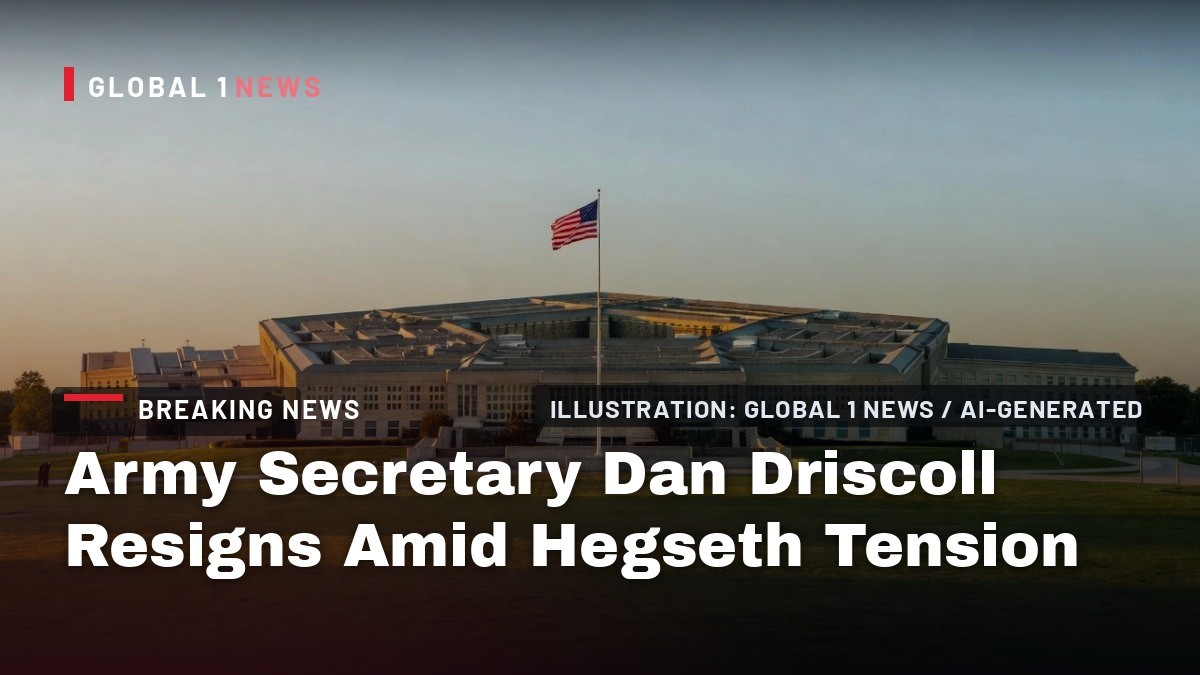
The U.S. Army’s top civilian leader is out. Army Secretary Dan Driscoll submitted his resignation to President Donald Trump on Sunday, August 31, 2026, according to multiple reports, ending a tenure marked by historic youth, a high-profile role in Ukraine peace efforts, and a bitter, months-long feud with Defense Secretary Pete Hegseth that gutted the service’s senior officer corps.
CNN, citing three sources familiar with the matter, broke the news of Driscoll’s resignation. The Wall Street Journal reported the move followed months of tension with Hegseth over the direction of the Army and the ouster of numerous senior officers. Reuters confirmed the Journal’s reporting the same day. The resignation, while sudden in its timing, was hardly a surprise to Pentagon insiders. Puck News had already dubbed Driscoll’s upcoming departure “the worst-kept secret in Washington,” with the real mystery being what the 38-year-old does next.
Driscoll’s exit leaves the Army in a precarious position. The service has been without a chief of staff since April 2026, when Hegseth fired Gen. Randy George without explanation. Now, it is also without a civilian secretary. The dual vacancy at the top of America’s largest military branch comes at a moment of global volatility, with ongoing ceasefire negotiations between Russia and Ukraine—talks in which Driscoll played an outsized, unorthodox role.
A resignation that was a long time coming
Driscoll’s resignation letter landed on the president’s desk on the last day of August, but the seeds of his departure were planted months ago. The Hill reported before the resignation that Driscoll had long communicated that between 23 and 24 months is the lifetime of an Army secretary in the Trump administration, and that he planned to depart the Pentagon around the end of 2026. The fact that he left four months early signals the friction with Hegseth had become untenable.
Political.org reported on August 21, 2026, that the conflict was rooted in rivalry, ideological friction, and fears inside the Pentagon that Driscoll had become a potential successor to Hegseth’s own position. That dynamic—a younger, media-savvy, Trump-loyalist Army secretary seen as a rising star—created a toxic environment at the highest levels of the Department of Defense. Military.com reported before the resignation that Driscoll was expected to step down by the end of the year, and possibly sooner, due to months of purported tension with Hegseth.
Neither the White House nor the Pentagon has yet announced a successor or a formal timeline for Driscoll’s departure, and the confirmation process for any nominee could take months. In the interim, the strategic vacuum is undeniable: the Army, which has not had a Senate-confirmed chief of staff since April, now faces the prospect of operating with neither a civilian secretary nor a uniformed leader at its helm.
The Hegseth feud: a timeline of tension
The relationship between Driscoll and Hegseth deteriorated publicly and dramatically over the spring and summer of 2026. The Atlantic reported in April 2026 that Hegseth removed the Army’s top officer mid-war, and that the Army secretary was in jeopardy. That report proved prescient.
On April 16, 2026, Hegseth fired Gen. Randy George, the Army chief of staff, without explanation. The firing sent shockwaves through the Pentagon. Driscoll, who was out of town at the time, later told lawmakers—according to ABC News—that he was not consulted and called George a “transformational leader.” The public rebuke of his boss’s decision was a clear signal that the civilian and military leadership of the Army were not on the same page.
The New York Times reported on August 25, 2026, that beyond Gen. George, Hegseth has fired or forced out a half-dozen senior officers—a generation of the Army’s most combat-hardened leaders—thinning the service’s top ranks. The Army has not had a chief of staff since April 2026, and there were no signs Hegseth was close to filling the position, current and former officials told the Times. The purge has left the Army’s senior leadership in a state of unprecedented flux, with combat commanders replaced by officers who, in some cases, lack the same depth of operational experience.
Driscoll’s frustration was not just about the firings themselves, but about the process. He was out of town and not consulted before George was fired, and he later publicly praised the ousted general—a clear signal that the civilian and military leadership of the Army were not on the same page. The feud was less about policy disagreements and more about control—who gets to shape the future of the Army. Hegseth, a former combat veteran, has made no secret of his desire to overhaul the military’s leadership culture. Driscoll, a Yale Law graduate and businessman, represented a different vision: one that embraced technological disruption but also respected institutional continuity.
The purge of senior Army officers and its impact
The scale of the officer purge is difficult to overstate. The New York Times’ reporting on August 25 detailed how Hegseth has systematically removed a half-dozen senior officers, including the Army chief of staff, in a matter of months. These were not marginal figures. They were generals who had led troops in Iraq, Afghanistan, and Syria—leaders with decades of combat experience and institutional knowledge.
The impact is already being felt. Without a chief of staff, the Army’s day-to-day operational command falls to deputies and regional commanders, but strategic planning, budget formulation, and force modernization efforts lack a single, authoritative uniformed voice. The vacancy also complicates the Army’s relationship with Congress, which appropriates funds and oversees military policy. Lawmakers have pressed the Pentagon on the firings: ABC News reported that Driscoll, when questioned by lawmakers in April, defended George as a “transformational leader” even as he recounted being out of town during the abrupt shake-up.
Driscoll’s resignation compounds the problem. The Army secretary is responsible for manpower, procurement, and civilian oversight. With that position now vacant, the service faces a leadership gap at the exact moment it is trying to modernize its forces, integrate drone warfare, and navigate the political minefield of the Russia-Ukraine ceasefire. Current and former officials told the Times that the thinning of the top ranks has created a culture of caution, with officers reluctant to speak candidly for fear of being the next to go.
Driscoll’s unusual rise: from Yale to the Pentagon
Dan Driscoll’s path to the Pentagon was anything but conventional. At 38 years old, he is the youngest-ever Army secretary, a distinction that made him a subject of fascination and, at times, skepticism. He is an Iraq War veteran, a former businessman, and a Yale Law School graduate. He is also a longtime Trump loyalist and a college friend of Vice President JD Vance, a connection that gave him unusual access to the highest levels of the administration.
Driscoll is frequently described as Trump’s “drone guy” for his embrace of emerging battlefield technologies, particularly unmanned aerial systems. He argued that the Army’s future depends on integrating drones, artificial intelligence, and networked warfare into its core doctrine—a position that put him at odds with traditionalists who favored conventional armor and artillery. His advocacy was not theoretical. Under his tenure, the Army accelerated several drone programs and pushed for greater investment in loitering munitions and reconnaissance UAVs.
His rise was also political. Axios reported in November 2025 that his impromptu role in Russia-Ukraine negotiations thrust him into the mainstream as a “Trump 2.0 power player.” That profile made him a valuable asset to the administration but also a target. The more visible he became, the more he seemed to threaten Hegseth’s authority. The feud, according to Political.org, was fueled by rivalry and ideological friction, with Pentagon insiders fearing that Driscoll was being positioned as a potential successor to Hegseth himself.
The Ukraine envoy role: a secretary beyond the Pentagon
Driscoll’s most consequential work may have been outside the Pentagon’s walls. BBC News profiled him as the youngest-ever Army secretary taking a central role in Ukraine peace efforts. CBS News reported that he met with members of the Russian delegation in Abu Dhabi, UAE, for several hours as part of peace-process talks. Those meetings, conducted with the tacit approval of the White House, placed Driscoll in the middle of the most sensitive diplomatic negotiations of the Trump administration’s second term.
The role was unusual for an Army secretary, whose portfolio is typically domestic and administrative. But Driscoll’s background—a combat veteran with business acumen and political instincts—made him a natural envoy. He was able to speak to Russian officials not as a career diplomat but as a pragmatic dealmaker. His involvement in the ceasefire talks gave him a level of visibility and influence that far exceeded his formal title.
That visibility, however, came with risks. The more Driscoll operated on the world stage, the more he encroached on territory traditionally reserved for the State Department and, more importantly, for the Defense Secretary. Hegseth, who has his own views on Ukraine policy, reportedly bristled at Driscoll’s freelance diplomacy. The tension between the two men was not just about Army leadership; it was about who speaks for the Pentagon in the most consequential foreign policy issue of the day.
What analysts say is at stake for the Army
The stakes of Driscoll’s departure extend far beyond one man’s career. The Army is in the middle of a generational transition. It is trying to modernize its forces for an era of drone warfare and great-power competition, while also managing the political fallout of the Ukraine conflict and the ongoing ceasefire negotiations. The loss of both its civilian secretary and its chief of staff leaves the service without a coherent leadership voice at a critical juncture.
Analysts point to several immediate concerns. First, the Army’s budget and modernization priorities will have no single senior advocate in the building or before Congress as the next budget cycle unfolds. Without a secretary to champion the service’s priorities, the budget is likely to face increased scrutiny and potential cuts. Second, the officer purge has created a leadership vacuum that will take years to fill. The generals who were fired or forced out were not easily replaceable; they represented a generation of leaders shaped by two decades of counterinsurgency and, more recently, by the lessons of the war in Ukraine.
Third, the Army’s morale is at risk. The New York Times reported that the purge has left officers looking over their shoulders, uncertain about their futures and reluctant to offer honest assessments. That culture of fear, if left unchecked, could undermine the Army’s effectiveness in ways that are difficult to measure but impossible to ignore. Driscoll’s resignation, coming on the heels of the purge, sends a signal that even the service’s top civilian advocate could not protect the institution from political interference.
What comes next: a leadership vacuum and a question of succession
The immediate question is who will replace Driscoll. The White House has not announced a nominee, and the confirmation process, if a nominee is put forward, could take months. In the interim, the Army will be led by acting officials, but their authority is limited. The service will struggle to make major procurement decisions, finalize its budget, or take bold strategic initiatives without a confirmed secretary.
The larger question is whether Hegseth will now move to fill the Army chief of staff position. The New York Times reported there were no signs he was close to doing so as of late August. The longer the position remains vacant, the more the Army’s operational readiness and strategic planning will suffer. The service is already operating with a reduced senior leadership team, and the loss of Driscoll removes the one figure who had both the president’s ear and the institutional credibility to push back against the Defense Secretary.
For Driscoll, the future is wide open. Puck News noted that the real mystery is what he does next. At 38, with a résumé that includes combat service, a Yale law degree, business experience, and a high-profile role in international diplomacy, he is well-positioned for a return to the private sector, a run for political office, or another role in the Trump orbit. His resignation, while a defeat in his feud with Hegseth, may ultimately be the beginning of a new chapter.
The Army, meanwhile, faces an uncertain path forward. It has lost its civilian leader, its top uniformed officer, and a generation of combat-hardened generals. The institution that remains is leaner, quieter, and more cautious. Whether that is a strength or a vulnerability will depend on who steps into the void—and how quickly.
This article was produced with AI-assisted research and editorial support. Sources: CNN, Reuters, The Wall Street Journal, The New York Times, The Hill, The Atlantic, BBC News, Axios.
By Jessica Ali, Staff Writer
What's Your Reaction?
 Like
0
Like
0
 Dislike
0
Dislike
0
 Love
0
Love
0
 Funny
0
Funny
0
 Wow
0
Wow
0
 Sad
0
Sad
0
 Angry
0
Angry
0

Editor-in-Chief at Global1.News. Atlanta-based journalist who cuts through the BS and tells it like it is. Lead anchor, host, and the voice you hear when the spin stops and the truth starts.










Comments (0)