
Abelardo de la Espriella Wins Colombia's Historic Tightest Presidential Runoff
**Keywords:** Abelardo de la Espriella, Colombia election 2026, Iván Cepeda, Gustavo Petro, Registraduría Nacional, Colombia right wing, Mexico Colombia trade, Pacific Alliance, Bogotá protests, ELN peace talks The DW News YouTube Short titled "Colombian right-wing candidate claims election victory" opens with footage from Bogotá's Plaza de Bolívar on Sunday, June 21, 2026, sho
The DW News YouTube Short titled "Colombian right-wing candidate claims election victory" opens with footage from Bogotá's Plaza de Bolívar on Sunday, June 21, 2026, showing Abelardo de la Espriella declaring victory after the Registraduría Nacional reported 99.99 percent of ballots counted.
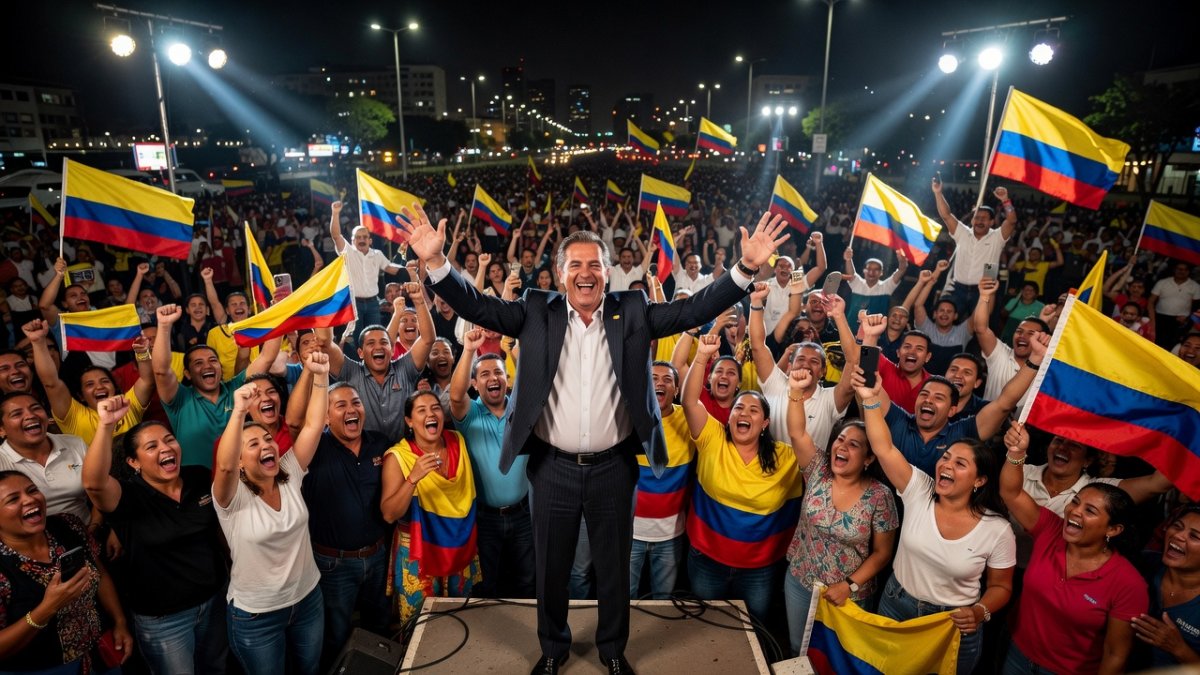
The election result — details of victory
Abelardo de la Espriella secured 49.7 percent of the vote against Iván Cepeda's 48.70 percent in the June 21, 2026 presidential runoff, a margin of less than one percentage point that marks the closest contest in Colombia's modern history. The Registraduría Nacional tallied 12.9 million votes for de la Espriella and 12.6 million for Cepeda, confirming the outcome after the first round on May 31 when de la Espriella received 43.7 percent and Cepeda 40.9 percent.
These numbers reflect deep polarization between right and left that has split families in the comunas of Medellín and rural communities around Cali. In Barranquilla's working-class neighborhoods, small business owners who rely on steady oil-sector jobs watched the results come in with mixed hope and concern over promised policy shifts.
The narrow victory replaces Gustavo Petro, Colombia's first left-wing president who served from 2022 to 2026 and was constitutionally barred from seeking re-election. De la Espriella, backed publicly by Donald Trump, now prepares to take office in August 2026 as the candidate who positioned himself as an anti-establishment savior.
This outcome directly affects displaced persons and campesinos in the departments of Cauca and Nariño, where previous peace initiatives had offered limited land restitution. The less-than-one-percent margin means every recount decision by the Registraduría Nacional carries immediate weight for Afro-Colombian communities in Cartagena who depend on stable local governance.
Who is Abelardo de la Espriella? — background
Abelardo de la Espriella, a 47-year-old lawyer and businessman with no prior elected office, earned the nickname "El Tigre" during the campaign for his aggressive rhetoric on security. He built his profile through private-sector work in Bogotá and Medellín before entering politics as a far-right populist challenger to the Petro-aligned left.
His lack of government experience stands in contrast to Iván Cepeda, the left-wing senator who carried Petro's endorsement and focused on continuing social programs in Barranquilla and Cali. De la Espriella's self-description as an anti-establishment savior resonated with voters frustrated by slow implementation of earlier reforms in rural areas.
Trump's public backing added international visibility, linking the campaign to broader hemispheric debates on trade and security that also involve Mexico through the Pacific Alliance. Colombian voters in Cartagena's port economy saw this alignment as a potential signal for stronger ties with U.S. energy markets.
Indigenous groups in the Sierra Nevada de Santa Marta region followed the candidate's rise closely, noting his business background offered little direct record on territorial rights. The 47-year-old's rapid ascent from private life to national frontrunner underscores how polarization has reshaped candidate selection across Colombia's major cities.

What his presidency means for Colombia — policy platform
De la Espriella has pledged an "iron fist" crackdown on crime and an immediate end to peace talks with armed groups including the Ejército de Liberación Nacional (ELN) and FARC dissidents. These commitments target urban violence in Medellín's comunas and extortion rackets affecting small farmers near Cali.
The candidate also promises to boost the oil and gas sector, a move expected to create jobs in Barranquilla's industrial corridor while raising environmental concerns among communities in the Magdalena River basin. Families in rural Nariño worry that halting negotiations could prolong displacement that has already uprooted thousands of campesinos.
Teachers and students in Bogotá's public universities anticipate shifts in education funding priorities once de la Espriella assumes office in August 2026. The policy platform's emphasis on security over dialogue mirrors earlier hard-line approaches that produced mixed results in Cartagena's tourism-dependent neighborhoods.
Afro-Colombian leaders in Buenaventura have voiced specific concerns that reduced engagement with armed groups could increase recruitment pressures on youth in port areas. The platform's concrete focus on energy expansion directly ties to Mexico-Colombia trade flows through the Pacific Alliance, where stable production matters for both nations' export strategies.
Impact on Latin America and Mexico — regional implications
Colombia ranks as Mexico's third-largest trading partner in Latin America, with strong links through the Pacific Alliance that facilitate goods movement between Cartagena and Mexican ports. De la Espriella's victory aligns with rightward shifts in several countries, altering dynamics within CELAC and the OAS on issues from migration to energy cooperation.
Both nations confront organized crime and drug trafficking, challenges that now face a Colombian administration promising stricter enforcement. Migrant workers crossing the Darién region may encounter changed Colombian policies that affect transit routes toward Mexico's southern border under USMCA/T-MEC frameworks.
The election result influences relations with Brazil and Venezuela, where Colombian positions on regional forums such as UNASUR could harden. Small business owners in Medellín who export textiles to Mexico watch for any adjustments in tariff preferences that might follow the August 2026 transition.
Indigenous and rural communities across the Andean region see the outcome as a test of whether security-focused governance can reduce violence without repeating past cycles of displacement. Mexico's own security cooperation with Colombia may evolve under the new leadership, particularly on joint operations targeting transnational networks operating between Barranquilla and Veracruz.
Reactions and protests — political fallout
Protests erupted in Bogotá and other cities immediately after the Registraduría Nacional's announcement, with demonstrators in Medellín's comunas and Cali's central plazas voicing opposition to the narrow result. Students and teachers organized marches that highlighted fears over halted social programs initiated under Petro.
In Barranquilla, small business owners aligned with Cepeda expressed concern that the "iron fist" approach could disrupt local economies tied to tourism and trade. Afro-Colombian groups in Cartagena held vigils emphasizing the need to protect community land rights during the transition period.
The polarization that produced the less-than-one-percent margin has left families divided in rural areas around the country, where support for continuing peace talks with the ELN remains strong. De la Espriella's Trump endorsement added an external dimension that some protesters in Bogotá framed as outside interference in Colombian sovereignty.
Displaced persons' organizations in Cali called for continued attention to restitution programs, warning that policy reversals could stall progress achieved between 2022 and 2026. The protests underscore how the election has mobilized both urban and rural populations ahead of the August 2026 inauguration.
What to watch for — transition and challenges ahead
De la Espriella will take office in August 2026 facing immediate tests on security coordination with the Colombian military and police in Medellín and Cali. Observers will monitor whether the promised end to ELN talks produces measurable reductions in extortion affecting campesino communities.
Trade relations with Mexico through the Pacific Alliance will require attention, especially regarding energy exports from Barranquilla that support joint supply chains. The Registraduría Nacional's final certification process continues to draw scrutiny from both camps in the capital.
Indigenous leaders in the Sierra Nevada and Afro-Colombian representatives in Cartagena plan to engage the incoming administration on territorial protections. Regional forums including the OAS will test Colombia's new stance on Venezuela and Brazil, with implications for broader Latin American migration management.
Students and teachers in Bogotá universities await signals on education budgets, while rural families in Nariño track any changes to land programs. The narrow victory leaves little margin for error as de la Espriella assembles his cabinet before the August 2026 handover. By Rosa Martinez, Staff Writer
This article was produced with AI-assisted research and editorial support. Reporting is based on sources cited in the article.
What's Your Reaction?
 Like
0
Like
0
 Dislike
0
Dislike
0
 Love
0
Love
0
 Funny
0
Funny
0
 Wow
0
Wow
0
 Sad
0
Sad
0
 Angry
0
Angry
0

Latin America/Andes Correspondent at Global1.News. Based in Bogota, covering politics, environment, energy, and social movements across the Andean region. Passionate about environmental journalism and communities protecting their land.













Comments (0)