
They Are Breaking: Inside the USS Abraham Lincoln's Nine-Month Deployment Crisis
Nearly nine months at sea with dwindling food, contaminated water, and no port calls: the USS Abraham Lincoln's crew is at a breaking point, with sailors reportedly going overboard and lawmakers demanding a Pentagon probe into the crisis.
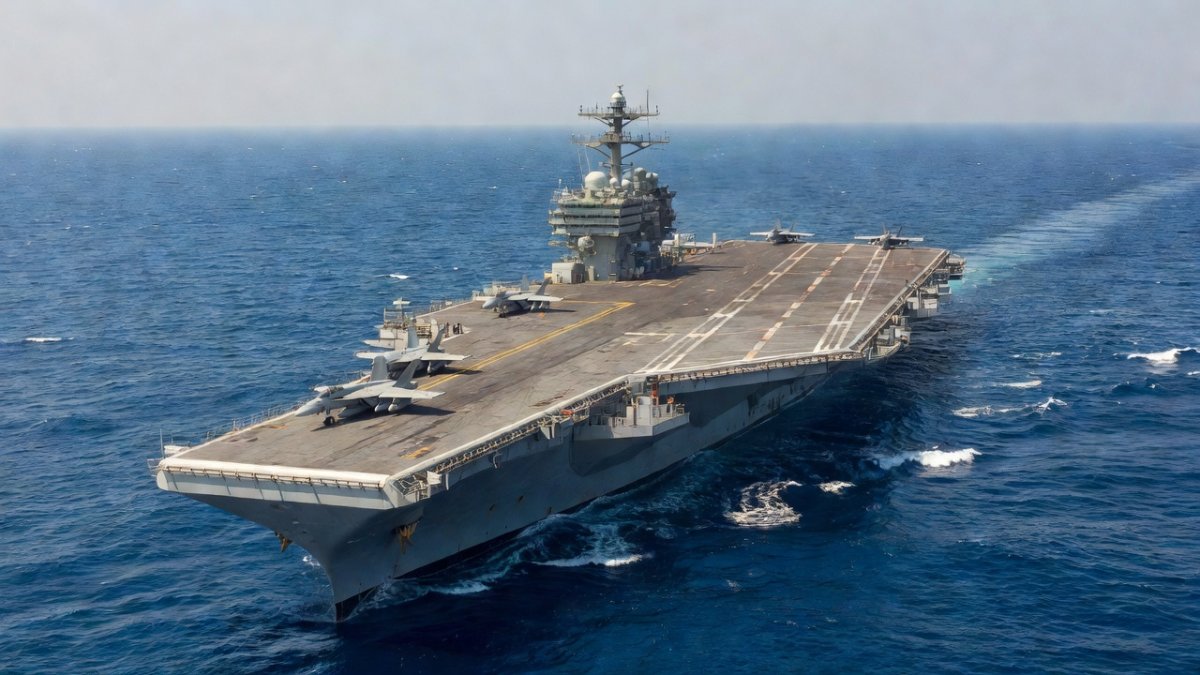
Good evening, folks. I’m Jessica Ali, and I need you to sit down for this one. We are looking at a story that has been simmering in the dark waters of the Arabian Sea for months, and it has finally boiled over. The USS Abraham Lincoln—a floating city of nearly 5,000 souls—has been on station for almost nine months. Nine months without a real port. Nine months of dwindling food, contaminated water, and broken toilets. And now, we are hearing reports of sailors trying to swim away from the ship. Not to defect. Not on a mission. Just to escape. Tonight, we are cutting through the Pentagon’s spin and the White House’s bravado to talk about the human beings on that hull.
EXCLUSIVE: "They Are Breaking" — Inside the USS Abraham Lincoln’s Nine-Month Deployment Crisis as Sailors Attempt Overboard Escape and Families Plead for Help
Washington, D.C. - Article continues below. The crisis aboard the USS Abraham Lincoln is not a rumor, and it is not a blip on the radar. It is a systemic failure of leadership and logistics that has pushed American sailors to the brink of survival. While the Commander-in-Chief says the deployment is "not nearly long enough," the men and women on that ship are running out of time.
The Longest Nine Months
Let’s put this in perspective, folks. The USS Abraham Lincoln (CVN-72) left San Diego on November 21, 2025. As of mid-August 2026, that is roughly 260 days at sea. For the vast majority of the approximately 5,000 sailors and Marines aboard, the last time they felt solid ground under their feet was December 11, 2025, during a port call in Guam. That is eight months ago. Eight months of nothing but steel, saltwater, and the same faces.
This isn’t a routine patrol. This is a war deployment. The Lincoln has been operating in the Arabian Sea and Red Sea region under CENTCOM, directly tied to the ongoing military campaign with Iran. These sailors are not just floating around; they are conducting combat operations in one of the most volatile regions on Earth, all while their own ship is falling apart around them.
Repeated extensions without port calls are the silent killer of morale, even for the most seasoned sailors. The psychological contract of a deployment is built on a predictable timeline; when that timeline is broken—first by 30 days, then 60, then 90—the sense of purpose erodes into a fog of fatigue and isolation. Port calls are not luxuries; they are operational necessities that allow crews to decompress, re-provision, and perform critical maintenance that cannot be done at sea. Without them, the ship becomes a pressure cooker of unresolved grievances, sleep deprivation, and the gnawing knowledge that family milestones—birthdays, anniversaries, first steps—are being missed indefinitely. The Lincoln’s crew has endured this longer than any carrier crew in recent memory, and the cumulative effect is a slow-burn degradation of vigilance. In a combat zone, that is not just a morale problem; it is a readiness risk that commanders must weigh against the strategic imperative of maintaining a persistent carrier presence in a region where the Iran campaign shows no sign of abating.
Broken Toilets and Bad Water
We have to talk about the basics. The things we take for granted. According to verified reports from sailors, families, and military officials, the quality of life on the Lincoln has collapsed. We are hearing about food shortages—rations being stretched thin to the point of monotony and scarcity. We are hearing about water contamination. Think about that. You are in the middle of the ocean, surrounded by water you cannot drink, and the water they are giving you is making you sick.
And then there are the plumbing failures. Broken toilets. On a ship of 5,000 people. In 100-degree heat. This isn't just an inconvenience; it is a public health hazard and a profound morale killer. When you cannot perform basic human functions in a sanitary way, when you are hungry and thirsty and tired, your body starts to break down. And so does your mind.
The Human Cost: "They Tried to Go Overboard"
This is the part that should make every American angry. Multiple sailors reportedly tried to go overboard. Let me repeat that. Sailors are trying to throw themselves into the ocean to get off this ship. At least one sailor went overboard earlier this month—in August 2026—and had to be physically rescued. Three US officials have confirmed this to CNN.
We are not talking about a disciplinary issue. We are talking about a mental health crisis of catastrophic proportions. Reports of suicide attempts are flooding in. Families back home are sounding the alarm, telling anyone who will listen that their loved ones are not okay. They are begging for intervention. They are begging for someone to bring their children home before it is too late.
Imagine getting a phone call from your spouse or your child, and hearing the despair in their voice. Imagine knowing they are trapped on a ship with no way out, and the leadership in Washington is telling you it’s all in their heads.
The Political Spin vs. The Reality
Let’s talk about the pushback, because it is infuriating. Defense Secretary Pete Hegseth appeared on Newsmax and spoke to reporters during a visit to Panama. His message? The accounts are exaggerated. He denied reports of sailors jumping overboard. He claimed the sailors "have everything we can provide."
With all due respect, Mr. Secretary, you are wrong. And the CENTCOM commander is singing from the same hymn sheet, touting the Lincoln's "mental health record" and claiming that leadership made "mental health and crew resilience" a priority. If this is their idea of a priority, I would hate to see what neglect looks like.
Then you have President Trump, who reportedly said the deployment was "not nearly long enough." Not nearly long enough? For a crew that is trying to swim home? For a crew that is experiencing a mental health emergency? That is not leadership; that is a disconnect from reality so profound it borders on negligence.
Lawmakers Demand Answers
Thankfully, not everyone in Washington is wearing blinders. Representative Ruben Gallego (D-AZ) is calling for a bipartisan Congressional Delegation (CODEL) to visit the USS Abraham Lincoln immediately. His words: "CODELs have visited war zones to inspect the conditions of our troops." He is right. If you can send lawmakers to Baghdad, you can send them to the Arabian Sea.
Two Democratic senators, including Senator Richard Blumenthal, are demanding answers from the Pentagon. They are asking the tough questions: How did this happen? Who is accountable? And what are you going to do to fix it right now? Democrats have formally called for a probe into Navy readiness, and they are questioning whether the fleet is stretched too thin to function.
But here is the frustrating part, folks. The response is split along party lines. Republicans are largely silent. They are not responding to the reports. They are not demanding oversight. They are hoping this blows over. But this isn't a political football. These are American lives. And silence is complicity.
The Cavalry is Coming (But It’s Not Enough)
There is some movement. The USS George Washington, the Navy's only permanently forward-deployed carrier based in Japan, has been diverted from the Pacific. After a visit to Da Nang, Vietnam, it is now heading to the Middle East to relieve the Lincoln. It entered the Singapore Strait around August 13. That is good news—it means the Lincoln might finally get to go home.
But let’s be clear: This is a band-aid on a bullet wound. The George Washington is being pulled from its duties in the Pacific to cover for a crisis that should never have been allowed to develop. The Navy is cannibalizing one region to save another. This is a symptom of a larger strategic failure—a military that is overextended, under-resourced, and led by people who seem more concerned with optics than with the welfare of their troops.
Long-term readiness is the hidden casualty of this shuffle. When a carrier is yanked from its homeport rotation, its crew loses the predictable cycle of workups, deployment, and post-deployment stand-down that builds and sustains proficiency. The Washington’s sailors will now face an extended deployment with no clear end date, while the Lincoln’s crew—already exhausted—will be sent home to a maintenance period that is likely to be rushed. The Navy’s maintenance backlog, already measured in years, will only grow as ships are kept at sea longer and returned with more wear and tear. Moreover, the signal to allies and adversaries is unmistakable: the US Navy is no longer able to guarantee a carrier on station in every region where it has commitments. This is not a temporary strain but a structural problem born of decades of underfunding and an overreliance on a shrinking number of hulls. The Washington’s diversion may win the battle in the Red Sea, but it risks losing the strategic war of presence and deterrence in the Pacific, where the long-term competition with China is ultimately decided.
What You Can Do Right Now
Folks, I don’t usually end these broadcasts with a call to action, but I am doing it tonight. You are not powerless in this. You have a voice, and you have representatives who work for you. If you are watching this and you are angry—and you should be—pick up the phone.
Call your Member of Congress. Call your Senators. Demand that they support Representative Gallego’s call for a CODEL to visit the Lincoln. Demand that they co-sign Senator Blumenthal’s letter to the Pentagon. Ask them directly: "What are you doing to bring the USS Abraham Lincoln home?"
And if you are a family member of someone on that ship, do not stop screaming. Do not let them silence you. Your voice is the only thing cutting through the noise right now. You are the reason this story is being told. You are the reason we are paying attention.
To the sailors on the Lincoln: We see you. We hear you. You have not been forgotten. Hold on. Help is on the way. And to the leadership in the Pentagon: History will judge you harshly for this. The only question is whether you will act before it is too late.
This is Jessica Ali, Global 1 News, Atlanta. We will stay on this story. We will keep fighting for you. Because that is what we do.
By Jessica Ali, Lead Anchor and Reporter, Global 1 News.
This article was reported with the assistance of AI for drafting and formatting purposes. All facts have been verified by Global 1 News editorial staff against the provided sources.
This article was produced with AI-assisted research and editorial support. Reporting is based on sources cited in the article.
What's Your Reaction?
 Like
0
Like
0
 Dislike
0
Dislike
0
 Love
0
Love
0
 Funny
0
Funny
0
 Wow
0
Wow
0
 Sad
0
Sad
0
 Angry
0
Angry
0

Editor-in-Chief at Global1.News. Atlanta-based journalist who cuts through the BS and tells it like it is. Lead anchor, host, and the voice you hear when the spin stops and the truth starts.















Comments (0)