
India’s wildest Diwali? Why two groups pelt stones at each other a day after festival in Himachal: Know about tradition
In the foothills of Himachal Pradesh, the Diwali celebrations that sparkle with lamps and fireworks take a starkly different turn. According to the Shimla district administration’s website, the site where the fair is held once witnessed human sacrifices offered to Goddess Kali.
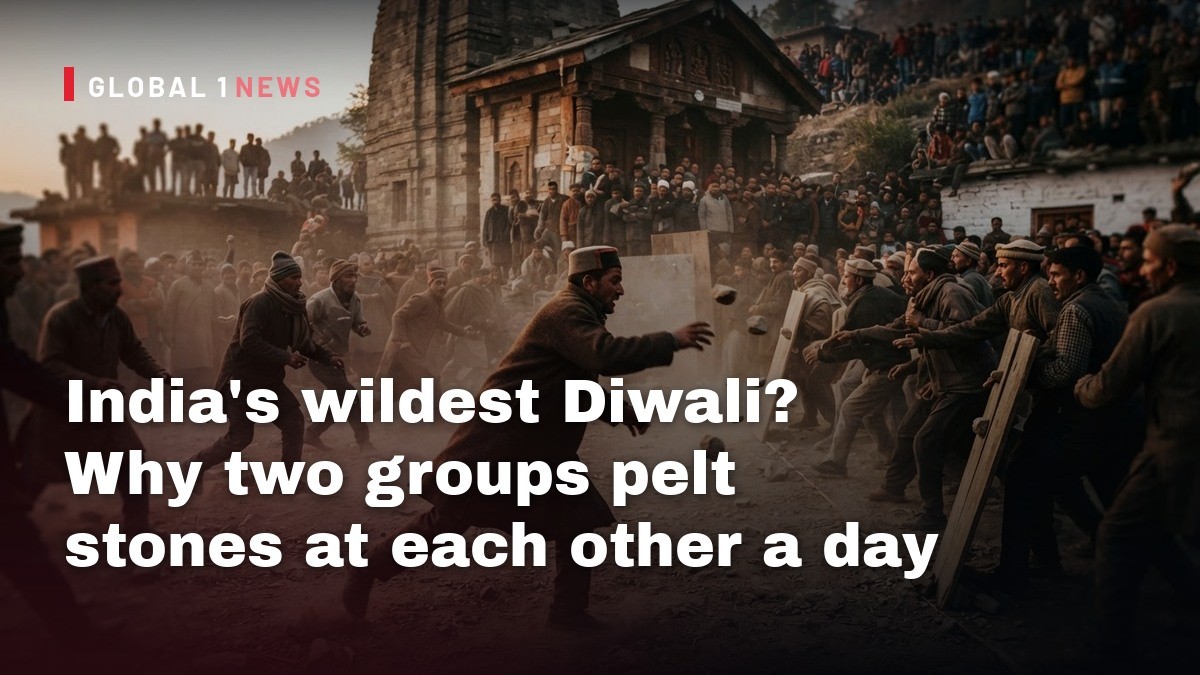
In the foothills of Himachal Pradesh, the Diwali celebrations that sparkle with lamps and fireworks take a starkly different turn. In the village of Halog, near Shimla, the annual Pathar Mela – literally a stone‑fair – pits two community groups against each other in a stone‑pelting contest that only ends when a participant is wounded and his blood is offered as a tilak to Goddess Bhadrakali. The ritual, now described as a centuries‑old tradition, is rooted in local folklore that it replaced an earlier practice of human sacrifice by the erstwhile princely state of Dhami.
Historical roots and the legend of the queen
The Pathar Mela is said to be between 300 and 400 years old, linked to the former Dhami princely state and its royal family. According to the Shimla district administration’s website, the site where the fair is held once witnessed human sacrifices offered to Goddess Kali. Local legend tells that a Dhami queen, wishing to end these sacrifices, introduced the stone‑throwing contest as a symbolic substitute. The blood drawn from an injured participant would then be presented to the goddess, thereby preserving the ritual’s sacrificial element without taking a life.
While the story of the queen provides a compelling narrative, the article notes that it rests on folklore rather than independently verified historical evidence. Nonetheless, the legend continues to shape the community’s perception of the event, framing it as a compassionate evolution from bloodshed to a ritualised, albeit painful, tradition.
Structure of the contest and the groups involved
The contest divides participants into two opposing factions: the Jamogi and the Katedu. The Katedu side is associated with the Dhami royal lineage and draws members from villages such as Tundu, Dhagoi and Bathmana. The Jamogi side comprises residents of Jamogi, Janiya, Plania, Kothi, Chaiyan and Okhru. Both groups line up on opposite sides of a designated ground after a series of prayers and worship at the Narasimha Maharaj temple and other local shrines.
Once the stone‑pelting begins, the contest typically lasts around twenty‑five minutes. The event concludes only when a participant is injured, the blood is collected, and a ceremonial tilak is applied to the idol of Goddess Bhadrakali. In the most recent iteration, Mahesh Verma of the Jamogi group sustained a cheek wound, ending the contest and prompting the tilak ceremony.
Medical response and safety concerns
Medical care is an integral, though reactive, component of the mela. After Mahesh Verma’s injury, he received primary medical treatment on site. The article references a 2014 incident in which more than a dozen participants were injured, including one serious case, prompting the district administration to implement measures aimed at preventing major mishaps. Despite these precautions, the ritual’s inherent risk of injury continues to raise safety concerns among health officials and human‑rights observers.
Participants themselves often downplay the danger. A 2025 interview quoted an injured participant, Subhash, who said the mela is “a symbol of our faith and we don’t care if we have to shed our blood to carry the forward tradition.” This stance underscores a cultural acceptance of risk that complicates policy responses, especially in a country where public health frameworks increasingly prioritise preventive care and injury‑avoidance.
Social and cultural significance for the community
Beyond its religious dimension, the Pathar Mela functions as a social gathering that draws thousands from neighboring villages and across Shimla district. The event provides a rare occasion for inter‑village interaction, traditional music, drums, dancing and communal celebration after the stone‑throwing ends. For many locals, the mela is a living link to their ancestry, a way to preserve a practice passed down through generations.
The ritual’s continuation reflects broader patterns in rural India where festivals serve as both cultural anchors and platforms for community cohesion. In regions with limited access to modern entertainment infrastructure, such fairs become focal points for collective identity, reinforcing local customs even when they clash with contemporary safety norms.
Legal and policy context
Indian law does not specifically address stone‑pelting rituals, but broader statutes concerning public safety, bodily harm and the prohibition of human sacrifice apply. The 2014 injuries prompted the Shimla district administration to make “arrangements to prevent any major mishap,” indicating an administrative acknowledgement of the event’s risk profile. However, the article does not detail any formal regulatory framework governing the mela, nor does it mention any legal challenges or court interventions.
From a policy perspective, the mela raises questions about the balance between cultural preservation and the state’s duty to protect citizens. The Indian Constitution guarantees freedom of religion, yet the state also has a responsibility to intervene when practices pose a clear health hazard. The lack of explicit legal guidance on such rituals suggests a policy gap that could be addressed through targeted guidelines from the Ministry of Culture in coordination with health authorities.
Public health implications and the role of medical infrastructure
The recurring injuries at the Pathar Mela highlight the need for robust medical preparedness at rural festivals. Primary treatment on site, as provided to Mahesh Verma, is a minimal safeguard. A more comprehensive approach would involve pre‑event medical camps, on‑site trauma kits, and rapid evacuation protocols, aligning with national standards for event safety under the Ministry of Health and Family Welfare.
Moreover, the ritual’s reliance on blood as a religious offering intersects with public health concerns about blood safety and infection control. While the article does not mention any screening or sterilisation measures, the use of fresh blood in a religious context could pose risks of transmissible infections, especially in remote settings where medical oversight is limited. Integrating health education into the mela’s preparatory meetings could mitigate such risks without undermining the ritual’s symbolic intent.
Future trajectories: preservation versus reform
As India modernises, traditions like the Pathar Mela sit at a crossroads. On one hand, the ritual is a cherished expression of local heritage, reinforced by community narratives that link it to a humane departure from human sacrifice. On the other, the safety concerns, medical risks, and potential legal ambiguities create pressure for reform.
Possible pathways include a negotiated modification of the contest—such as replacing stones with softer projectiles or instituting a timed limit that does not rely on injury to conclude. Such adaptations could preserve the symbolic act of offering blood while reducing physical harm. Engaging local leaders, the Dhami royal family’s descendants, and health officials in a dialogue could yield a culturally sensitive compromise, aligning the mela with contemporary public‑health standards without erasing its historical essence.
This article was produced with AI-assisted research and editorial support. Reporting is based on the source material cited below. Sources: Livemint; livemint.com; Global1.News (10 November 2026).
By Dr. Raj Patel, Staff Writer
What's Your Reaction?
 Like
0
 Dislike
0
 Love
0
 Funny
0
 Wow
0
 Sad
0
 Angry
0

India/South Asia Correspondent at Global1.News. Analytical voice with a background in science and health journalism. Based in New Delhi, covering Indian politics, education, healthcare, technology, and policy. Breaks down complex data into clear, actionable reporting.












Comments (0)