
University of Haifa Faces NIS 58 Million Annual Deficit, Forced Layoffs and Potential Merger on the Horizon
The University of Haifa is staring down a structural financial crisis that will force the institution to shed hundreds of staff and lecturer positions, implement tens of millions of shekels in annual cuts, and explore a potential merger with an engineering-focused institution, according to a financial efficiency plan approved by the Council for Higher Education's Planning and Budgeting Committee.
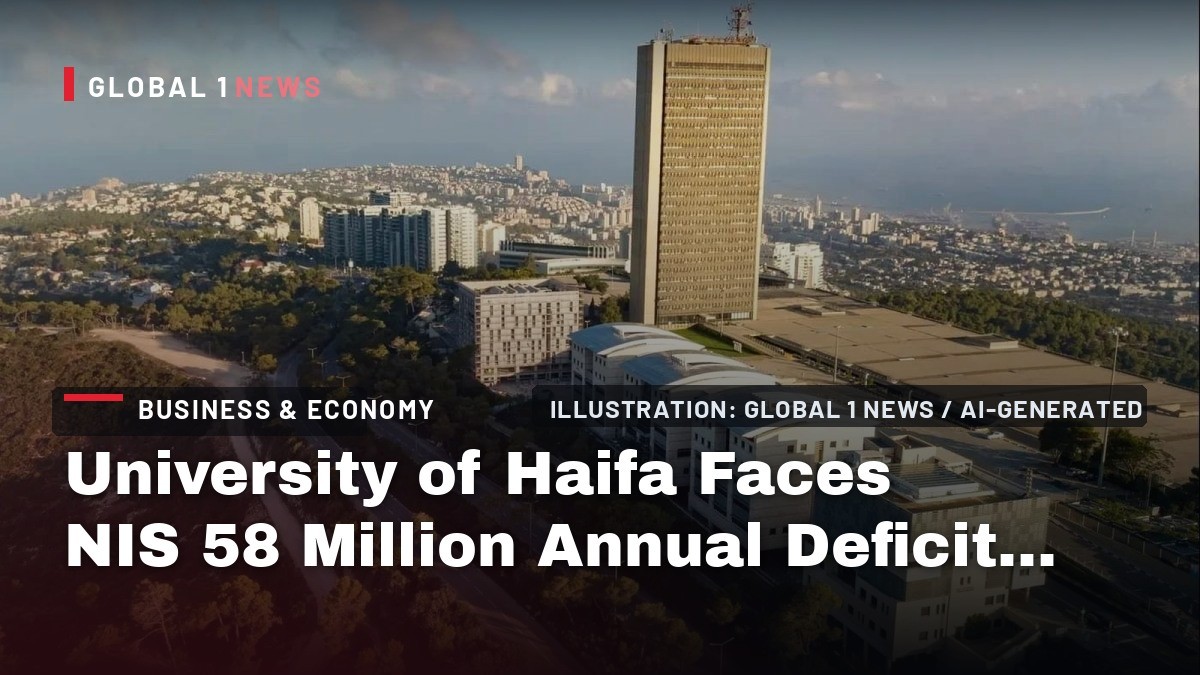
The University of Haifa is staring down a structural financial crisis that will force the institution to shed hundreds of staff and lecturer positions, implement tens of millions of shekels in annual cuts, and explore a potential merger with an engineering-focused institution, according to a financial efficiency plan approved by the Council for Higher Education's Planning and Budgeting Committee. The plan, which covers the 2026-2030 period, comes as the university grapples with combined annual financial pressure of roughly NIS 58 million, driven by the end of its dedicated pension fund and changes to the research funding model. The approval signals deep concerns about the long-term viability of Israel's northernmost research university.
The Scope of the Crisis: Hundreds of Jobs on the Line
The efficiency plan, approved by the Planning and Budgeting Committee's plenum in recent days following discussions held about a month prior, requires the University of Haifa to implement sweeping cuts across its operations. Hundreds of staff members and lecturers are expected to lose their jobs or have their positions reduced as the university aligns its workforce with its diminished financial reality. The plan's targets are steep and immediate: savings of NIS 24 million in the 2026-2027 academic year, rising to NIS 42 million in 2027-2028, NIS 48 million in 2028-2029, and NIS 46 million in 2029-2030 and in a steady state, all measured against the 2025-2026 baseline year. These figures represent a dramatic recalibration for an institution that has long positioned itself as a bridge between Israeli academia and the diverse communities of the north, from the Carmel ridge overlooking Haifa Bay to the broader Galilee region. The cuts will inevitably ripple through the university's academic programs, research output, and its role as an economic anchor for the Haifa metropolitan area.The Pension Burden: A NIS 42 Million Weight
At the heart of the university's financial deterioration lies the burden of budgetary pensions, a challenge familiar to many Israeli public institutions but one that has hit the University of Haifa with particular force. According to the Planning and Budgeting Committee document, the end of the dedicated fund used for pension payments, alongside ongoing expenditure growth, is expected to weigh down the institution's budget by approximately NIS 42 million. This is not a short-term cash flow issue but a structural problem: as veteran faculty and administrative staff retire, the university must continue paying their pensions from its operating budget, with the dedicated fund that once cushioned these payments now depleted. The pension challenge reflects a broader demographic reality across Israeli higher education. Many universities established in the 1960s and 1970s, including Haifa, are now facing a wave of retirements from their founding generations of faculty. Unlike newer institutions with younger workforces, these veteran universities carry the accumulated pension obligations of decades of employment, creating a fiscal drag that is difficult to escape without either dramatic revenue growth or painful workforce reductions.Research Funding Model Changes: An Additional NIS 16 Million Hit
The second major factor driving the deficit is the change in the research funding model. The reduction in the safety net following the update to the research model is expected to subtract an additional NIS 16 million from the university, following efficiency measures estimated at approximately NIS 4 million. The new funding model, which the Planning and Budgeting Committee has been rolling out across Israeli universities, ties institutional support more closely to research outputs and external grant acquisition. For a university like Haifa, which has historically received a safety net to compensate for its relatively smaller research base compared to institutions like the Hebrew University of Jerusalem or the Technion, this shift represents a significant loss of guaranteed funding. The university will be required to align its research outputs with the new funding model, a process that will likely accelerate the concentration of research activity among the most productive faculty members while potentially reducing support for smaller or emerging research groups. This alignment is not merely an administrative exercise; it will shape hiring decisions, laboratory investments, and the very character of academic life on Mount Carmel.The Planning and Budgeting Committee's Enforcement Powers
The Planning and Budgeting Committee has not limited itself to setting savings targets. The plan includes a series of potential enforcement measures designed to ensure compliance. If the University of Haifa fails to present a balanced budget each year, the committee's professional team can recommend canceling the quota addition approved for the university in August 2025, canceling the safety net adjustment approved in May 2026, and even appointing an accompanying accountant for the institution. Ahead of the 2027-2028 academic year, the committee will examine the implementation of the plan and the balance of the university's budget. If the planned moves have not matured or prove insufficient, additional efficiency steps and other measures will be considered to bring the institution to a permanent budget balance. The university administration will be required to submit a detailed quarterly report to the Planning and Budgeting Committee, including a comparison between actual expenses and income versus forecasts. Two follow-up meetings will be held each year with the participation of the university president, director-general, and chief financial officer. By the 2028-2029 academic year, the committee will examine the option of appointing an external accountant to perform an in-depth review of wage expenses at the university, potentially leading to additional efficiency steps.The Merger Question: Engineering Disciplines in Play
One of the most striking clauses in the plan is the possibility of an academic merger. According to the Planning and Budgeting Committee's decision, as part of the strategic move, the University of Haifa will consider merging with another institution that has engineering disciplines. The document did not specify which institution the merger might occur with or what stage the examination is in. The most obvious engineering-focused institution in the region is the Technion-Israel Institute of Technology, located just down the mountain in Haifa — though a merger between the two would be unprecedented and logistically complex. The merger consideration reflects a broader trend in Israeli higher education toward consolidation and specialization. As the Planning and Budgeting Committee prepares for the next five-year plan, it appears increasingly willing to consider structural solutions to financial problems rather than simply providing additional funding. For the University of Haifa, a merger could offer access to engineering research funding streams and a broader academic portfolio, but it would also raise profound questions about institutional identity, governance, and the preservation of the university's unique character as a hub for social sciences, humanities, and interdisciplinary research.Faculty-Student Ratio Review: Implications for Lecturers
The plan also includes a systemic review of the target ratio between the number of faculty members and students at the university, to be conducted by the Planning and Budgeting Committee's professional team as part of preparations for the next five-year plan. Depending on the results, a recommendation may be made to alter the target set for the institution. This review carries significant implications for hundreds of lecturers who are expected to end their employment as the university adjusts to a leaner faculty structure. The faculty-student ratio is a sensitive metric in Israeli higher education, balancing quality of instruction against financial sustainability. A higher ratio means larger classes and fewer faculty members, which can affect research output and the quality of the student experience. For the University of Haifa, which has prided itself on personalized attention and accessibility for students from the north's diverse communities, a shift toward a less favorable ratio could fundamentally alter its educational model.The University's Response: Growth Amidst Austerity
The University of Haifa has pushed back against the narrative of decline, framing the current period as one of opportunity rather than crisis. In its response, the university stated that it is currently in one of the most significant periods of growth and activity in its history, pointing to accelerated academic development and financial strength in several key areas. The university's administration has emphasized its cooperation with the Planning and Budgeting Committee, and the committee's plenum has welcomed this cooperation and the reaching of agreements, while clarifying that the implementation of the plan and meeting the set milestones will remain under ongoing monitoring. The university's commitment to balancing its budget includes raising new sources, including donations and increasing withdrawals from capital market investment yields. In the 2026-2027 academic year alone, the scope of required additional sources is estimated at approximately NIS 9.7 million. The university also expects to reduce the deficit by approximately NIS 1.8 million in the 2026-2027 academic year by increasing the number of medical students beyond the approved quota, and to withdraw a remaining balance of about NIS 5.5 million from the dedicated fund used in recent years for budgetary pension payments.What This Means for Israeli Higher Education
The University of Haifa's crisis is not an isolated event but a harbinger of challenges facing Israeli higher education as a whole. The combination of pension obligations, changing research funding models, and pressure to increase efficiency is reshaping the financial landscape of universities across the country. The Planning and Budgeting Committee's willingness to impose strict conditions, including potential mergers and external oversight, signals a new era of accountability in which institutions must demonstrate financial sustainability or face structural intervention. For the north of Israel, the stakes are particularly high. The University of Haifa is not just an academic institution; it is a major employer, a driver of regional economic development, and a gateway to higher education for Jewish, Arab, and Druze students from across the Galilee. The layoffs and budget cuts will be felt far beyond the campus on Mount Carmel, affecting families, businesses, and communities throughout the region. As the university navigates this challenging period, the decisions made in the coming years will shape not only its own future but also the broader landscape of Israeli higher education and the social fabric of the north.This article was produced with AI-assisted research and editorial support. Sources: The Jerusalem Post.
By Hannah Berg, Staff Writer
What's Your Reaction?
 Like
0
Like
0
 Dislike
0
Dislike
0
 Love
0
Love
0
 Funny
0
Funny
0
 Wow
0
Wow
0
 Sad
0
Sad
0
 Angry
0
Angry
0

Hannah Berg
Israel Correspondent at Global1.News. Based in Tel Aviv, covering Israeli politics, security, technology, and society. Provides balanced, deeply-sourced reporting on one of the most closely-watched regions in the world.















Comments (0)