
Thailand Deports French National Under New Enforcement Framework
BANGKOK — Thailand has formally ordered the deportation of a French national from the Kingdom, marking the second time the government has invoked its new Interior Ministry regulations to expel a foreigner deemed to be behaving badly.
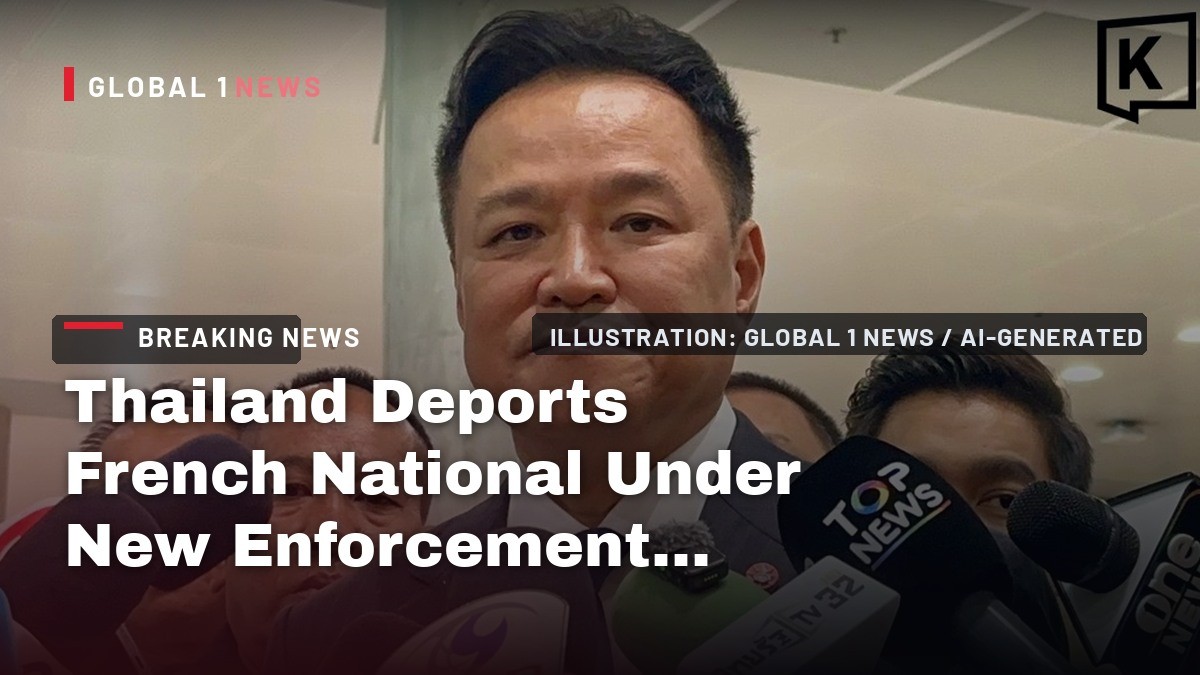
BANGKOK — Thailand has formally ordered the deportation of a French national from the Kingdom, marking the second time the government has invoked its new Interior Ministry regulations to expel a foreigner deemed to be behaving badly. Prime Minister and Interior Minister Anutin Charnvirakul signed the order on Monday, confirming that the law, once on the books, must be carried out without exception.
The move follows the earlier deportation of an Israeli national under the same framework, and it arrives amid a heated and highly publicised dispute on the tourist island of Koh Samui involving foreign visitors and a local zoo operator. For Thai readers watching this story unfold, the case raises important questions about how far the government is willing to go to police foreign conduct, and what it means for the millions of visitors who call Thailand home, even temporarily.
Deportation Order Targets French National in Koh Samui
Interior Ministry Order No. 2355/2026, signed by Anutin on 7 September, orders the deportation of Kevin Dimino, a French national, from the Kingdom. The order makes Dimino the second foreign national to be expelled under the new deportation framework, following the earlier order against Israeli national Yaacov Ohayon.
The signing took place at Parliament, where Anutin spoke to reporters at 11:35 on Monday. When asked about the deportation, the prime minister nodded and said simply, "The law is already in place, so it must be enforced." His tone was matter-of-fact, suggesting that the government views this not as a controversial new step but as the routine application of rules that have already been established.
Dimino is the husband of Jindarat, 35, the owner of Samui Exotic Park, a zoo on the popular island. The couple recently filed a police complaint alleging that a group of Israeli tourists had repeatedly violated the zoo's rules, harassed Jindarat, and threatened to harm her family and burn down her home and zoo. The dispute has drawn significant attention across Thailand, with many following the twists and turns of the allegations on social media and in the press.
Government Cites Threat to Public Order and Safety
According to the deportation order, Dimino's conduct was deemed to pose a serious threat to public order and the well-being of others. The order alleges that Dimino engaged in threatening and intimidating behaviour, physical assault, and conduct causing trouble and annoyance to others. Authorities also accused him of creating divisions among people based on race and religion and causing conflict among tourists.
The order further states that Dimino engaged in reckless behaviour that could endanger other people or their property, without regard for their safety or causing them inconvenience. Such conduct, the authorities said, violated the law and was contrary to public order, good morals, and the well-being of the public.
The legal basis for the deportation rests on Section 5 of the Deportation Act B.E. 2499 (1956), which allows for the removal of foreigners whose presence is deemed contrary to public order, good morals, or the well-being of the public. Anutin exercised his authority under this section, together with Regulation No. 4 of the Prime Minister's Office Regulation on Deportation B.E. 2569 (2026), to order Dimino to leave Thailand.
The order also cites a ruling by the Koh Samui Provincial Court, which found Dimino guilty under Sections 43(4) and 43(8), together with Section 158/1, second paragraph, of the Land Traffic Act B.E. 2522 (1979). The court initially imposed a fine of 10,000 baht, but because Dimino pleaded guilty and his admission was deemed beneficial to the proceedings, the court reduced the punishment by half under Section 78 of the Criminal Code, leaving a fine of 5,000 baht. The court also ordered the confiscation of the seized item.

Samui Exotic Park, the zoo at the centre of the dispute on Koh Samui. (Khaosod English)
The Koh Samui Zoo Dispute That Sparked the Case
To understand how this deportation order came about, one must look at the wider dispute on Koh Samui involving foreign tourists and the local zoo operator. Jindarat, who owns Samui Exotic Park with her husband Dimino, recently filed a police complaint alleging that a group of Israeli tourists had repeatedly violated the zoo's rules and later harassed her, threatened to harm her family, and threatened to burn down her home and zoo.
According to Jindarat, the dispute began when the group allegedly refused to pay admission fees, requested refunds, and behaved in ways she considered dangerous to the animals. She alleged that members of the group had ignored instructions while feeding animals, opened cages, and allowed animals that did not get along to come into contact. She also alleged that a visitor struck a bird after it landed on the person's shoulder, causing the bird to collapse and die.
In response to these incidents, the zoo operator said she eventually displayed a Palestinian flag and refused entry to the group. She said the decision was intended to protect her business and staff rather than to target people based on nationality. The move, however, drew sharp reactions from some quarters, and the dispute escalated further.
Jindarat subsequently alleged that she received messages threatening to harm her family and burn down her home, followed by a more recent threat to burn the zoo. She also said she became concerned after allegedly seeing a vehicle repeatedly parked near and circling her home.
Husband's Actions Under Scrutiny
Jindarat also acknowledged that Dimino had gone to a business operated by the other party after receiving what she described as threatening and provocative messages. She denied allegations that her husband had threatened to prevent Israelis from living on Koh Samui, a claim that would have serious implications if proven.
According to Jindarat, the visit was recorded on video from her husband's departure by car through his arrival, conversation at the location, and return. She said the footage could be provided to authorities and made public to establish what happened. Her family, she said, was prepared to take responsibility for its own actions and provide evidence so authorities and the public could assess the dispute based on facts rather than competing allegations.
This insistence on transparency suggests that the couple believes they have nothing to hide. Whether the authorities agree remains to be seen, but the deportation order indicates that the Interior Ministry has concluded that Dimino's conduct crossed a line that Thailand is no longer willing to tolerate.
Prime Minister Defends Enforcement Framework
Speaking to reporters at Parliament, Anutin defended the government's approach to deporting foreigners who misbehave. When asked whether more foreigners on a watchlist could face deportation, he said anyone whose conduct was considered inappropriate could be removed. "If someone behaves badly, Thailand does not want these people to stay in the country," he said.
The prime minister also addressed a question about whether the first Israeli national deported under the new regulations had filed an appeal. Anutin said the person would have to appeal directly to the prime minister, explaining that the deportation order was signed by the Interior minister, and therefore the appeal must be submitted to the prime minister for consideration. "I have not yet seen the appeal letter," he added.
Reporters also asked Anutin whether he had received a report concerning an Israeli cemetery in Chachoengsao province. The prime minister said he had received information from Deputy Interior Minister Phonphir Suwannachavi and confirmed that there was no such development and that it would not proceed. When asked whether foreign nationals could establish cemeteries on Thai soil, Anutin said he was not certain of the detailed legal requirements but stressed that the feelings of Thai people should also be taken into consideration.
When asked whether problems involving foreigners in Thailand were becoming more widespread again, Anutin rejected the suggestion outright. "It's not widespread. The question is incorrect. The problems have all been resolved," he said.
Appeal Process Offers a Path Forward
Despite the deportation order, Dimino retains the right to appeal. Under Section 8 of the Deportation Act, he may ask for the deportation order to be revoked or request that he not be removed from Thailand. The appeal must be submitted within seven days of being informed of the order.
The appeal must be directed to the prime minister, who signed the deportation order in his capacity as Interior minister. This creates a somewhat unusual situation in which the individual who issued the order is also the person who must consider the appeal. Anutin acknowledged this dynamic when speaking to reporters, noting that he had not yet seen any appeal letter from the first deportee.
For legal observers in Thailand, the seven-day window is short but not unprecedented. The process is designed to move quickly, reflecting the government's desire to resolve such cases without prolonged legal battles. Whether Dimino chooses to appeal remains unclear, but his wife's statements suggest that the family is prepared to fight the allegations with evidence.

Koh Samui, one of Thailand's most tourism-dependent islands. (Global 1 News)
What This Means for Thailand's Tourism Economy and Expat Communities
For Thailand, a country that welcomed tens of millions of tourists each year before the pandemic and has been working hard to rebuild its tourism economy, the deportation of foreign nationals is a delicate matter. On one hand, the government wants to send a clear message that Thailand is not a place where foreigners can behave with impunity. On the other hand, it must be careful not to alienate the very visitors and expatriates who contribute so much to the local economy.
Koh Samui, in particular, relies heavily on tourism. The island's beaches, resorts, and nightlife draw visitors from around the world, and many foreigners have chosen to make it their home. The dispute at Samui Exotic Park has already generated significant attention, and the deportation order is likely to be watched closely by both the expat community and the tourism industry.
The government's position, as articulated by Anutin, is that the problems are not widespread and have been resolved. Whether that assessment holds up in the coming weeks will depend on how the appeal process unfolds and whether any further incidents arise. For now, the message from Bangkok is clear: Thailand expects foreigners to respect its laws and its people, and those who do not will be asked to leave.
By Ann Srisawat, Staff Writer
This article was produced with AI-assisted research and editorial support. Sources: Khaosod English
What's Your Reaction?
 Like
0
Like
0
 Dislike
0
Dislike
0
 Love
0
Love
0
 Funny
0
Funny
0
 Wow
0
Wow
0
 Sad
0
Sad
0
 Angry
0
Angry
0

Southeast Asia Correspondent at Global1.News. Based in Bangkok, covering Thai and Southeast Asian politics, economy, technology, and culture. Deep regional perspective on one of the world's most dynamic regions.













Comments (0)