
Chinese Battery Giants Out-Earn EV Makers as Price War Bites
Seven Chinese battery makers led by CATL earned over 50 billion yuan in H1 2026, up 49%, while 11 EV carmakers' profits fell 19% to 28.8 billion yuan - a supply-chain divide Japan's auto industry is watching closely.
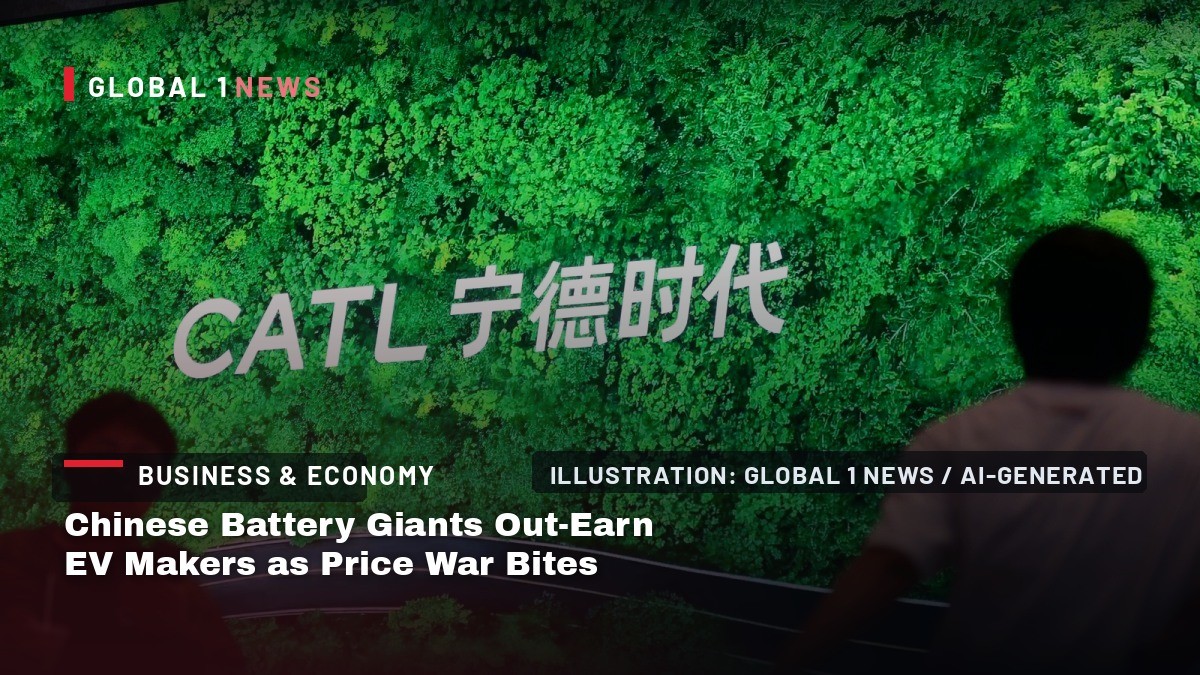
Upstream Wins, Downstream Bleeds: A New Profit Map for China's EV Chain
SHANGHAI - China's electric vehicle supply chain is being redrawn by its own price war. In the first half of 2026, the country's seven largest battery makers earned more than 50 billion yuan (US$7.4 billion) in combined net profit, up 49 per cent year on year, while 11 major EV manufacturers watched their collective interim profit shrink 19 per cent to 28.8 billion yuan, according to company filings compiled by the South China Morning Post.
The gap is no longer marginal. Battery suppliers' combined profit now runs 75 per cent higher than the carmakers' total - a year earlier, the suppliers actually trailed the assemblers by 4.56 per cent. For an industry Beijing spent a decade nurturing into the world's largest EV ecosystem, the divergence raises an uncomfortable question: who really captures the value when domestic EV demand stalls?
Battery Makers Pocket the Upside
The upstream windfall is heavily concentrated in one company. CATL, the Ningde-based giant that supplies roughly four of every ten batteries installed in China, reported first-half net profit up 42 per cent to about 43.3 billion yuan, according to its interim results, and contributed more than 85 per cent of the seven majors' combined profit. Revenue rose nearly 55 per cent to 276.9 billion yuan, with grid-scale energy storage - a business line analysts increasingly link to AI data-centre demand - accounting for close to a fifth of the total.
Behind CATL, the challengers are growing even faster. EVE Energy, CALB Group and Gotion High-Tech all posted three-digit growth in first-half net profit, a pace that outpaced their larger rival, even though their absolute numbers remain small. In July, CATL held a 42.33 per cent share of China's EV battery market, followed by BYD at 19.23 per cent, CALB at 6.95 per cent, Gotion at 6.29 per cent and EVE Energy at 6.05 per cent, data from the China Automotive Battery Innovation Alliance showed.
Why the Price War Hit Carmakers Harder
The squeeze on carmakers is a demand story as much as a pricing one. China's retail EV sales declined about 14 per cent year on year to roughly 4.7 million units in the first half, dragged down by shrinking sales of budget models after Beijing began pulling back purchase-tax exemptions, according to the China Passenger Car Association (CPCA) via the Post. Overall passenger-vehicle retail has fallen even harder, pushing the CPCA to cut its full-year forecast to a decline of around 14 per cent.
"Profits have diverged sharply between upstream and downstream sectors," Cui Dongshu, the CPCA's secretary general, wrote on social media on Friday. "This reflects how price wars are severely squeezing downstream's room to operate, while profits along the supply chain are highly concentrated among leading upstream companies." Industry-wide margins for the first five months of the year fell to roughly 3.4 per cent, Cui has said, as lithium and other input costs climbed even as showroom prices kept falling.
CATL's Dominance and the Counter-Moves It Provokes
High technical barriers and strong export demand have cemented the pricing power of leaders such as CATL, said Yale Zhang, managing director of the consultancy Automotive Foresight in Shanghai. But he cautioned that the imbalance carries risk for suppliers too: Chinese carmakers must pay more attention to battery-pack safety, he said, because "any quality issue would affect their global reputation" and could further weaken the bargaining power of the assemblers that buy from CATL and its peers.
The dominance is already provoking a response. EV makers from BYD to smaller brands are building in-house battery capabilities and deepening ties with tier-two suppliers in search of cheaper alternatives, which analysts say could narrow the profitability gap over time. Meanwhile, the leaders are diversifying outward: CATL has pushed into grid storage, the power sector and even robotics, while rolling out licensing-style arrangements that let overseas carmakers build plants using its technology. "The few big battery makers can probably maintain their position and technological lead," said Lucas Zhang Liutong, director of Hong Kong-based consultancy WaterRock Energy Economics, "so they should continue to have good pricing power."
Exports Become the Escape Valve
With the domestic market shrinking, exports are the industry's pressure-release valve - and the numbers point to an acceleration. Morgan Stanley estimated in an August 24 report that China's EV exports would jump 95 per cent year on year to 4.88 million units in 2026 and rise a further 55 per cent to 7.57 million units in 2027. Robust overseas shipments, analysts say, are what allow battery suppliers to defend pricing even as domestic carmakers bleed.
The export surge is not without friction. European regulators have spent two years probing Chinese EV subsidies, and Beijing itself has urged carmakers to avoid "disruptive competition" and to price overseas sales on the basis of costs and market conditions. How those tensions resolve will help determine whether the profit gap between China's battery leaders and its carmakers is a cyclical quirk or a structural feature.
Japan's Car Industry Feels the Squeeze
The divergence in China is echoing through Japan's auto industry, which is fighting its own electrification battle on thinner margins. For the fiscal year that ended in March, Japan's seven major carmakers reported a collective plunge in profits: Honda swung to a net loss after sharp write-downs on its EV programme, Nissan posted a second consecutive annual loss, and Toyota saw profits eroded by US tariffs, including a 15 per cent duty on Japanese-built cars. Honda has since asked suppliers to cut costs as part of a push to fend off Chinese rivals, Reuters reported on September 2.
Tokyo is also repositioning on batteries. On June 2, the Ministry of Economy, Trade and Industry revised its 2022 "Battery Industry Strategy" into a broader "Battery and Power Industry Strategy," citing structural oversupply, supply-chain risk and surging power-control demand from AI data centres. The update keeps a target of 150 GWh of annual domestic battery manufacturing capacity between 2030 and the mid-2030s, aims to triple Japanese companies' global battery-related sales from 2025 to 2035, and pushes full-scale commercialisation of all-solid-state batteries around 2030. Japanese suppliers such as Panasonic Energy, which is anchoring its strategy on premium cells and North American expansion, now compete against a Chinese industry that controls the cost curve - and increasingly licenses its technology to the very carmakers Japan hopes to supply.
What to Watch For
The near-term direction depends on policy and price. Cui Dongshu has predicted the market will "gradually stabilize in the third quarter and return to a growth trajectory in the fourth," though he has framed that as an optimistic case. Beijing's next round of new-energy vehicle tax-break reductions, scheduled for January 1, 2027, could pull some demand forward late this year - or deepen the wait-and-see mood if consumer confidence stays fragile.
For Tokyo, the stakes are twofold. Japanese automakers still hold commanding share in hybrid-heavy markets, but China's battery champions are exporting into the same Southeast Asian and European showrooms where Japanese brands are strongest, and doing so with batteries that increasingly define the product. Whether Japan's answer is all-solid-state cells, licensing partnerships or a slower hybrid-led transition, the profit map now visible in China - upstream consolidating, downstream squeezed - is a preview of the global contest taking shape.
By Kenji Tanaka, Staff Writer
This article was produced with AI-assisted research and editorial support. Sources: South China Morning Post, China Passenger Car Association, METI, Morgan Stanley, Reuters.
What's Your Reaction?
 Like
0
Like
0
 Dislike
0
Dislike
0
 Love
0
Love
0
 Funny
0
Funny
0
 Wow
0
Wow
0
 Sad
0
Sad
0
 Angry
0
Angry
0
Japan Correspondent at Global1.News. Tokyo-based voice covering Japanese politics, technology, economy, and culture. Tracks the intersection of tradition and innovation in one of the world's most dynamic societies.












Comments (0)