
Tamil Nadu Unveils Rs 651 Crore Healthcare Expansion: 6,098 New Seats, Fivefold Insurance Hike, and a 400-Bed Hospital for Perambalur
The Tamil Nadu government on Wednesday announced a sweeping healthcare and medical education package under Rule 110 of the state assembly’s business rules, committing over Rs 651 crore in new funding to address the state’s—and by extension, India’s—critical shortage of medical professionals and the
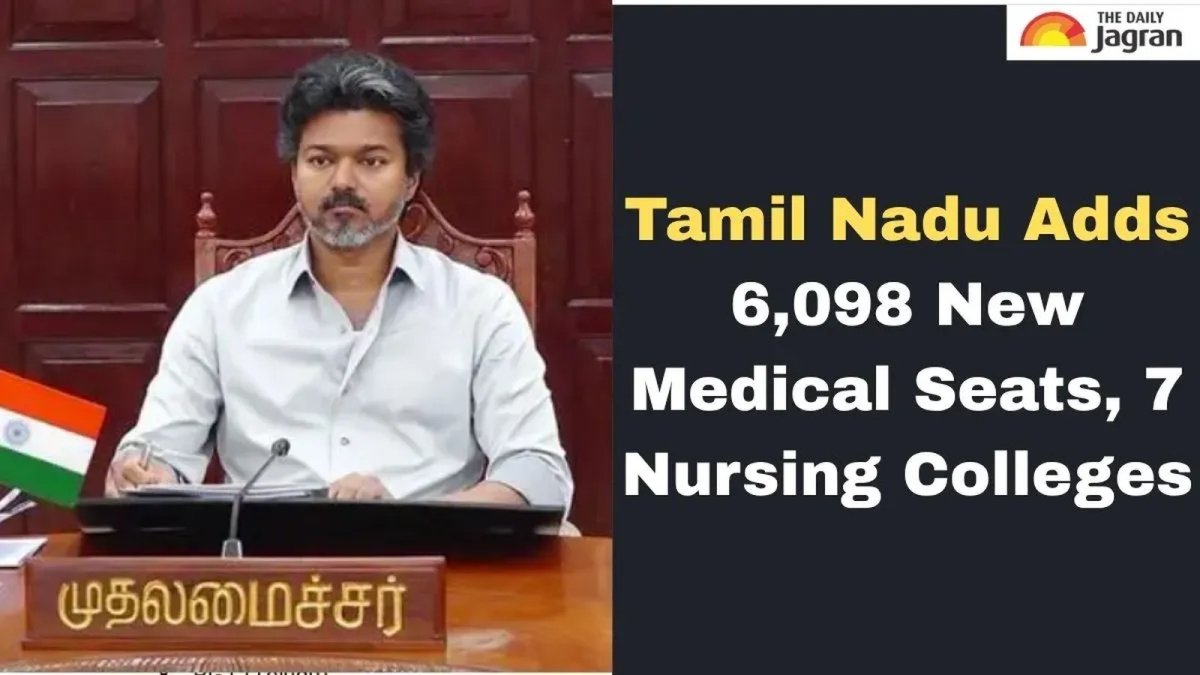
Tamil Nadu’s Rs 651 Crore Bet on Doctors, Nurses, and Universal Health Coverage: A Data-Driven Look at the State’s Largest Medical Workforce Expansion
Chennai, Tamil Nadu – August 19, 2026 — Chief Minister Vijay’s announcement on Wednesday marks a decisive shift in Tamil Nadu’s healthcare strategy, moving beyond incremental budget allocations to a structural overhaul of its medical education pipeline and insurance safety net. The package, revealed in the state assembly, earmarks Rs 351 crore specifically to increase student admission capacity in government medical colleges and allied institutions, creating 6,098 additional seats across medical, nursing, and paramedical courses. Simultaneously, the state has proposed a fivefold increase in the annual treatment limit under its flagship insurance scheme, from Rs 5 lakh to Rs 25 lakh, a move that directly targets the out-of-pocket expenditure that pushes an estimated 55 million Indians into poverty annually, according to National Sample Survey data.

The 6,098-Seat Workforce Blueprint: Beyond MBBS
The seat expansion is the most granular detail of Wednesday’s announcement, and its composition reveals a deliberate, multi-tier workforce strategy. The breakdown is as follows: 735 additional seats in medical courses (MBBS and post-graduate), 660 B.Sc. Nursing seats, 1,925 additional seats in nursing colleges and schools, and 2,778 seats across 12 distinct paramedical courses. This is not merely a bid to produce more doctors; it is an acknowledgment that India’s health crisis is equally a crisis of nurses and allied health professionals.
Data from the NITI Aayog and the Ministry of Health and Family Welfare has repeatedly flagged that India’s nurse-to-population ratio stands at approximately 1.7 per 1,000, against the World Health Organization’s (WHO) recommended benchmark of 3 per 1,000. Tamil Nadu, despite being a relative outlier in public health metrics—with an infant mortality rate of 11 per 1,000 live births compared to the national average of 28—has struggled to fill this gap. The 2,585 new nursing seats (660 B.Sc. plus 1,925 diploma-level) represent a 15-18% increase in the state’s annual nursing output, a critical injection given that Indian hospitals currently face a shortage of over 2.4 million nurses, as per the Indian Nursing Council’s 2023 assessment.
The 2,778 paramedical seats across 12 courses are equally significant. These will train technicians in radiology, operation theatre technology, dialysis, and emergency care—roles that are the backbone of any functional hospital but are often the most understaffed in district-level facilities. For a state that operates one of the densest networks of government medical colleges in the country, this expansion ensures that the physical infrastructure is matched by human capital.
Perambalur’s 400-Bed Hospital: Bridging the Central Tamil Nadu Gap
In a move aimed at geographic equity, the government has sanctioned a 400-bed multi-speciality hospital in Perambalur district at an estimated cost of Rs 300 crore. The state government has described the facility as "world-class," offering advanced treatment that will ostensibly reduce the need for patients from the central Tamil Nadu belt to travel to Chennai or Coimbatore for tertiary care. Perambalur, a district with a population of approximately 5.6 lakh, currently relies on secondary care facilities and referrals to Tiruchirappalli, which is over 60 kilometers away.
This investment is part of a broader pattern of decentralizing super-speciality care. The new hospital is expected to include departments for cardiology, neurology, and oncology—specialties where specialist availability in rural India remains severely constrained. The Rs 300 crore allocation for a single district hospital signals that the state is prioritizing capital expenditure on health infrastructure, a move that aligns with the central government’s Pradhan Mantri Ayushman Bharat Health Infrastructure Mission, though Tamil Nadu has historically preferred to fund such projects through its own state budget to maintain autonomy over service delivery.
Insurance Limit Hike: From Rs 5 Lakh to Rs 25 Lakh
Perhaps the most financially consequential announcement is the proposed increase in the annual treatment limit under the Chief Minister’s Comprehensive Health Insurance Scheme (CMCHIS) from Rs 5 lakh to Rs 25 lakh. This fivefold increase is a direct response to the reality of catastrophic health expenditure in India. According to the National Health Accounts 2021-22, out-of-pocket expenditure still constitutes nearly 47% of total health spending in India, despite the existence of central schemes like Ayushman Bharat. Tamil Nadu’s CMCHIS, which is separate from the central scheme, covers over 1.5 crore families.
The hike to Rs 25 lakh is not merely symbolic. It brings the state scheme’s coverage limit in line with the actual cost of treating complex conditions such as cancer, organ transplants, and severe cardiac procedures in private hospitals, which often charge between Rs 15 lakh and Rs 30 lakh for such treatments. By raising the cap, the state is effectively signaling that it will cover the full cost of tertiary care for its citizens, reducing the need for "top-up" private insurance or distress borrowing. This is a significant fiscal commitment; the state finance department will need to manage the higher claims liability alongside the Rs 351 crore education allocation.

Transgender Healthcare Inclusion: A Targeted Equity Measure
In a notable social equity move, the government has brought additional medical and surgical services for transgender persons under the CMCHIS at seven named facilities: Chennai’s Stanley Medical College Hospital, and government hospitals in Tirunelveli, Thoothukudi, Chengalpattu, Thiruvarur, Karur, and Kanyakumari. This is a targeted intervention addressing a community that faces significant barriers to healthcare access, including discrimination and a lack of trained medical staff for gender-affirming procedures.
The selection of these seven districts is strategic—they represent a geographic spread across the state’s northern, central, and southern belts, ensuring that transgender individuals do not have to travel to Chennai for specialized care. While the government has not specified the exact procedures covered, the inclusion of "surgical services" suggests coverage for gender-affirming surgeries, which remain prohibitively expensive in the private sector. This move places Tamil Nadu at the forefront of states addressing transgender health needs, a policy area where the central government’s Transgender Persons (Protection of Rights) Act, 2019, has been largely silent on healthcare financing.
The Milk Price Conundrum: A Rs 360 Crore Rural Subsidy
While the healthcare announcements dominated the headlines, the government also moved to shore up its rural support base by raising the milk procurement price from Rs 38 to Rs 41 per litre, and increasing the government incentive from Rs 3 to Rs 5 per litre. This benefits more than 3.16 lakh milk producers across the state, at an estimated additional cost of Rs 30 crore per month, or Rs 360 crore per year. The effective price to the farmer rises to Rs 46 per litre, a 12% increase that is intended to offset rising fodder and feed costs.
This is a politically astute move, as dairy cooperatives are a powerful voting bloc in the state’s western and southern districts. However, it also places a direct burden on the state exchequer and on Aavin, the state’s dairy cooperative, which will have to absorb the higher procurement cost without necessarily passing it on to consumers, given the inflationary environment. The Rs 360 crore annual outlay for milk subsidies, when juxtaposed with the Rs 351 crore for medical education, highlights the state’s dual challenge: investing in long-term human capital while managing immediate rural welfare demands.
The Bottom Line
Wednesday’s announcement is a comprehensive, data-driven response to India’s twin healthcare crises: workforce shortage and financial toxicity. The 6,098-seat expansion, the Rs 25 lakh insurance cap, and the Perambalur hospital are not isolated measures but components of a cohesive strategy to make Tamil Nadu a self-reliant healthcare hub. The state is betting that by training its own nurses and paramedics, it can reduce its dependence on private, for-profit institutions that often poach government-trained staff.
For the average Tamil Nadu citizen, the implications are clear: a government hospital bed is becoming more accessible, the financial ceiling for treatment has been raised to a level that covers most catastrophic illnesses, and the state is actively building capacity in underserved districts like Perambalur. The fiscal cost is substantial—over Rs 1,000 crore in combined new commitments—but the potential return, in terms of improved health outcomes and reduced poverty, is far greater. As India grapples with a national doctor-to-population ratio of 1:834 (against a WHO standard of 1:1,000, but with severe rural-urban skew), Tamil Nadu is choosing to lead by example, investing in the entire healthcare value chain rather than just hospital beds.
This article was produced with AI-assisted research and editorial support. Sources: NDTV, ANI, The Statesman, Asianet News, The Daily Jagran.
— By Dr. Raj Patel, Staff WriterWhat's Your Reaction?
 Like
0
Like
0
 Dislike
0
Dislike
0
 Love
0
Love
0
 Funny
0
Funny
0
 Wow
0
Wow
0
 Sad
0
Sad
0
 Angry
0
Angry
0

India/South Asia Correspondent at Global1.News. Analytical voice with a background in science and health journalism. Based in New Delhi, covering Indian politics, education, healthcare, technology, and policy. Breaks down complex data into clear, actionable reporting.















Comments (0)