
Angélique Kidjo makes history for Africa with star on Hollywood Walk of Fame
LOS ANGELES — The Hollywood Walk of Fame has a new address for African music, and it bears the name of a woman from Benin who has spent four decades proving that the continent's rhythms are the heartbeat of global sound.
Angélique Kidjo makes history for Africa with star on Hollywood Walk of Fame
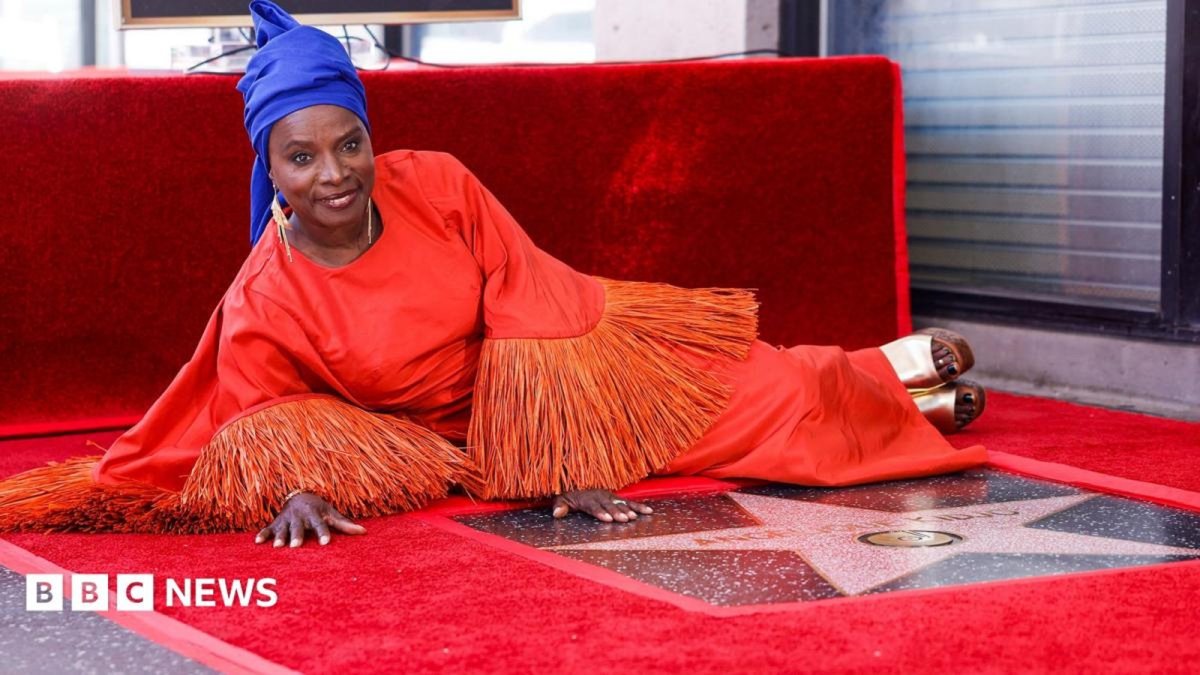
LOS ANGELES — The Hollywood Walk of Fame has a new address for African music, and it bears the name of a woman from Benin who has spent four decades proving that the continent's rhythms are the heartbeat of global sound. Angélique Kidjo, the 66-year-old five-time Grammy winner, was immortalised on Tuesday with her own star, becoming the first African musician to receive the honour.
For a continent that has given the world the blues, jazz, rock, and the very foundations of modern pop, the moment felt less like a personal achievement and more like a long-overdue recognition of Africa's place in the story of music itself. Kidjo, known for her commanding voice and her ability to weave the traditions of her native Benin with funk, jazz, and R&B, made that point with characteristic force at the unveiling ceremony.
"We Africans just don't know what we've given to the world, and what we continue giving to the world for the music to exist," she told the gathered crowd. "Without us, there's no music possible on this planet."
A Star That Speaks to a 'Small Village' Vision
The ceremony was not a quiet, formal affair. It was filled with singing and dancing, a celebration that matched the energy of the woman being honoured. Kidjo was joined by her family, close friends, and a constellation of stars who came to pay tribute, including Hollywood actors Willem Dafoe and Djimon Hounsou — the latter also hailing from Benin — and Nigerian Afrobeats star Adekunle Gold.
As the star was unveiled, Kidjo reflected on what the honour truly meant to her. "The star for me means that my vision of the world as a small village is a reality," she said. "It doesn't matter where we come from, what language we speak, which skin colour we have. We are human. It's one human family."
That vision has guided her career since she left Benin for Paris in 1983, a departure driven by the oppressive atmosphere of the country's then-communist government. "From the moment the communist regime arrived in Benin, I became aware that the freedom we enjoy can be snatched away in a second," she told the BBC in 2023. That awareness has fuelled a body of work that is as politically conscious as it is musically adventurous.
Four Decades of Blending Worlds
Kidjo's catalogue is a map of modern African music's global reach. Over 18 albums, she has taken the sounds of West Africa and fused them with funk, jazz, pop, and R&B, creating a signature style that is unmistakably hers. Her collaborations read like a who's who of contemporary music: Burna Boy, John Legend, Bono, and Alicia Keys have all shared studio time with her. Her latest album, HOPE!!, released earlier this year, features production from Pharrell Williams and collaborations with Ayra Starr, Quavo, Nile Rodgers, and Diane Warren.
The numbers behind her career are staggering. She has been nominated for 17 Grammy awards and has won five. In 2023, she received the Polar Music Prize, one of the most prestigious honours in the music world. Two years earlier, Time magazine named her one of the 100 Most Influential People on the planet.
But for those who know her work best, the statistics only tell part of the story. Willem Dafoe offered a more personal tribute at the ceremony. "She is without a doubt the hardest working woman in showbusiness," he said. "The first time I saw Angélique perform live, I thought her music, her dancing, her commitment were incredible."
The actor, best known for his roles in "Spider-Man" and "Poor Things," compared her energy to that of soul legend James Brown, whom he called the "hardest working man in showbusiness." But Dafoe was quick to note that Kidjo's impact goes beyond performance. "She's not only an incredible performer — she doesn't pop on the mic like I do — songwriter and musician, but also an incredibly kind and giving person and a real deal activist."
More Than Music: A Life of Advocacy
That activism is not a side project; it is central to who Kidjo is. She serves as a goodwill ambassador for both Unicef and Oxfam, and she co-founded the Batonga Foundation, an organisation dedicated to helping vulnerable young girls and women in Benin get access to education. For Kidjo, the star on the Walk of Fame is not just a marker of her own success, but a platform to continue that work.
Harvey Mason Jr, the CEO of the Recording Academy, which oversees the Grammy awards, praised Kidjo's broader impact at the ceremony. "She's connected cultures, she's crossed borders, she's reminded audiences everywhere that while we may come from different backgrounds, her music unites in a way that few other things can," he said.
For African readers, particularly those in Senegal and across West Africa, Kidjo's achievement carries a special resonance. She is not just a star from the continent; she is a woman who has carried the region's musical heritage with her to the world's biggest stages, never forgetting where she came from. Her music has always been a bridge — between Benin and the world, between tradition and innovation, between the village and the global stage.
A Historic Moment for Africa on the Walk of Fame
The Hollywood Walk of Fame now features more than 2,800 stars, but until Tuesday, Africa's representation was limited to just one name: Charlize Theron, the white South African actress. Kidjo's star changes that, adding a distinctly African musical voice to a sidewalk that celebrates the world's entertainment icons.
The significance of that moment was not lost on those who attended the ceremony. For Kidjo, it was a validation of a lifetime of work that has consistently pushed against boundaries — musical, cultural, and political. Her career has been defined by a refusal to be boxed in, a determination to show that African music is not a niche genre but a fundamental part of the world's musical DNA.
Her statement at the ceremony — that without Africans, "there's no music possible on this planet" — is not hyperbole. The rhythms of West Africa travelled across the Atlantic during the transatlantic slave trade and became the foundation of blues, jazz, rock, and eventually hip-hop and Afrobeats. Kidjo's star is a recognition of that lineage, a public acknowledgement of a debt that the global music industry owes to the continent.
A Legacy That Keeps Growing
At 66, Kidjo shows no signs of slowing down. Her latest album, HOPE!!, is a testament to her continued relevance, featuring collaborations with some of the biggest names in contemporary music. She remains a vital voice in conversations about diversity in the music industry, having previously spoken out about the need for the Grammys to better represent African artists.
Her journey from Benin to Paris to Los Angeles is a story of resilience and vision. She left her homeland at a time when artistic freedom was under threat, but she never left behind the music that shaped her. Instead, she brought it with her, sharing it with the world and, in the process, changing the way the world hears Africa.
As the ceremony came to a close, with the singing and dancing that had marked the event, Kidjo's star stood as a permanent reminder of what one woman from Benin could achieve. But for Africans across the continent, it is more than that. It is a symbol of pride, a recognition that the music that has sustained communities for generations is finally getting its due on the world's most famous sidewalk.
The star is now in the ground, but Kidjo's impact continues to rise. For the small village she has always believed the world to be, this honour is a homecoming of sorts — a confirmation that the music of Africa belongs to everyone, and that everyone, finally, is beginning to understand that.
This article was produced with AI-assisted research and editorial support. Sources: BBC Africa.
By Amara Diop, Staff Writer
What's Your Reaction?
 Like
0
Like
0
 Dislike
0
Dislike
0
 Love
0
Love
0
 Funny
0
Funny
0
 Wow
0
Wow
0
 Sad
0
Sad
0
 Angry
0
Angry
0

West Africa/Sahel Correspondent at Global1.News. Dakar-based journalist covering politics, security, climate, and development across Francophone and Anglophone West Africa. Tells the stories of a region undergoing profound transformation.











Comments (0)