
Sudan strike on Chad fuel market kills 12, escalating border war
The Sudanese air force has bombed a fuel market just inside Chad's eastern border, killing at least 12 people and wounding seven more, according to Chadian security officials. The strike, which hit the Adikoun area on Thursday, August 27, marks a dangerous new phase in Sudan's four-year civil war — one that now threatens to pull a neighboring state directly into the conflict.
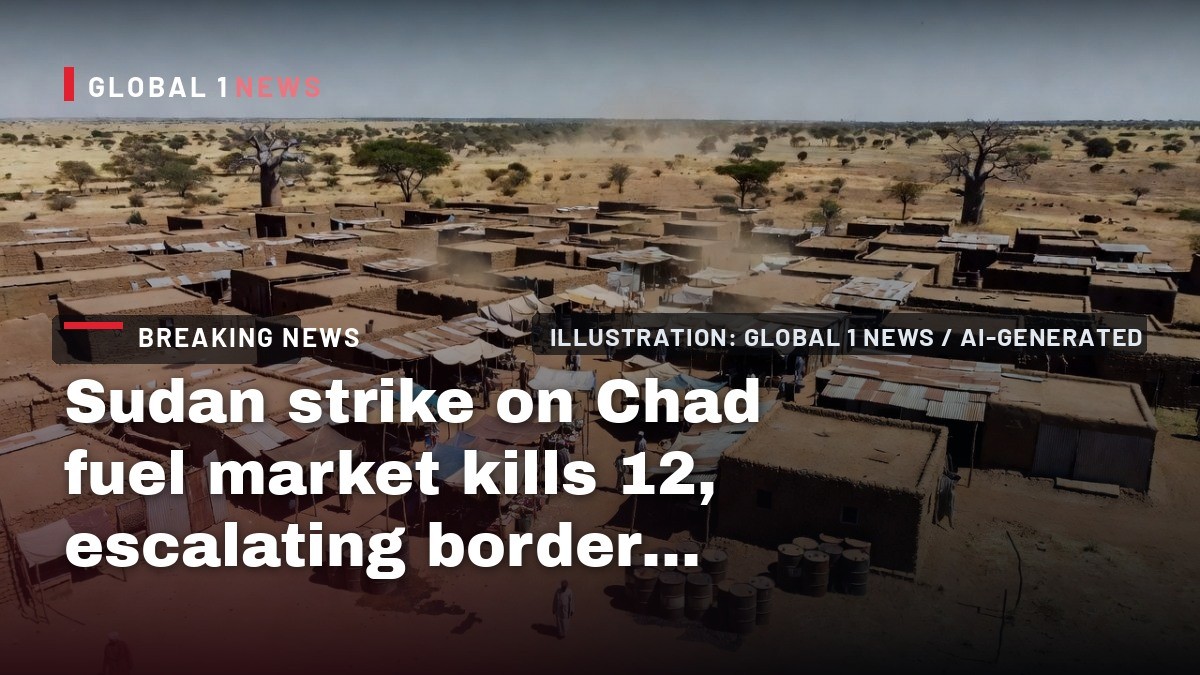
The Sudanese air force has bombed a fuel market just inside Chad's eastern border, killing at least 12 people and wounding seven more, according to Chadian security officials. The strike, which hit the Adikoun area on Thursday, August 27, marks a dangerous new phase in Sudan's four-year civil war — one that now threatens to pull a neighboring state directly into the conflict.
Sudan strike on Chad fuel market kills 12, escalating border war
N'Djamena, Chad — The charred remains of fuel drums and market stalls were still smoldering Friday morning in Adikoun, a dusty trading post near the Chad-Sudan border, after a Sudanese warplane dropped its payload on a crowded fuel market. Chadian authorities say the attack killed at least 12 people and wounded seven others, and they are pointing the finger squarely at Sudan's army.
What Happened
The air strike struck the Adikoun fuel market on Thursday, a time when the area would have been busy with traders, truckers, and locals buying fuel for generators and vehicles. A Chadian security source who spoke to Agence France-Presse on condition of anonymity said Sudan's air force "targeted a fuel market where the RSF refuel."
The Rapid Support Forces, or RSF, are the paramilitary group that has been fighting Sudan's regular army since April 2023. The market sits on the Chadian side of a border that has never been formally demarcated — a porous, sprawling frontier that has become a lifeline for the RSF's supply networks.
Reports from the area suggest panic as the bomb hit, with people running in every direction as fuel drums ignited and sent thick black smoke into the sky. The wounded were rushed to clinics on both sides of the border, though medical resources in this remote region are scarce and overwhelmed.
The attack was not a stray bomb or a case of mistaken coordinates. Chadian officials say it was a deliberate strike on a known supply point — a message, perhaps, or an attempt to sever the RSF's logistical lifeline. Either way, it landed on Chadian soil, and that changes the calculus.
The Accusation and the Denial
Chad's government did not mince words. In an official statement, it accused the Sudanese Armed Forces, or SAF, of carrying out the strike on Chadian territory and demanded accountability. The accusation carries weight: this is not the first time Chad has complained about Sudanese military incursions, but it is the first time a strike has killed this many people on Chadian soil.
Khartoum rejected the accusation outright. In a statement of its own, Sudan's army denied launching any attack on Chadian territory and called for an independent investigation into the incident. The denial is predictable — no government wants to admit to bombing a neighbor — but it also reflects the fog of a war that has already killed tens of thousands and displaced millions.
The tension between the two countries is not new. Sudan's army has long accused Chad of aligning with the RSF, providing sanctuary and supply routes for the paramilitary force that has been locked in a brutal struggle with the SAF for control of Sudan. Chad denies these allegations, insisting it remains neutral and is simply hosting refugees who fled the violence.
But the accusations have been flying in both directions for years. In May 2026, Sudan accused Chad of launching air strikes on its territory. Chad denied that too. The pattern is familiar: each side blames the other, each side denies, and the border remains a flashpoint where a single spark can ignite a wider conflict.
Washington's Response
The United States did not wait for the investigation to conclude. Washington condemned the raid and blamed Sudan's army, urging restraint on all sides. US officials have also pushed for a truce following the cross-border strike, according to diplomatic sources.
The American position is significant. The US has been trying to broker an end to Sudan's civil war for years, with limited success. But this strike crossed a line — bombing a sovereign neighbor's territory is not just a war crime, it is an act that threatens to destabilize an entire region.
Washington's condemnation was swift and unambiguous, but what follows is the real question. Will the US back its words with action? Sanctions? Diplomatic pressure at the UN? Or will this become another statement of concern that changes nothing on the ground?
The Biden administration has been cautious about getting drawn deeper into Sudan's conflict, but the cross-border dimension changes the stakes. Chad is a key regional actor, a member of the Sahel alliance, and a country that has hosted hundreds of thousands of Sudanese refugees. If Chad gets dragged into the war, the entire region could go up in flames.
A War Spilling Across Borders
Sudan's civil war began in April 2023, when tensions between the SAF under General Abdel Fattah al-Burhan and the RSF under Mohamed Hamdan Dagalo — known widely as Hemedti — erupted into open fighting. The two men had been uneasy allies, but their power struggle over the future of Sudan turned into a full-blown war that has devastated the country.
The war has been marked by brutal mass killings, abductions, and rape, according to UN officials who briefed the Security Council this week. Catastrophic hunger is spreading, and this year's flooding has made an already dire situation even worse. The UN calls Sudan the world's worst humanitarian crisis — a label that carries weight given the number of crises competing for attention.
Nearly one million people have fled Sudan into Chad, which shares a long, porous border with the Darfur region. Darfur, of course, has its own history of genocide and displacement, and the current war has reawakened those traumas. The refugees who crossed into Chad are not just statistics; they are survivors of a conflict that has shown no mercy.
Chad has borne the burden of this refugee influx with limited international support. Camps along the border are overcrowded, underfunded, and increasingly vulnerable to the spillover effects of the war. Thursday's strike is a stark reminder that Chad cannot remain an island of stability while its neighbor burns.
The Fuel-Market Supply Chain
Why target a fuel market? The answer lies in the logistics of a war that has become as much about supply lines as about front lines. Analysts note that the RSF has used informal fuel markets and smuggling networks along the Chad-Sudan border to resupply its forces, particularly after losing major territory in Darfur and Kordofan.
The RSF, which began as a militia drawn from Arab tribes in Darfur, has always relied on cross-border networks for fuel, weapons, and other essentials. As the SAF has pushed the RSF back in key areas, those networks have become even more critical. The fuel market in Adikoun was not just a place to buy petrol; it was a node in a supply chain that keeps the RSF fighting.
By striking that market, the SAF was trying to cut off the RSF's fuel supply. But the strike also killed civilians — traders, transporters, and ordinary people who were just trying to make a living in a region where poverty is endemic and opportunity is scarce.
The targeting of a fuel market is a reminder that modern warfare is not just about soldiers and tanks. It is about the infrastructure that sustains armies, and the civilians who get caught in the crossfire when that infrastructure is attacked.
A Humanitarian Catastrophe in Its Fourth Year
This strike did not happen in a vacuum. It happened in the context of a war that has been raging for more than four years, with no end in sight. The UN has described Sudan as the world's worst humanitarian crisis, and the numbers back that up.
Mass killings, abductions, and rape have become routine. Hunger is spreading, with millions facing acute food insecurity. This year's flooding has compounded the misery, destroying crops, homes, and infrastructure. The people of Sudan are not just fighting a war; they are fighting for survival.
The refugees in Chad are a testament to the scale of the catastrophe. Nearly one million people have crossed the border, seeking safety from a conflict that has shown no regard for civilian life. They have arrived with nothing, and they are dependent on aid that is chronically underfunded.
Thursday's strike adds a new dimension to this crisis. It is no longer just a civil war; it is a regional conflict with the potential to draw in neighboring states. The Sahel is already a volatile region, plagued by jihadist insurgencies, political instability, and climate shocks. The last thing it needs is a full-blown war between Sudan and Chad.
What Comes Next
The immediate question is whether Chad will retaliate. The Chadian government has demanded an investigation, but it has also shown restraint so far. A military response would risk a wider war that Chad can ill afford, but doing nothing could be seen as weakness.
The United States has urged restraint and pushed for a truce, but Washington's influence in the region is limited. The Sahel has been drifting away from Western influence, with several countries turning to Russia for security support. Chad, however, has maintained ties with the West, and that could give diplomats some leverage.
For the people of Adikoun, the immediate concern is more basic: burying the dead, tending to the wounded, and figuring out how to rebuild a market that was their livelihood. The fuel market was not just a target; it was a community hub, a place where people gathered, traded, and survived.
The strike raises the risk of direct state-to-state escalation between Sudan and Chad, and that is a prospect that should worry everyone. A war between two countries in the Sahel would be a humanitarian disaster of staggering proportions, and it would further destabilize a region that is already on the brink.
This is why the strike matters beyond the immediate death toll. It is a sign that Sudan's civil war is no longer contained within Sudan's borders. It is spilling over, and the consequences could be felt across the region and beyond.
The world has been slow to respond to Sudan's crisis, and the people of Sudan have paid the price. Now, with the conflict threatening to engulf Chad, the cost of inaction is only going to rise. The question is whether the international community will finally step up — or whether it will watch another country descend into chaos.
By Jessica Ali, Staff Writer
This article was produced with AI-assisted research and editorial support. Sources: Al Jazeera, Agence France-Presse (AFP), Hindustan Times, Rio Times, Verity News, Telesur.
What's Your Reaction?
 Like
0
Like
0
 Dislike
0
Dislike
0
 Love
0
Love
0
 Funny
0
Funny
0
 Wow
0
Wow
0
 Sad
0
Sad
0
 Angry
0
Angry
0

Editor-in-Chief at Global1.News. Atlanta-based journalist who cuts through the BS and tells it like it is. Lead anchor, host, and the voice you hear when the spin stops and the truth starts.













Comments (0)