
Israeli President Herzog says proposed halt to US aid came as a surprise
Israeli President Isaac Herzog’s recent remarks about a possible halt to United States aid have reverberated far beyond the corridors of power in Jerusalem.
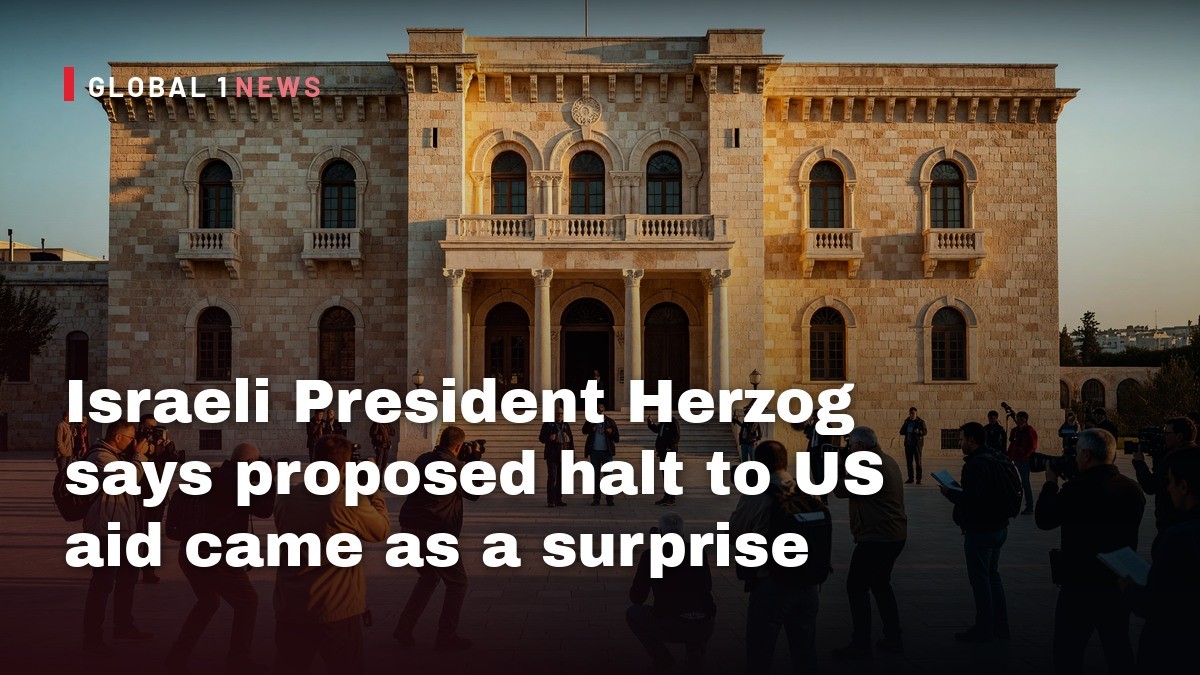
Israeli President Isaac Herzog’s recent remarks about a possible halt to United States aid have reverberated far beyond the corridors of power in Jerusalem. Speaking to reporters on Thursday, Herzog described the prospect of ending the annual US financial assistance as “a bolt from the blue,” underscoring how sudden policy shifts can destabilise not only strategic calculations but also the everyday lives of civilians who live under the shadow of an ever‑escalating conflict. While the president’s surprise is evident, the broader implications of a potential suspension of the four‑billion‑shekel aid package—often cited as roughly $3.8 billion—raise urgent questions about the humanitarian cost, the legal framework governing foreign military assistance, and the fragile political landscape within Israel itself.
Herzog’s Shock and the Scale of US Assistance
President Herzog’s comments, reported by the Hebrew‑language daily Maariv, convey a personal sense of disbelief at the reported decision to discontinue the aid. The president’s exact words, “The issue of halting the 4 billion shekels in annual US aid hit me like a bolt from the blue,” capture the abruptness of the news. The figure cited by the source aligns with other reports that translate the aid into roughly $3.8 billion annually, a sum that has long underpinned Israel’s military procurement, intelligence capabilities, and defensive infrastructure.
Beyond the headline numbers, the aid represents a cornerstone of the US‑Israel strategic partnership, a relationship that has been reinforced through decades of joint exercises, technology sharing, and coordinated diplomatic efforts. The sudden prospect of a suspension, therefore, threatens to unsettle a long‑standing security architecture that has been justified by both nations as essential for regional stability. Yet, as Herzog’s reaction suggests, the decision appears to have been taken without prior consultation, leaving Israeli leadership scrambling to assess the immediate operational and fiscal ramifications.
The Human Cost of a Funding Gap
While the financial dimensions dominate headlines, the real impact of a funding interruption would be felt most acutely by civilians on both sides of the border. Israel’s defense budget, heavily supplemented by US aid, funds a range of systems that Israel argues are necessary to protect its population from rocket attacks, border infiltrations, and other security threats. A sudden reduction could force the Israeli Defence Forces to re‑prioritise resources, potentially curtailing the maintenance of missile‑defence batteries, surveillance drones, and border‑security technologies that have been credited with reducing civilian casualties during past escalations.
Conversely, the Palestinian population, already bearing the brunt of occupation, settlement expansion, and periodic military operations, could experience an indirect effect. A perceived weakening of Israel’s defensive posture might embolden hard‑line elements on both sides, increasing the risk of miscalculations that could trigger renewed violence. Moreover, any shift in the balance of power may affect the already precarious humanitarian situation in Gaza, where restrictions on movement, electricity, and medical supplies have already pushed the health system to the brink. The prospect of a funding gap, therefore, is not merely a budgetary issue but a catalyst that could exacerbate the human suffering already endured by thousands.
International Law and the Ethics of Military Aid
Under international law, foreign military assistance is subject to scrutiny when the recipient state is engaged in actions that may contravene humanitarian norms. The United Nations and various human‑rights bodies have repeatedly called for investigations into alleged violations of the laws of armed conflict in the occupied territories. While the source material does not detail any specific legal arguments, the very discussion of halting aid reflects a growing international debate about the conditions attached to military financing.
Human‑rights advocates argue that continued financial support without robust safeguards may amount to complicity in potential violations of international humanitarian law. The surprise expressed by Herzog underscores a disconnect between the expectations of the Israeli leadership and the evolving standards of accountability that donor states are increasingly adopting. If the United States were to suspend aid pending compliance with human‑rights benchmarks, it could set a precedent for linking security assistance to the observance of international legal obligations, a shift that would reverberate across other US‑aligned security arrangements worldwide.
Political Turbulence Within Israel
The timing of Herzog’s remarks coincides with Israel’s ongoing general elections for the 26th Knesset, held on 27 October 2026. The image of the president and his wife casting votes in West Jerusalem, captured by Saeed Qaq of Anadolu Agency, highlights a nation in the midst of political renewal. The election results will shape the composition of the Knesset and, by extension, the government’s capacity to negotiate with the United States over aid terms.
Political parties in Israel have long differed on the extent and conditions of US assistance. Some factions view the aid as indispensable for national security, while others argue for greater self‑reliance or for leveraging the aid to extract diplomatic concessions. The surprise expressed by Herzog may fuel internal debates, prompting opposition leaders to question the government’s preparedness for a potential funding shortfall. In a parliamentary system where coalition building is essential, any perceived vulnerability could influence bargaining power, policy priorities, and the overall stability of the incoming administration.
Strategic Implications for US‑Israel Relations
Beyond the immediate financial considerations, the prospect of halting aid raises strategic questions about the future of the US‑Israel alliance. The United States has historically framed its support for Israel as a cornerstone of its Middle‑East policy, arguing that a secure Israel contributes to regional stability and serves as a democratic counterweight. However, shifting geopolitical dynamics—such as the increasing influence of Iran, the evolving role of Russia and China in the region, and the United States’ own domestic budgetary pressures—have prompted a re‑examination of longstanding commitments.
If the United States were to suspend the four‑billion‑shekel package, it would signal a significant recalibration of its strategic posture. Such a move could be interpreted by regional actors as a weakening of US resolve, potentially emboldening adversarial states or non‑state actors to test Israel’s defenses. Conversely, it could also encourage Israel to diversify its security partnerships, seeking new technology transfers or procurement channels from other allies. The strategic ripple effects of an aid suspension would thus extend far beyond bilateral finances, reshaping power calculations across the Middle East.
Human‑Rights Perspectives on Aid Conditionality
From a human‑rights standpoint, the debate over US aid is inseparable from the lived realities of Palestinians under occupation. International humanitarian law obliges occupying powers to ensure the welfare of the civilian population, a duty that has been the subject of numerous UN resolutions and International Court of Justice opinions. Critics argue that unconditional military aid enables practices that exacerbate civilian suffering, such as the use of force in densely populated areas and the expansion of settlements deemed illegal under international law.
Human‑rights organisations have long called for aid conditionality that ties financial support to compliance with human‑rights standards. While the source material does not specify whether such conditions are currently in place, the very discussion of a potential halt suggests that the United States may be reconsidering its approach. Introducing clear, enforceable conditions could serve as a lever to encourage policy changes that mitigate civilian harm, while also aligning US foreign assistance with its professed commitment to human rights and democratic values.
Looking Ahead: Scenarios and Recommendations
Given the uncertainty surrounding the proposed suspension, several scenarios could unfold. In the best‑case scenario, the United States clarifies its intentions, engages in transparent dialogue with Israeli officials, and establishes a framework for conditional aid that balances security needs with human‑rights obligations. In a worst‑case scenario, the aid is abruptly withdrawn without a transition plan, leading to operational disruptions for Israel’s defence forces and heightened tensions that could spark renewed conflict, further endangering civilians on both sides.
To navigate these possibilities, it is essential for policymakers in Washington and Jerusalem to adopt a collaborative, rights‑based approach. This would involve: (1) establishing clear criteria for aid continuation that are tied to verifiable compliance with international humanitarian law; (2) creating joint monitoring mechanisms involving independent experts to assess the impact of aid on civilian protection; and (3) ensuring that any policy shift is communicated transparently to avoid the “bolt from the blue” effect that President Herzog described. By foregrounding human‑rights considerations alongside security concerns, both nations can work toward a more sustainable partnership that respects the dignity and safety of all peoples in the region.
This article was produced with AI-assisted research and editorial support. Reporting is based on the source material cited below. Sources: Middle East Monitor; middleeastmonitor.com; Global1.News (07 November 2026).
By Fatima Al-Rashid, Staff Writer
What's Your Reaction?
 Like
0
 Dislike
0
 Love
0
 Funny
0
 Wow
0
 Sad
0
 Angry
0
Gulf/MENA Correspondent at Global1.News. Based in Doha, covering Gulf politics, energy markets, diplomacy, and development across the Middle East and North Africa. Tracks the economic transformation of the Gulf states.










Comments (0)