
EU must have role in Ukraine peace deal, Kallas warns Putin
As Europe grapples with the lingering spectre of war in Ukraine, the continent’s security architecture is being tested on multiple fronts. Such integration would likely involve a combination of military assistance, intelligence sharing, and political coordination within EU mechanisms.
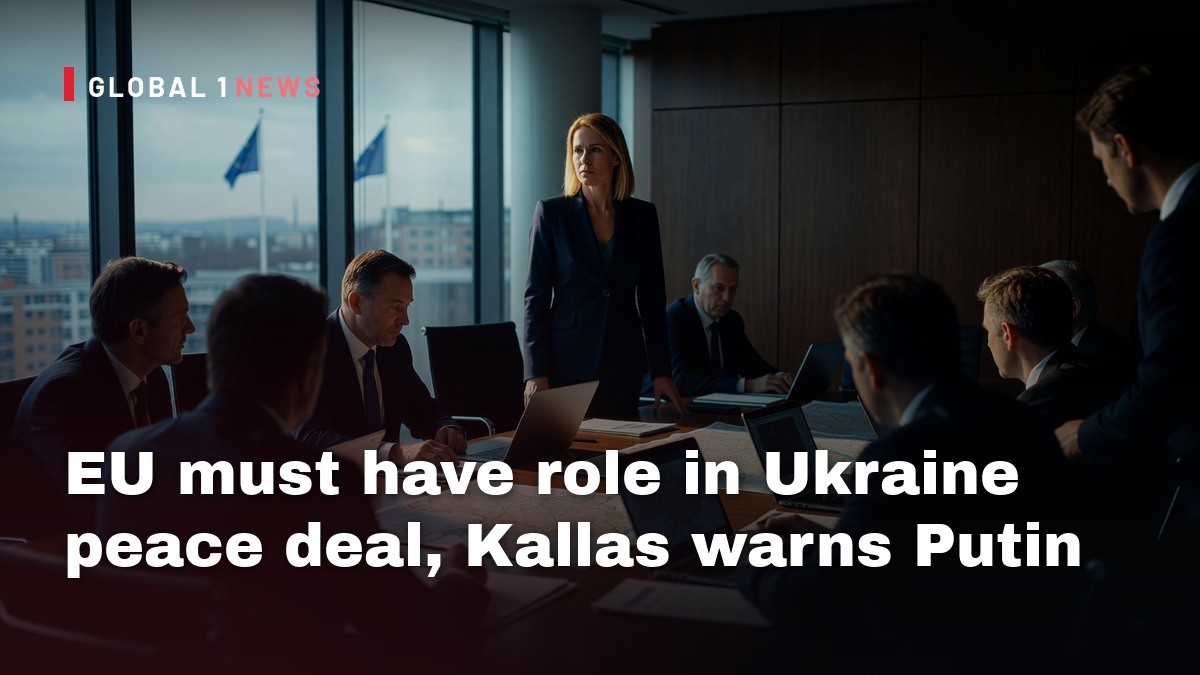
As Europe grapples with the lingering spectre of war in Ukraine, the continent’s security architecture is being tested on multiple fronts. The recent remarks of EU foreign policy chief Kaja Kallas in Warsaw underscore a growing consensus among Western capitals that any durable settlement to the conflict must embed Kyiv within the broader European security framework. This stance reflects not only a strategic calculation about Russia’s waning ability to dictate the region’s future, but also a deeper, long‑standing competition between great‑power interests and the internal dynamics of the EU‑NATO partnership. In a region where Sunni‑Shia rivalries, energy dependencies and great‑power rivalries intersect, the insistence on EU involvement signals a shift toward a more integrated, collective approach to European security.
EU’s Non‑Negotiating Role in the Ukraine Peace Process
Kaja Kallas made clear that the European Union cannot be sidelined in any prospective peace agreement between Moscow and Kyiv. Speaking alongside Polish Foreign Minister Radoslaw Sikorski and Ukrainian Foreign Minister Andrii Sybiha, she emphasized that “any agreement in order to be implemented will require the European Union to be part of it.” This declaration positions the EU not merely as a diplomatic observer but as a necessary participant whose endorsement is essential for the legitimacy and enforceability of any settlement.
The insistence on EU participation reflects a broader strategic calculus: the bloc seeks to ensure that any peace terms align with its normative framework on sovereignty, territorial integrity and democratic governance. By demanding a seat at the negotiating table, the EU also aims to prevent a scenario where Russia could extract concessions that undermine the security guarantees currently afforded to Ukraine under NATO and EU auspices. In effect, Kallas’s warning to Vladimir Putin that he “has no authority to veto decisions concerning European security” reinforces the message that Moscow’s leverage is limited when the West moves in concert.
Integrating Ukraine into Existing European Security Structures
Kallas highlighted the existing “European security architecture” that already comprises NATO and the EU, arguing that Ukraine’s full integration into these structures is essential for long‑term stability. She noted that “we must make sure Ukraine is integrated into this architecture,” a statement that signals a push for deeper institutional ties, possibly extending beyond the current partnership arrangements to more formalized security commitments.
Such integration would likely involve a combination of military assistance, intelligence sharing, and political coordination within EU mechanisms. The emphasis on NATO’s role underscores the alliance’s continued relevance as the primary military guarantor, while the EU’s mention points to its growing capacity to coordinate sanctions, reconstruction aid and diplomatic outreach. Together, these institutions form a dual‑track approach that can both deter further Russian aggression and provide Ukraine with a roadmap toward eventual Euro‑Atlantic membership.
Regional Implications: Baltic Sea States and the Wider Security Dialogue
The comments were delivered at an informal gathering of foreign ministers from Baltic Sea states, a forum that has increasingly become a crucible for regional security discussions. The inclusion of these ministers reflects the heightened sensitivity of countries bordering the Baltic and Black Seas to Russian manoeuvres, and their desire to align closely with both NATO and EU policies.
For the Baltic states, which have historically viewed Russian ambitions with suspicion, Kallas’s message reinforces a shared security outlook that transcends national borders. The collective stance taken in Warsaw suggests a coordinated push to ensure that any peace settlement does not compromise the security guarantees that have underpinned the region’s post‑Cold War stability. This regional cohesion could translate into a more unified front in future EU‑NATO deliberations on Ukraine’s status.
EU’s Strategic Interests Beyond the Immediate Conflict
Beyond the immediate goal of ending hostilities, the EU’s insistence on participation reflects deeper strategic interests. Europe’s energy security, for instance, remains intertwined with the outcomes of the Ukraine war. While the source material does not detail energy considerations, the broader context of the conflict’s impact on gas supplies underscores why the EU is keen to shape any settlement that could affect transit routes and market dynamics.
Moreover, the EU’s call for an end to Russian sabotage activities targeting Europe, as noted by Kallas, signals a broader concern about hybrid threats that extend beyond conventional warfare. By framing sabotage as a security issue, the EU positions itself as a defender against a spectrum of Russian tactics, from cyber‑attacks to disinformation, thereby justifying a more expansive role in the peace process.
Balancing NATO and EU Roles: A Delicate Coordination
Kallas’s remarks foreground the delicate balance between NATO’s military mandate and the EU’s political‑economic toolkit. While NATO remains the primary collective defence organisation, the EU’s growing competence in crisis management, sanctions coordination and reconstruction financing makes it an indispensable partner in post‑conflict scenarios.
The dual emphasis on both institutions suggests a future where the EU may assume a more pronounced role in security matters traditionally dominated by NATO. This could manifest in joint planning exercises, shared intelligence platforms, and coordinated diplomatic outreach to Moscow. Such synergy would reinforce the message that any peace agreement must be compatible with the broader trans‑Atlantic security architecture.
Implications for Russia’s Diplomatic Calculus
By stating unequivocally that Putin “has no authority to veto decisions concerning European security,” Kallas challenges Russia’s traditional leverage in shaping the European security order. This stance signals to Moscow that any unilateral moves to dictate terms will be met with a united European front that includes both NATO and the EU.
Consequently, Russia may be compelled to reassess its diplomatic strategy, potentially seeking to engage directly with the EU to circumvent NATO’s influence. However, Kallas’s warning that the EU cannot be excluded from the process suggests that such overtures would need to align with the bloc’s core principles, limiting Moscow’s room for maneuver.
Future Outlook: Toward a Comprehensive European Security Settlement
The convergence of EU, NATO and regional actors around the principle of inclusive peace negotiations marks a pivotal moment in the European response to the Ukraine war. As Kallas articulated, the EU’s involvement is not optional but essential for any agreement to be viable and enforceable. This position reinforces the broader strategic narrative that Europe’s security future will be shaped collectively, rather than being left to the whims of a single external power.
Looking ahead, the EU’s insistence on participation may translate into concrete diplomatic initiatives, such as a formal EU‑led peace conference or a joint EU‑NATO mediation team. Such mechanisms would aim to embed Ukraine’s future within the established security architecture, ensuring that any peace settlement is anchored in the continent’s collective defence and political frameworks. In doing so, Europe would not only secure a durable end to the conflict but also reaffirm the principle that its security architecture remains a shared, indivisible enterprise.
This article was produced with AI-assisted research and editorial support. Reporting is based on the source material cited below. Sources: Daily Sabah Middle East; dailysabah.com; Global1.News (08 November 2026).
By Malik Hassan, Staff Writer
What's Your Reaction?
 Like
0
 Dislike
0
 Love
0
 Funny
0
 Wow
0
 Sad
0
 Angry
0
Middle East Correspondent at Global1.News. Based in Beirut, covering politics, conflict, energy, and society across the Middle East. Brings context and depth to a region often reduced to headlines.








Comments (0)