
New GRAP Rules in Delhi; Restrictions in NCR October 2026: Are you aware of this parking fees update?
From 1 November 2026 to 28 February 2027, Delhi’s motorists will face a steep rise in parking fees at authorised sites, a move the state government says is part of a broader winter air‑quality strategy.
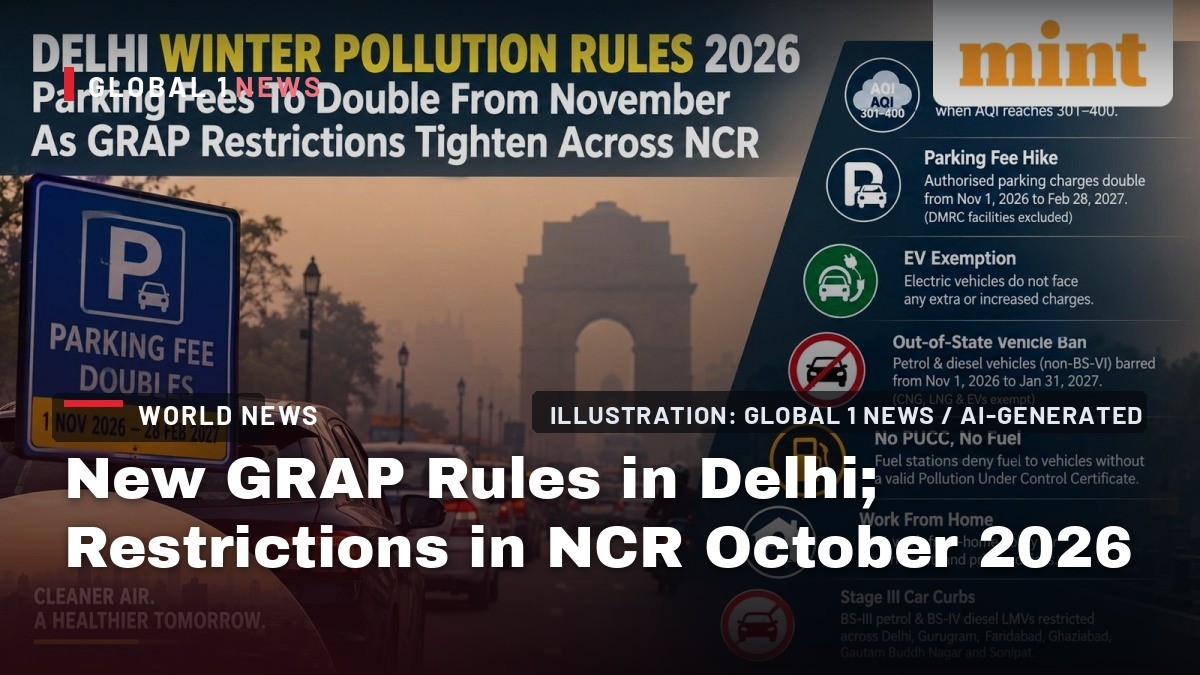
From 1 November 2026 to 28 February 2027, Delhi’s motorists will face a steep rise in parking fees at authorised sites, a move the state government says is part of a broader winter air‑quality strategy. By doubling the cost of parking, officials hope to nudge commuters away from private‑vehicle trips during the months when the capital’s smog typically peaks. The policy, announced alongside a revised Graded Response Action Plan (GRAP), also brings tighter vehicle‑entry rules, mandatory Pollution Under Control Certificate (PUCC) checks and a 50 percent work‑from‑home mandate for many offices. Understanding how these measures intersect with existing transport, health and policy frameworks is crucial for commuters, businesses and policymakers across the National Capital Region (NCR).
Why parking fees are being doubled
The Delhi government has framed the parking‑fee hike as a “pollution‑response” lever that can be activated independently of the GRAP stages. While the revised GRAP, approved by the Commission for Air Quality Management (CAQM) on 28 September, outlines 48 actions across four stages, the parking charge increase is a standing measure for the entire winter period, not limited to the very poor air‑quality category (AQI 301‑400) that triggers Stage II. By making the cost of using authorised parking facilities twice the current rate, the administration aims to make commuters reconsider “unnecessary car journeys” and shift towards public transport, especially the Delhi Metro, whose parking facilities are exempt.
Electric vehicles (EVs) also receive an exemption from the additional charge, reflecting the government’s broader push for cleaner mobility. This aligns with the national push under the Faster Adoption and Manufacturing of Hybrid and Electric Vehicles (FAME) scheme, though the article does not specify any direct linkage. The selective exemption signals a policy intent to reward low‑emission technologies while still applying pressure on conventional internal‑combustion vehicles.
Revised GRAP: structure and timing
The revised GRAP, announced on 29 September, expands to 48 actions spread across four stages, each tightening restrictions as air quality worsens. Stage II, defined by an AQI of 301‑400, already carries a set of curbs, but the parking fee increase operates as a parallel, pre‑emptive measure. The plan also details that parking charges can be raised further when a particular GRAP stage is activated, though the current doubling is a baseline winter measure.
Beyond parking, the GRAP introduces vehicle‑entry restrictions for out‑of‑state cars that do not meet BS‑VI emission standards, effective from 1 November 2026 to 31 January 2027. Cleaner‑fuel vehicles, including CNG and EVs, are exempt. This tiered approach mirrors earlier Delhi initiatives that targeted high‑polluting diesel trucks and older two‑wheelers, but now extends to interstate passenger cars, reflecting the growing contribution of cross‑border traffic to the capital’s winter smog.
Vehicle restrictions and PUCC enforcement
From 1 November 2026, vehicles registered outside Delhi that fail to meet BS‑VI standards will face entry bans across the NCR, except for those running on cleaner fuels such as CNG or electricity. This restriction runs concurrently with the parking fee hike, creating a two‑pronged deterrent against private‑car use. The policy also mandates that fuel stations deny service to vehicles lacking a valid PUCC, a move aimed at tightening on‑spot compliance.
To enforce PUCC checks, the government is deploying automated number‑plate‑recognition (ANPR) cameras. These systems will flag non‑compliant vehicles in real time, linking to a central database of PUCC records. While the article does not detail penalties, the use of ANPR suggests a shift towards automated, data‑driven enforcement, reducing reliance on manual spot checks and potentially increasing compliance rates.
Impact on commuters and businesses
The combined effect of higher parking fees, vehicle entry bans and PUCC enforcement is likely to reshape commuting patterns across the NCR. For daily commuters who rely on private cars, the doubled parking cost at authorised lots—excluding Delhi Metro facilities—adds a direct financial burden. Many office workers will also experience a shift in workplace dynamics, as the government and private firms are instructed to operate with 50 percent of staff working from home during the November‑February window.
Businesses that depend on logistics and delivery services may need to adjust routing to avoid restricted zones, especially in Delhi, Gurugram, Faridabad, Ghaziabad, Gautam Buddha Nagar and Sonipat, where Stage III restrictions on BS‑III petrol and BS‑IV diesel light motor vehicles will apply when air quality deteriorates further. Companies with large commuter fleets might explore transitioning to EVs or CNG vehicles to benefit from the exemptions, aligning fleet policy with the emerging regulatory landscape.
Public health implications
Winter smog in Delhi has historically been linked to spikes in respiratory ailments, cardiovascular stress and premature mortality. By targeting private‑vehicle use—one of the major contributors to nitrogen oxides and particulate matter—the government hopes to blunt the seasonal surge in pollutants that push the AQI into the “very poor” bracket. The article notes that the measures aim to “limit emissions from transport, construction and other sources before winter conditions trap pollutants close to the ground,” underscoring a preventive rather than reactive approach.
Reducing vehicle density during the winter months could translate into measurable health benefits, especially for vulnerable groups such as children, the elderly and those with pre‑existing respiratory conditions. While the source does not provide quantitative health impact assessments, the policy’s alignment with the broader national Clean Air Programme suggests an intent to meet the target of a 20‑30 percent reduction in PM2.5 concentrations by 2025, a benchmark that remains relevant for 2026.
Technology and data‑driven enforcement
The rollout of ANPR cameras for PUCC verification reflects a growing reliance on technology to enforce environmental regulations. By linking vehicle registration data with real‑time emissions compliance, authorities can automate denial of fuel and impose entry bans without manual intervention. This mirrors similar deployments in other Indian metros, where smart‑city initiatives have integrated traffic monitoring with pollution control.
Additionally, the GRAP’s 48‑action framework likely incorporates digital dashboards for tracking AQI trends and triggering stage‑specific curbs. While the article does not elaborate on the data infrastructure, the reference to “automated number‑plate recognition cameras” indicates a broader ecosystem of sensors and analytics that could feed into a central command centre, enabling rapid response as air‑quality metrics cross predefined thresholds.
Looking ahead: policy continuity and challenges
As the winter window closes on 28 February 2027, the government will assess the efficacy of the parking fee hike and associated restrictions. The temporary nature of the measure—tied to the winter smog season—means that any long‑term behavioural shift among commuters will depend on the perceived inconvenience and cost of private‑car use versus the convenience of public transport and alternative mobility options.
Future policy cycles may see the parking fee model extended or refined, especially if data from the ANPR system and AQI monitoring demonstrate a clear correlation between reduced vehicle density and improved air quality. However, challenges remain: ensuring equitable access to affordable parking, managing enforcement consistency across the sprawling NCR, and addressing potential pushback from vehicle‑owner groups. The success of the current framework will hinge on coordinated action across transport authorities, environmental regulators and the tech providers that underpin the enforcement mechanisms.
This article was produced with AI-assisted research and editorial support. Reporting is based on the source material cited below. Sources: Livemint; livemint.com; Global1.News (10 October 2026).
By Dr. Raj Patel, Staff Writer
What's Your Reaction?
 Like
0
Like
0
 Dislike
0
Dislike
0
 Love
0
Love
0
 Funny
0
Funny
0
 Wow
0
Wow
0
 Sad
0
Sad
0
 Angry
0
Angry
0

India/South Asia Correspondent at Global1.News. Analytical voice with a background in science and health journalism. Based in New Delhi, covering Indian politics, education, healthcare, technology, and policy. Breaks down complex data into clear, actionable reporting.














Comments (0)