
Russian Glide Bomb Kills 30 at a Kramatorsk Bus Stop as Pryluky Toll Reaches 22
A Russian glide bomb struck two buses at a stop in Kramatorsk, killing at least 30 people, as the death toll from a cruise missile strike on an apartment block in Pryluky reached 22, including five children.

Russia's two deadliest strikes on Ukrainian civilians this month landed within hours of each other: a glide bomb that hit two buses at a stop in the eastern front-line city of Kramatorsk on Thursday, and a cruise missile that collapsed an apartment block in Pryluky a day earlier.
In Kramatorsk at least 30 people were killed and 18 wounded. In Pryluky the death toll reached 22, including five children. Kramatorsk was hit again later the same day, and Russia's attacks on Kyiv continued overnight.
Ukrainian officials say the attacks deliberately targeted civilians. Moscow has made no immediate comment on the Kramatorsk bus strike, and denies targeting civilians while regularly pounding Ukrainian cities.
Russian Glide Bomb Kills 30 at a Kramatorsk Bus Stop
Kramatorsk, Ukraine — The strike hit at about 10 a.m. local time on Thursday, as the city's buses ran their morning routes. Eighteen people were wounded. Police said the attack took place on a street where two city buses were operating at the time.
The Bus Stop on Yuvileina Street
The bomb struck an area next to a dental clinic on Kramatorsk's Yuvileina Street, according to the Donetsk regional prosecutor's office. Images posted by local prosecutors showed the burning metal shell of a bus, debris scattered across the road, and some victims on the pavement. A second bus also caught fire. Three people were killed by shelling in the village of Bilenke, which forms part of the Kramatorsk community and borders the city. Later on Thursday a Russian drone struck a civilian car in Kramatorsk, killing two more people, the Kramatorsk City Council said on its Telegram channel. Roads in Kramatorsk and neighbouring Slovyansk have been festooned with nets to protect traffic from drones, but the nets offer little protection against aerial bombs. Al Jazeera correspondent Audrey MacAlpine noted that glide bombs "do not have the precision of a ballistic missile or the first-person view of something like a drone," and said there was no way of knowing whether the buses were intentionally targeted or were "at the wrong place at the wrong time."
What Ukrainian Officials Say Happened
The death toll climbed through the day: President Volodymyr Zelensky was still reporting 12 confirmed dead in an earlier Telegram update before the figure rose to at least 30. Kramatorsk City Council described the bus strike as "yet another horrific crime committed by the Russian army against the civilian population," adding: "Once again, the Russians have struck a location where there are absolutely no military targets." Regional head Vadym Filashkin wrote on Telegram that "the Russians are deliberately targeting civilians. For them, a bus full of passengers is an attractive target precisely because a single strike can kill as many people as possible." He added: "These are not 'the consequences of war', nor dry statistics. These are people killed by the Russian army. Russia comes to Ukrainian land with death." Filashkin said all public transport had been ordered to stop in Kramatorsk and Slovyansk: "we have no right to risk the lives of passengers and drivers." He appealed to anyone still in the eastern front-line region to move to safer parts of Ukraine.
Pryluky: Five Children and a Collapsed Block
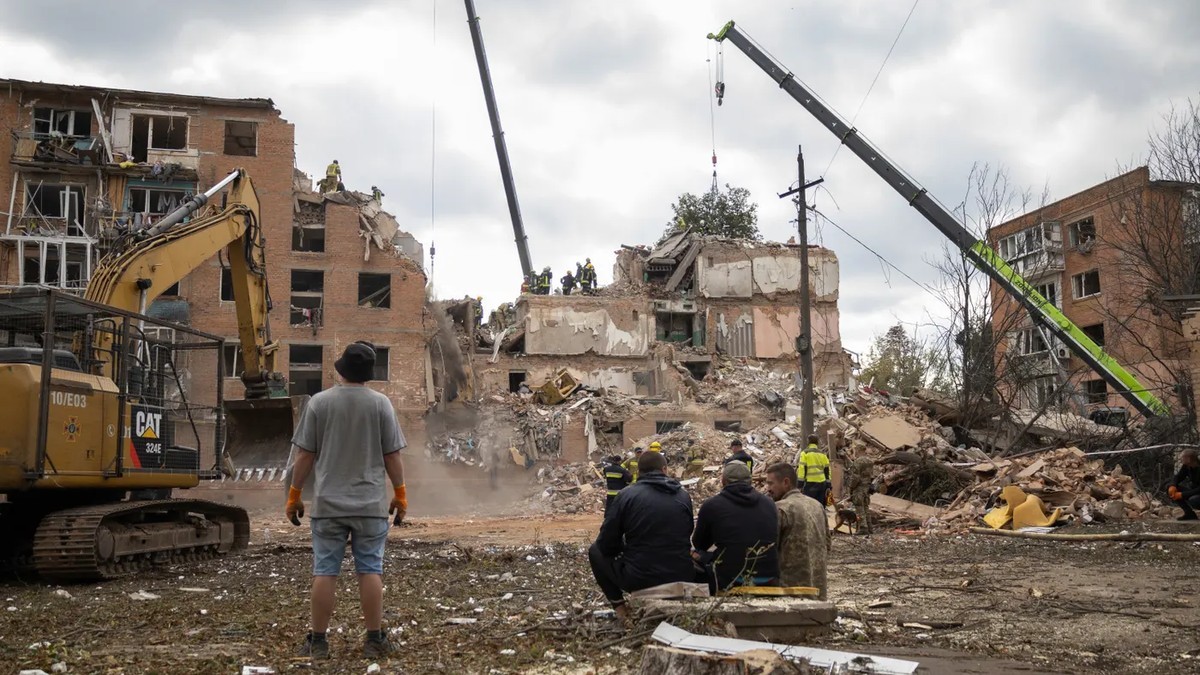
A Russian Kh-101 cruise missile partially destroyed a five-storey apartment building in Pryluky, in the northern Chernihiv region, on the morning of Wednesday 7 October, when many residents were still asleep. The building collapsed, entombing those inside. The death toll reached 22, including five children aged between one and eight — three of them only a year old. Another 54 people were injured, seven of them children, according to Ukraine's State Emergency Service. The search and rescue operation has concluded: more than 500 emergency personnel took part, and 15 people were pulled from the rubble, among them a five-year-old child. Pryluky lies about 150 km (93 miles) from the capital, Kyiv. The Chernihiv regional governor is Vyacheslav Chaus.
Kyiv Under Round-the-Clock Fire
Zelensky said Russia launched a wave of missile and drone attacks on 10 regions of Ukraine on Wednesday evening and early Thursday morning. Kyiv mayor Vitali Klitschko said four people were killed and 19 injured in "enemy attacks" in the capital on Thursday; Kyiv police reported the same death toll but put the number of injured at two. Both figures are on the record. Two people were found dead on Thursday after a fire at a four-storey building hit by a drone in the densely populated Solomyansky district. The city's metro network briefly halted all train traffic because of a voltage drop from "external power centres," then resumed at greater intervals. Water authorities warned that pressure was dropping across the city's right bank because of power cuts. Klitschko has said the attacks, which have hit key transport bridges in the city as well as the rail network and the energy grid, were "tearing Kyiv apart."
Zelensky's Demand for Concrete Action
"This strike will not go without our response," Zelensky said after the Kramatorsk bombing. In a Telegram statement he added: "This strike will not go unanswered. Russia is attempting to destroy all life in Donbas, and the world must respond … firmly." He also said: "Russia is trying to destroy all life in Donbas, and the world needs to react to this. React harshly — exactly as the Russians deserve for all the deaths they have caused." Turning to Ukraine's military needs, he said: "Supplies of anti-ballistic capabilities, ammunition for our combat aircraft, and investments in interceptors — all of this is directly helping save lives every day. Important talks with our partners will take place today and tomorrow." Ukraine's partners needed to provide "concrete action through new defence packages for the protection of Ukraine," he said. Earlier in the week Zelensky had warned of intelligence suggesting plans for a major Russian onslaught; in Kyiv, families responded by heading to metro stations for shelter.
Britain's Foreign Secretary at the Rubble
UK Foreign Secretary Ed Miliband visited the Pryluky strike site with Zelensky on Thursday. He said the attack showed Putin's "evil intent and evil strategy," and announced "more sanctions on Russia, on the war machine of Putin, on the shadow fleet, on the oil companies, on the crypto, on the financing of the war." Miliband told Zelensky the UK would stand with Ukraine "as long as it takes for you to prevail in this conflict." The visit put the allies' attention on air defence, the gap Ukraine says it cannot close alone: interceptor missiles are in short supply around the world, leaving the country with little chance of stopping incoming Russian ballistics. Miliband's stop in Pryluky came hours before Ukraine's negotiating team was due to meet US envoys in Miami.

Ukraine's Answer: Drones Over Russia
A drone caused a fire at a data centre belonging to Yandex, Russia's largest technology company and the operator of the country's most popular search engine, in the central Ryazan region south-east of Moscow, the firm told AFP. Unverified social media images showed thick black smoke pouring from the roof. The former head of Ukraine's Centre for Countering Disinformation wrote on Telegram that Kyiv was responsible: "Two can play at this game." Russian state media reported that a number of websites in Russia were inaccessible after the attack. Ukraine claimed to have struck a large oil refinery complex in the city of Salavat, about 1,200 km (750 miles) east of Moscow, which Ukraine's General Staff described as one of Russia's largest oil refining and petrochemical facilities. A man was killed and a woman injured in a drone attack on the Moscow region, governor Andrei Vorobyov said. In Russia's Omsk region, governor Vitaly Khotsenko said Kyiv had hit an industrial zone; Omsk, in Siberia, hosts an oil refinery operated by Gazprom Neft.
A Dangerous Stalemate: Washington's Read
US Secretary of State Marco Rubio, speaking to reporters during a visit to Portugal on Thursday, said Russia's war in Ukraine was at a "dangerous stalemate" and that Washington would keep working towards a settlement: "We'd love to see a negotiated settlement to this war that is permanent, enduring, and fair." Rubio warned that escalation "could wind up being a sabotage campaign in neighbouring countries that are members of NATO," and could turn "what is a war between two countries into a much broader and far more dangerous regional conflict." He added: "This war needs to end in a negotiated settlement. The sooner, the better... But we're also not going to invest in pointless processes if we can't make progress." The comments came as US envoys Steve Witkoff and Jared Kushner were preparing to meet Ukrainian officials in Miami on Friday 9 October, in a fresh attempt to revive efforts to end the war. The talks are expected to last two days.
Miami Talks and a Closing Window
Zelensky confirmed the meeting: "The Ukrainian negotiating team is due to meet Jared Kushner and Steve Witkoff in the US tomorrow. We are also counting on a European team to join our negotiating group." He said Ukraine's delegation would include chief of staff Kyrylo Budanov, the head of Ukraine's Foreign Intelligence Service Rustem Umerov, first deputy head of the President's Office Sergiy Kyslytsya, and parliamentary faction leader David Arakhamia. Zelensky said last week that Washington wanted to broker a new round of talks between Ukraine and Russia by the end of October; the Kremlin has said three-way talks involving the US could take place in October. Previous rounds have produced no tangible progress towards peace. The Miami meeting follows a week in which Russia struck deep into Ukraine's cities and Ukraine sent long-range drones in the other direction.
The Fortress Belt and the Numbers Behind It
Kramatorsk and neighbouring Slovyansk form part of a "fortress belt," and are the last two big cities in northern Donetsk under full Ukrainian military control. Kramatorsk served for much of the war as a logistics and supply hub for the Ukrainian military; it now comes under almost daily Russian attack as Russian forces move closer to the city's eastern edge. Glide bombs are fitted with winglets so they glide towards a target rather than simply falling; in late August, as many as nine were fired at Kramatorsk in one day. Russia is trying to capture the remaining 20 percent of Donetsk territory still held by Ukraine, and the Kremlin claims the wider Donbas as its own. The United Nations says Ukraine saw more civilians killed by August this year than in all of 2025.
By Jessica Ali, Staff Writer
This article was produced with AI-assisted research and editorial support. Sources: BBC, The Guardian, Al Jazeera, Meduza, UNN, Odessa Journal, CGTN and France 24.
What's Your Reaction?
 Like
0
Like
0
 Dislike
0
Dislike
0
 Love
0
Love
0
 Funny
0
Funny
0
 Wow
0
Wow
0
 Sad
0
Sad
0
 Angry
0
Angry
0

Editor-in-Chief at Global1.News. Atlanta-based journalist who cuts through the BS and tells it like it is. Lead anchor, host, and the voice you hear when the spin stops and the truth starts.













Comments (0)