
South Korea's KOSPI Crisis: Semiconductor Dependency Exposed as Markets Plunge
The Scale of the July Correction South Korea's financial markets experienced a historic reckoning in July 2026 as the Korea Composite Stock Price Index (KOSPI) plunged 33 percent in a single month — the steepest monthly decline on record. The correction erased approximately $2.18 trillion in market value across two sessions alone on July 28 and 29, with circuit breakers triggered multiple times as panic selling gripped Seoul's financial district. The KOSPI had closed 2025 at
The Scale of the July Correction
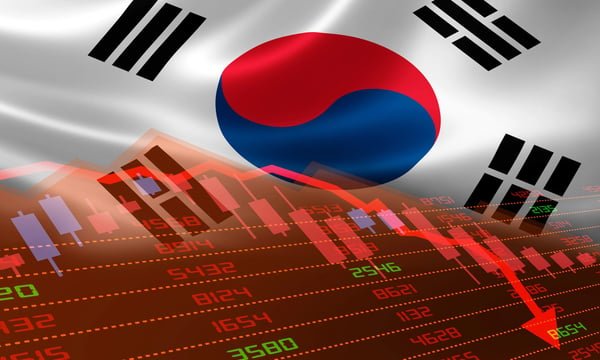
South Korea's financial markets experienced a historic reckoning in July 2026 as the Korea Composite Stock Price Index (KOSPI) plunged 33 percent in a single month — the steepest monthly decline on record. The correction erased approximately $2.18 trillion in market value across two sessions alone on July 28 and 29, with circuit breakers triggered multiple times as panic selling gripped Seoul's financial district.
The KOSPI had closed 2025 at 4,214 points, riding a wave of optimism driven by the artificial intelligence boom that had propelled Korean semiconductor stocks to unprecedented heights. Investment banks, including Goldman Sachs, had raised their KOSPI targets as high as 12,000 points, projecting 300 percent earnings growth for 2026. The disparity between those ambitious forecasts and the reality of the July crash underscores the fragility of an equity market built on concentrated sector exposure.
On June 23, the KOSPI had already fallen 10 percent in a single session, with circuit breakers halting trading twice. By July 2, the index closed at 7,648.09 — down 655.32 points or 7.89 percent from the prior session. The subsequent July 28-29 collapse brought the index to levels not seen since early 2025, erasing nearly all gains from the AI-driven rally.
Semiconductor Export Dominance: A National Dependency
The roots of this vulnerability lie in South Korea's extraordinary dependence on semiconductor exports. In June 2026, the country's semiconductor exports surged 199.5 percent year-on-year, reaching $44.8 billion and accounting for 43.8 percent of total national exports. This concentration means that the health of the entire Korean economy is effectively tied to the global semiconductor cycle — and specifically to demand for memory chips driven by AI data center investment.
Data from the Ministry of Economy and Finance (MOEF) shows that no other OECD economy has a single product category accounting for such a large share of total exports. Korea's nearest competitor in export concentration, Taiwan, relies on semiconductors for approximately 35 percent of exports. The gap has widened dramatically over the past three years as AI-related demand supercharged Korean chip exports while other sectors — automobiles, shipbuilding, petrochemicals — grew at more modest single-digit rates.
The Korea Development Institute (KDI) has warned repeatedly that this level of concentration creates asymmetric risk exposure. When global AI investment sentiment shifts — as it did in late June and July 2026 following disappointing earnings guidance from major US technology firms — the impact on Korea's economy is magnified far beyond what diversified economies experience.
Samsung and SK Hynix: A Two-Stock Market
The KOSPI's structural vulnerability is most visible in the dominance of just two companies. According to the Korea Exchange, the combined market capitalization of Samsung Electronics and SK Hynix reached approximately 2,140 trillion won ($1.6 trillion) as of mid-2026, representing 41 percent of the total KOSPI market capitalization of 5,200 trillion won ($3.5 trillion).
This concentration means that the broader Korean equity market has effectively become a two-stock play on semiconductor demand. When Samsung Electronics and SK Hynix fell more than 12 percent each during the June 23 circuit-breaker session, the KOSPI's decline was mathematically guaranteed regardless of how other sectors performed. The price-to-earnings ratios of both companies — between 18x and 24x, elevated by AI-driven expectations — left them particularly exposed to sentiment shifts.
The chaebol structure that has defined Korean capitalism since the 1960s has evolved into an extreme form of sector concentration. Unlike the 1997 Asian Financial Crisis, when the problem was excessive debt and cross-guarantees among affiliated companies, the current vulnerability stems from over-reliance on a single product category whose demand cycle is increasingly tied to the speculative sentiment of global AI investors in New York, San Francisco, and Shanghai.
The CXMT Factor: Chinese Competition Intensifies
Compounding the domestic concentration risk is the emergence of credible Chinese competition in the memory chip market. ChangXin Memory Technologies (CXMT), China's leading DRAM manufacturer, surged 466 percent on its STAR Market debut in late July, raising 12.5 trillion won (approximately $9.4 billion). The valuation lifts CXMT's global DRAM share toward 10 percent — still modest compared to Samsung's ~40 percent and SK Hynix's ~30 percent, but the trajectory is unmistakable.
For Korean semiconductor makers, CXMT's ascent represents a structural threat that differs from previous competitive challenges. Unlike earlier Chinese attempts to enter the memory market, CXMT has access to advanced manufacturing equipment, US-listed supply chain partners, and deep capital markets. The company's STAR Market listing was significantly oversubscribed, reflecting strong domestic Chinese investor appetite for semiconductor self-sufficiency plays.
The Korea Institute for International Economic Policy (KIEP) has assessed that Chinese memory chipmakers could capture 15 to 20 percent of the global DRAM market within three years, compressing margins for Samsung and SK Hynix at precisely the time when their capital expenditure requirements for next-generation technology nodes are escalating. This dynamic mirrors earlier patterns in shipbuilding and consumer electronics, where Korean industry leaders eventually ceded market share to well-capitalized Chinese competitors.
Government Response: Emergency Measures and Structural Questions
The Financial Services Commission (FSC) and the Ministry of Economy and Finance convened an emergency market meeting on July 29, announcing stepped-up curbs on leveraged exchange-traded funds (ETFs) that had amplified the selloff. Leveraged and inverse ETFs, which had grown to represent a disproportionate share of daily KOSPI trading volume, created a feedback loop in which forced deleveraging during the downturn accelerated the pace of declines.
President Lee Myung-hee's administration has ordered the Korea Exchange to review circuit breaker thresholds and consider expanding the range of stocks eligible for short-selling — a politically sensitive issue in Korea, where short-selling has long been viewed with suspicion by retail investors who constitute a significant portion of market participants. The government has also signaled potential tax incentives for foreign long-term investors, attempting to stabilize foreign capital outflows that reached $12 billion in the last week of July alone.
However, these measures address symptoms rather than the underlying structural vulnerability. The Korea Discount — the persistent tendency for Korean equities to trade at a discount to global peers due to governance concerns, low dividend payouts, and chaebol ownership structures — remains unresolved despite years of Corporate Value-Up program initiatives. The current crisis reveals that the Korea Discount has a sector-concentration dimension that previous reform efforts have not adequately addressed.
Historical Parallels and Lessons Unlearned
Korea has experienced export-concentration crises before. In the 1980s, shipbuilding and construction dominated Korea's export profile; both sectors collapsed in the 1997 Asian Financial Crisis as order books evaporated and the won depreciated. In the 2000s, consumer electronics and steel led Korean exports, only to face margin compression from Chinese competitors in the 2010s.
In each cycle, the Korean economy ultimately diversified — but often only after the crisis forced structural adjustment. The semiconductor era has been different in scale: no previous product category has accounted for 43.8 percent of exports. The implied leverage of the broader economy on semiconductor demand has no precedent in Korea's modern economic history.
The Bank of Korea's financial stability report from June 2026 noted that household debt-to-GDP ratios remain elevated at 102 percent, and that the concentration of household wealth in real estate and equity markets creates a wealth-effect channel through which the KOSPI correction could dampen domestic consumption. Unlike earlier export-led downturns, where external demand shocks were partially offset by domestic stimulus, Korea's current fiscal headroom is constrained by structural budget pressures from an aging population and rising social welfare commitments.
The Path Forward: Diversification, Value-Up, and Global Positioning
The July 2026 KOSPI crisis should catalyze a serious national conversation about economic diversification. The MOEF and the Korea Development Institute have identified several sectors with potential for export growth — including advanced batteries, bio-pharmaceuticals, and AI software services — but these remain nascent compared to the semiconductor juggernaut.
Corporate governance reform under the Value-Up program has made incremental progress, with Samsung Electronics announcing enhanced shareholder returns and SK Hynix adopting international accounting standards for its ADR listings. But the fundamental structure of chaebol governance — controlling families maintaining disproportionate influence through circular shareholding and affiliated entities — has not changed meaningfully.
Internationally, Korea must navigate the intensifying US-China technology competition without sacrificing its semiconductor competitive position. The CHIPS Act subsidies and export controls from Washington create both opportunities (supply agreements with US technology firms) and constraints (limited technology transfer to Chinese customers). Korea's diplomatic balancing act — maintaining security alignment with the United States while preserving commercial access to the Chinese market — becomes more fraught as memory chips become a strategic technology domain.
The 33 percent KOSPI correction is not merely a market event. It is a signal that Korea's economic model — export-led growth concentrated in a single strategic industry — has reached its structural limits. The question confronting policymakers in Seoul is whether the diversification and reform that follow this crisis will be proactive and deliberate, or reactive and disorderly — as they have been in every previous Korean economic adjustment.
By Prof. David Park, Staff Writer
This article was produced with AI-assisted research and editorial support. Reporting is based on sources cited in the article.
What's Your Reaction?
 Like
0
Like
0
 Dislike
0
Dislike
0
 Love
0
Love
0
 Funny
0
Funny
0
 Wow
0
Wow
0
 Sad
0
Sad
0
 Angry
0
Angry
0
East Asia/Technology Correspondent at Global1.News. Seoul-based voice covering Korean politics, technology, business, and culture. Analyzes how technology and geopolitics intersect across East Asia.














Comments (0)