
PAOCC Hits Back at Chinese Embassy Over Sanjia Raid, Challenges Beijing to Open Public Dialogue
In a recent ANC 24/7 report, the Presidential Anti-Organized Crime Commission (PAOCC) delivered a sharp rebuke to the Chinese Embassy in Manila, escalating a diplomatic standoff over a controversial raid on a steel plant in Misamis Oriental.
In a recent ANC 24/7 report, the Presidential Anti-Organized Crime Commission (PAOCC) delivered a sharp rebuke to the Chinese Embassy in Manila, escalating a diplomatic standoff over a controversial raid on a steel plant in Misamis Oriental. The dispute centers on the arrest of 69 Chinese workers in May, an operation that has since spiraled into a war of words over sovereignty, selective justice, and the treatment of foreign nationals on Philippine soil. For ordinary Filipinos, this is not just a diplomatic spat—it is a test of whether the nation can enforce its own laws without fear of foreign retaliation.
PAOCC Hits Back at Chinese Embassy Over Sanjia Raid, Challenges Beijing to Open Public Dialogue
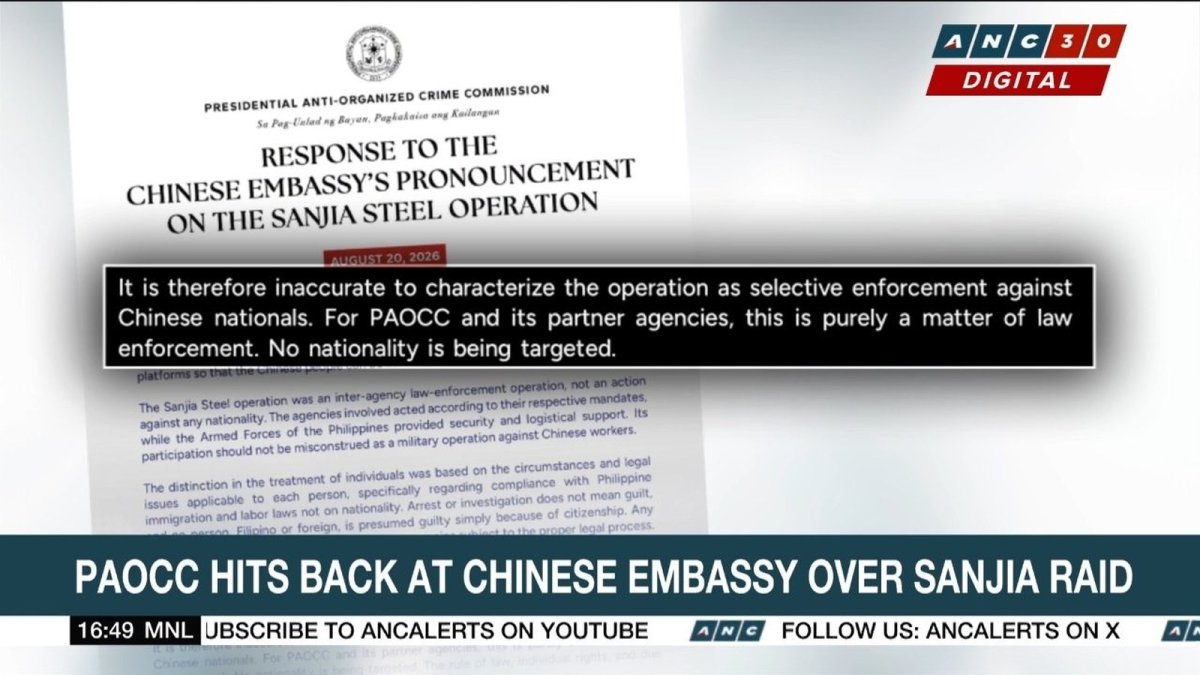
Manila, Philippines – August 20, 2026 — The Presidential Anti-Organized Crime Commission (PAOCC) on Thursday slammed the Chinese Embassy in Manila for its remarks on the government's operation at a steel plant in Misamis Oriental, accusing the diplomatic mission of "a clear disregard for diplomatic decorum and the sovereign laws of the Philippines." In a strongly worded statement, PAOCC challenged the Embassy to allow the same open public dialogue on Chinese social media platforms "so that the Chinese people can be informed of the full, transparent facts." The retort comes after the Chinese Embassy questioned why only Chinese workers were arrested during the raid while about 300 Filipinos were released on the spot, asking if "nationality [is] being used as the basis for distinguishing between people and determining guilt."
The Diplomatic Backlash
PAOCC's statement, released today, was unyielding in its defense of the operation's legitimacy. The commission emphasized that the Sanjia Steel operation was an inter-agency law-enforcement action, not an act targeting any specific nationality. "Its participation should not be misconstrued as a military operation against Chinese workers," PAOCC said, referring to the role of the Armed Forces of the Philippines (AFP), which provided security and logistical support during the raid. The commission rejected claims that Chinese nationals were selectively targeted, stating: "The distinction in the treatment of individuals was based on the circumstances and legal issues applicable to each person, specifically regarding compliance with Philippine immigration and labor laws not on nationality."
The challenge to the Chinese Embassy was pointed: allow the same unfiltered public discourse on Chinese platforms that Filipinos enjoy on social media. PAOCC's demand reflects a growing frustration within the Philippine government over what it perceives as Beijing's attempts to influence domestic law enforcement through diplomatic pressure. The commission's statement also served as a reminder that the operation was conducted within the bounds of Philippine law, with all agencies acting within their mandates.
What Happened at Sanjia Steel
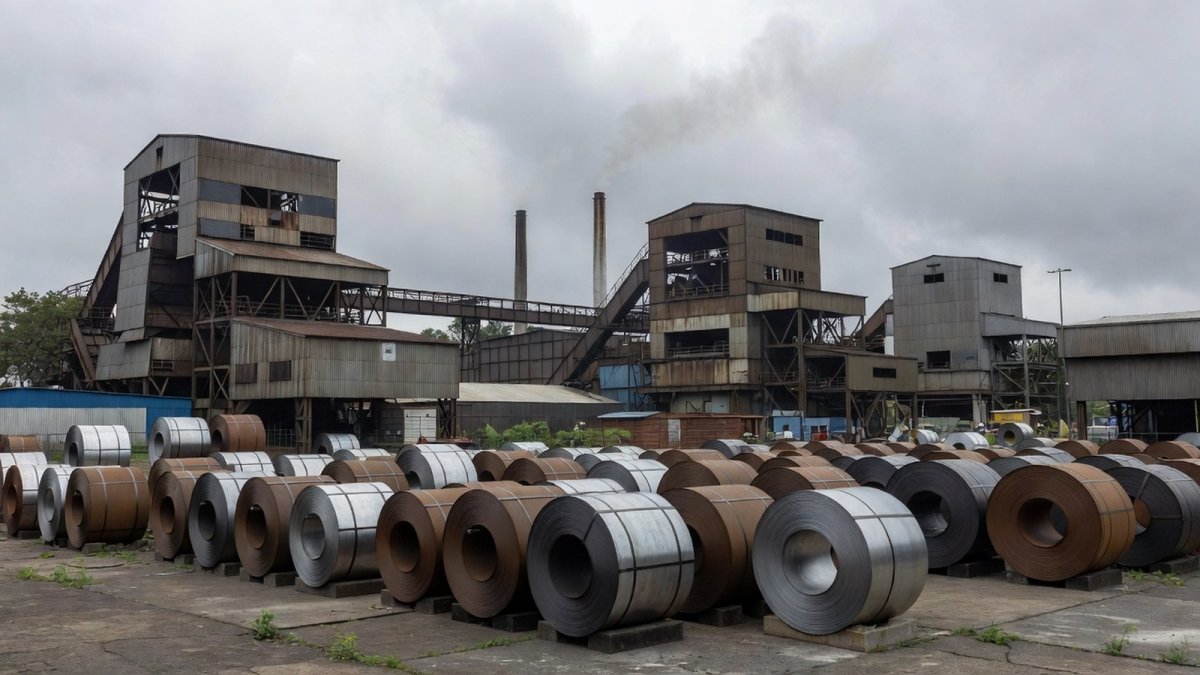
The controversy traces back to May 15-16, 2026, when close to 70 Chinese workers—69 to be exact—were arrested in a joint operation by PAOCC and the National Bureau of Investigation (NBI) at Philippine Sanjia-Steel Corporation inside the PHIVIDEC Industrial Estate in Tagoloan, Misamis Oriental. The arrests were made over alleged violations of immigration, labor, and environmental laws. Authorities found the facility allegedly substandard and hazardous to health, raising immediate concerns about the safety of workers and the surrounding community.
Sanjia Steel, however, has called the operation "harassment." Spokesperson and legal counsel Julia Chu was blunt in her assessment: "This was not about public safety. This was harassment packaged as law enforcement... Legitimate compliance issues are ordinarily addressed through a Notice of Violation process—not by serving criminal search warrants, shutting down an industrial complex, and detaining technical personnel." Chu's statement highlights the company's contention that the raid was disproportionate and politically motivated, a claim that PAOCC and the Department of National Defense (DND) have categorically denied.
The Embassy's Objections
Chinese Embassy spokesperson Ji Lingpeng on Wednesday escalated the rhetoric, questioning why Defense Secretary Gilbert Teodoro allegedly personally led a team that arrested Chinese workers and why military personnel and aircraft were mobilized. "Isn't that precisely selective and targeted law enforcement?" Ji asked. He added: "National security is certainly important, but it cannot be built on fabricated narratives, deliberately exaggerated threats, and the framing and persecution of a particular group of people." The Embassy's statements have been interpreted by Philippine officials as an attempt to delegitimize the operation and pressure Manila into releasing the detained workers.
Defense Secretary Gilbert Teodoro fired back with characteristic bluntness, accusing the Chinese Embassy of acting as a "PR firm" for individuals involved in illegal activities, including businessman Tony Yang. "The Chinese Embassy is now a PR firm for Tony Yang and other illegal activities in this country, which are apparently their clients... they are covering up for these people," Teodoro said. The DND and PAOCC jointly denied that authorities selectively targeted Chinese workers, reiterating that the operation was based on evidence of legal violations, not nationality.
Philippine Context
This diplomatic clash is unfolding against a backdrop of increasingly strained China-Philippines relations, marked by territorial disputes in the West Philippine Sea and growing concerns over Chinese economic influence. The Senate hearing on August 13, 2026, led by Sen. Risa Hontiveros (committee on economic affairs), brought to light a startling revelation: PAOCC Executive Director Benjamin Acorda Jr., a former PNP chief, testified that China had threatened to arrest Filipino workers in China if the Philippines did not release the Chinese nationals arrested in the raid. "During their visit to my office... we were told that there was a threat to arrest Filipinos in their country if we did not release the Chinese workers," Acorda told the Senate.
Hontiveros did not mince words in her reaction, stating that such threats or retaliation for legitimate law enforcement operations should be protested. "Those kinds of threats or simple retaliation for legitimate law enforcement operations in our country are certainly not something to be appreciated at all," she said, noting that it was not the first time the embassy had made such threats, citing personal experience. Acorda also raised eyebrows by revealing that on the second day of the operation, the Chinese Embassy already had complete copies of the documents—"It seemed like they obtained the documents even before we did," he said, suggesting possible intelligence leaks or unauthorized access.
Adding another layer of concern, the NBI has raised alarm over radiologically-contaminated steel bars linked to Sanjia. The NBI said Sanjia's connection to that network heightened concerns that the facility's operations may form part of a broader pattern of foreign economic activity warranting closer national security and regulatory scrutiny. This revelation has shifted the narrative from a simple labor dispute to a potential national security issue, complicating the diplomatic standoff.
Impact on Filipinos
For ordinary Filipinos, this dispute is not abstract. The PHIVIDEC Industrial Estate in Tagoloan is a hub of economic activity in Northern Mindanao, employing thousands of workers, many of whom are Filipinos. The raid and subsequent shutdown of Sanjia Steel have disrupted livelihoods, with about 300 Filipino workers released on the spot left uncertain about their employment status. The controversy also raises questions about the safety of working conditions in foreign-owned plants and the enforcement of labor and environmental laws that protect Filipino workers.
Beyond the immediate economic impact, this dispute touches on national sovereignty. The Chinese Embassy's questioning of Philippine law enforcement actions, and the alleged threat to arrest Filipino workers in China, strikes at the heart of the nation's ability to govern itself. For Filipinos, the message is clear: the government must stand firm against foreign interference, even at the risk of diplomatic fallout. The steel supply chain is also a concern, as Sanjia Steel is a major supplier in the region, and its shutdown could affect construction and manufacturing sectors that rely on its products.
Reactions and Responses
Sen. Hontiveros has been vocal in her support for the operation, urging the executive branch to protest the alleged threats from China. Civil society groups have also weighed in, with some expressing concern over the militarization of law enforcement operations, while others have praised the government for taking a firm stand on sovereignty. Business groups, meanwhile, are watching closely, wary of the potential economic repercussions of a diplomatic rift with China, one of the country's largest trading partners.
Public sentiment appears divided. Some Filipinos support the government's actions, viewing them as a necessary assertion of sovereignty, while others worry about the long-term consequences of antagonizing a major economic power. The controversy has also sparked discussions on social media, with many netizens debating the fairness of the operation and the role of foreign embassies in domestic affairs. At the center of it all is a simple question that resonates in every barangay: can the Philippines enforce its own laws without fear of foreign pressure?
What to Watch For
In the coming weeks, several developments are expected to shape the outcome of this dispute. The Senate is likely to hold further hearings on the matter, with Sen. Hontiveros pushing for a formal protest against China's alleged threats. The court cases of the 69 detained Chinese workers will also be closely monitored, as their outcomes will set a precedent for how foreign nationals are treated under Philippine law. Diplomatic fallout is inevitable, but the extent of the damage to China-Philippines relations remains to be seen. The DND and PAOCC have indicated they will continue to enforce the law without fear or favor, signaling that this operation is just the beginning of a broader crackdown on illegal activities in foreign-owned enterprises.
The Sanjia Steel controversy is a defining moment for the Philippines. It tests the nation's resolve to uphold its laws in the face of foreign pressure, and its ability to protect the rights and safety of all workers, regardless of nationality. As the diplomatic war of words continues, one thing is certain: the Filipino people are watching, and they expect their government to act with integrity, transparency, and unwavering commitment to sovereignty. The outcome of this dispute will not only shape the future of foreign investment in the Philippines but also set the tone for how the nation navigates its complex relationship with China in the years to come.
By Bella Reyes, Staff Writer
This article was produced with AI-assisted research and editorial support. Reporting is based on sources cited in the article.
What's Your Reaction?
 Like
0
Like
0
 Dislike
0
Dislike
0
 Love
0
Love
0
 Funny
0
Funny
0
 Wow
0
Wow
0
 Sad
0
Sad
0
 Angry
0
Angry
0

Philippines/Southeast Asia Correspondent at Global1.News. Manila-based journalist covering Philippine politics, environment, maritime security, and social issues. Passionate about marine conservation and the communities protecting the Philippines' natural heritage.















Comments (0)