
South Africa's ANC Falls Below a Third and Calls Its Own Result Catastrophic
South Africa's ANC fell to 30.89 per cent and 3,164 council seats in the 2026 local elections, its worst result ever, leaving seven of eight metros without an outright winner as coalition talks begin.
South Africa's governing party recorded its lowest share of the vote since the end of apartheid, and by Sunday night its own secretary-general had supplied the verdict the numbers had already written. The African National Congress finished the 2026 local government elections on 30.89 per cent of the national vote, holding 3,164 of the 10,526 council seats contested across 213 municipalities. It is the first time the party has fallen below a third of the vote in a national contest, and it leaves seven of the country's eight metropolitan municipalities without a single party able to govern alone.
South Africa's ANC Falls Below a Third and Calls Its Own Result Catastrophic
Midrand, South Africa — Mosotho Moepya, chairperson of the Electoral Commission, declared the elections free and fair on Sunday evening at the national Results Operations Centre at the Gallagher Convention Centre, closing a count that had run since polling day on 4 November through a Constitutional Court order, a national ballot reprint and a wave of objections.
A Verdict the ANC Called Catastrophic Itself
The scale of the loss is best read against 2021 rather than against the party's own mythology. The ANC fell by almost fifteen percentage points nationally in five years, according to BusinessTech's reading of the count, while the Democratic Alliance gained just under three points. ActionSA, which took 2.33 per cent in 2021, climbed to 5.67 per cent and 219 seats. The uMkhonto weSizwe Party, in its local government debut, took 9.61 per cent and 701 seats, almost all of it in KwaZulu-Natal. The party that led the transition in 1994 is now the largest single force in the country and the second or third force in most of its cities.
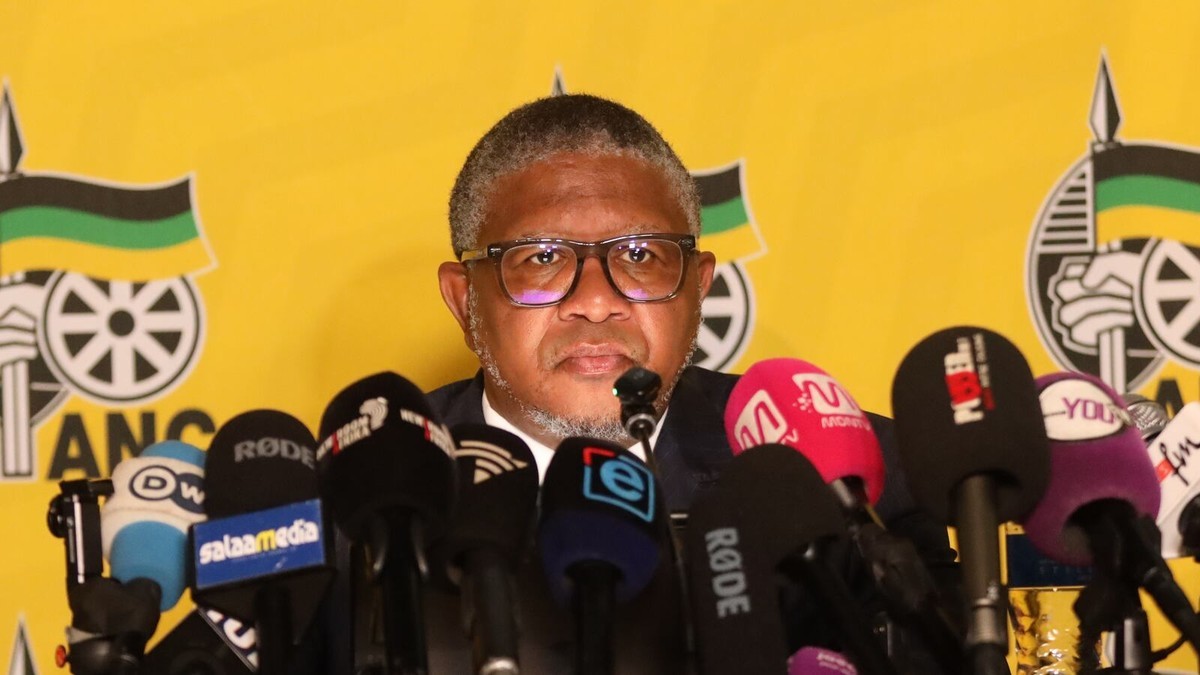
Fikile Mbalula, the ANC's secretary-general, did not contest the meaning of it. “This has been a catastrophic outcome,” he told reporters at the results centre on Saturday, adding that internal polling had suggested the party could count on at least 34 per cent. “We knew this outcome was coming.”
What the Ballots Actually Said
Turnout rose, and that is the detail that should worry the governing party most. Some 14.9 million of the 29.2 million registered voters cast a ballot, a turnout of 52 per cent, up 6.1 percentage points from the 45.9 per cent recorded in 2021. More South Africans participated than in the previous municipal election, and the ANC still shed almost fifteen percentage points of its national share. The spoilt ballot rate was 1.84 per cent.
The logistics were vast and, by the commission's own account, imperfect. A total of 521 political parties and 636 independent candidates fielded roughly 137,000 candidates. The commission printed just over 100 million ballot papers, deployed some 188,000 staff across 23,696 voting stations and accredited about 6,000 observers from 121 organisations. Moepya also disclosed that a member of commission staff died at a voting station in Mahikeng on election day.
Five Metros Blue, and Two the ANC Still Leads
The Democratic Alliance finished first in Johannesburg, Tshwane, Ekurhuleni, Nelson Mandela Bay and Cape Town. The ANC leads in Buffalo City and Mangaung, and the MK Party leads in eThekwini. In Johannesburg the DA took 34.79 per cent against the ANC's 20.25 per cent, with ActionSA third on 16.27 per cent, the Economic Freedom Fighters on 6.52 per cent and the MK Party on 5.57 per cent. In Tshwane the DA reached 34.37 per cent, ActionSA 22.07 per cent and the ANC 20.22 per cent.
Ekurhuleni followed the same pattern with the DA on 30.68 per cent, the ANC on 22.11 per cent and ActionSA on 18.5 per cent. In Nelson Mandela Bay the DA took 44.17 per cent to the ANC's 25.48 per cent, and eighteen parties will share seats in that council. Buffalo City, at 41.93 per cent, is now the ANC's strongest metro. Mangaung is the tightest: 33.91 per cent for the ANC against 33.49 per cent for the DA, a gap of less than half a point, and the ANC lost outright control of it for the first time.
Cape Town, and Seven Cities Without a Winner
Cape Town was the only metro where any party cleared fifty per cent of the vote. The DA took 56.42 per cent there, with the ANC on 13.95 per cent, the Patriotic Alliance on 3.77 per cent and the EFF on 3.73 per cent. Everywhere else the arithmetic now governs the politics. Johannesburg's 270-seat council needs 136 for a majority; preliminary allocations put the DA on 91 and ActionSA on 43, which is 134, two seats short of a working majority between them.
Tshwane has 214 seats and ActionSA won 48 of them, making Nasiphi Moya's party the hinge of any Gauteng deal. eThekwini has 223 seats and needs 112. The MK Party's 86 seats were the largest single bloc, ahead of the DA's 57, the ANC's 37, the Inkatha Freedom Party's 15, ActionSA's seven and the EFF's four.
We Will Not Beg for Mayorship
Mbalula's briefing was as much an attempt to set terms as to concede. “As we speak, there are no formal talks under way,” he said on Saturday. “We expect that such discussions will begin soon and the ANC will approach them in good faith.” He listed three options and refused to rank them: coalition government, confidence-and-supply arrangements with another party's executive, or opposition. “But we will not negotiate with anyone with a cap in their hand, begging,” he said. “We are not in the business of begging for mayorship or any other positions.”
The party's national executive committee meets this week to convert that into what Mbalula called a national doctrine for every hung council. He also confirmed the ANC had requested a recount in Gauteng and lodged objections over alleged discrepancies in the count. The party's own spokesperson, Mahlengi Bhengu, was blunter still: “There is no room for arrogance. As much as we still have a national footprint across the country, we have suffered a serious decline. The SG described it as catastrophic; we couldn't agree more.”
ActionSA Holds the Door Shut on Zille
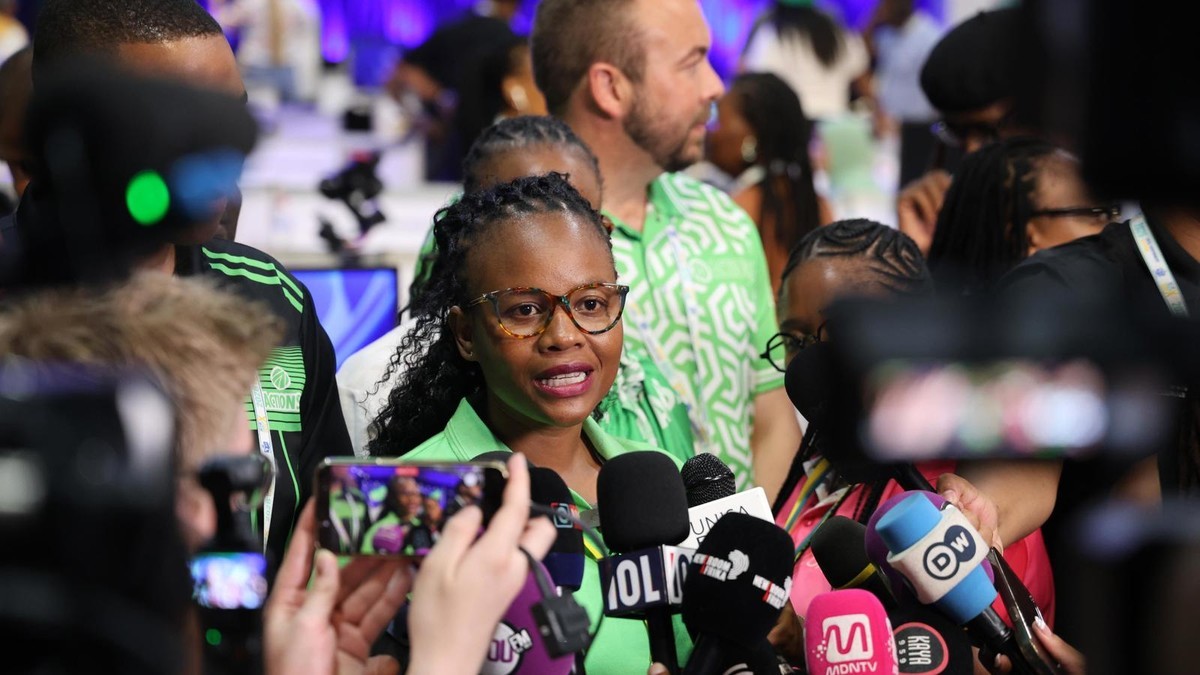
The clearest obstacle to a DA-led Gauteng is not the ANC but the man who would have to sign the deal. Herman Mashaba said any arrangement involving ActionSA must keep Moya in the Tshwane mayoralty, and he set a price the DA would struggle to pay. “And also in Tshwane, you remove that racist Cilliers Brink, Nasiphi Moya must continue serving all the residents of Tshwane,” he said at the results centre. “And you guys can take Ekurhuleni.” If the DA were not prepared to do that, he added, there was no reason to waste anyone's time.
He has also ruled out sitting down with the DA while Helen Zille, its federal council chairperson, is in the room. ActionSA's national chairperson, Michael Beaumont, described a first round of talks with the ANC as “productive” and mutually respectful. Zille has said she would favour a two-party coalition with either ActionSA or the ANC, on the argument that fewer partners make an administration easier to manage.
The Party Disputing the Election It Won
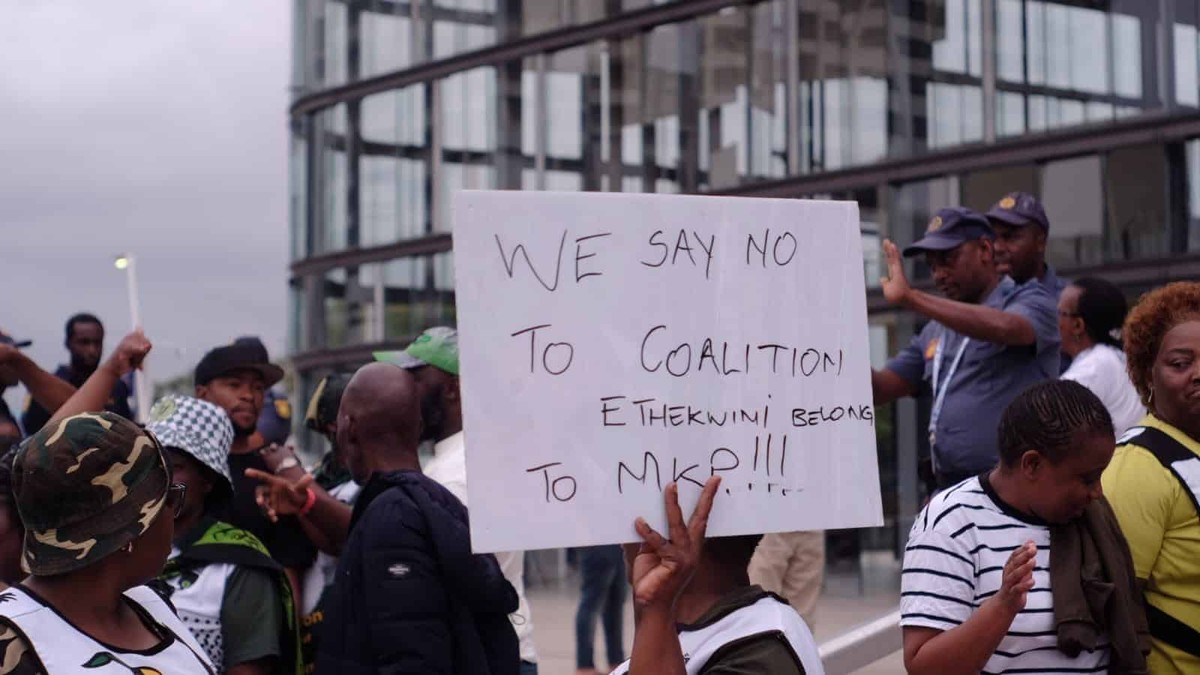
In eThekwini the winner is contesting the count it won. The MK Party lodged a formal objection on Friday under section 65 of the Municipal Electoral Act, signed by acting secretary-general Lindiwe Makubu and addressed to commissioner Titi Pitso. It alleges a system failure at the eThekwini results centre disrupted data streams and altered visible audit trails, and that figures on the electronic leaderboards deviate from the certified Form NP041 results slips counter-signed by party agents at voting stations.
It wants the disputed entries locked, an independent forensic analyst appointed by the contesting parties to examine the commission's data-processing systems, the withdrawal of commission remarks about its agents, and the final announcement and gazetting of results postponed until every dispute is resolved. The objection was lodged on Friday with an application for condonation in case it is processed after the five o'clock statutory deadline. MK officials have said they will not enter coalition talks with preconditions attached.
Three Deals on the Table, and No Deadline to Sign Them
Three broad shapes are in play. The first is a progressive alliance of ActionSA, the ANC, the MK Party, the EFF and the Patriotic Alliance, which would carry Johannesburg, Tshwane, Ekurhuleni and the smaller hung metros, with ActionSA taking Tshwane and the ANC keeping Johannesburg and Ekurhuleni. The second is a DA-ANC pact. The third is a DA-ActionSA arrangement, which on the numbers falls short of a majority in both Johannesburg and Ekurhuleni.
There is no legal deadline for any of it. Political parties are not obliged to conclude a coalition agreement within any fixed period. President Cyril Ramaphosa used his address on Sunday to ask for something narrower: that councils be constituted without unnecessary delays, that office-bearers be elected through good-faith negotiation and that municipal budgets be passed on time. “This is not a weakness of democracy,” he said. “It is an expression of the choices that the people have made.”
What Is Not Established
The count of hung councils is not settled even in the telling. Moepya put it at 127 of 213 municipalities, with 72 under outright control, a breakdown that leaves fourteen councils unaccounted for. An analysis published by The Common Sense put the number needing cooperation at 138, against 66 in 2021, while an EWN headline on Monday said 108 municipalities remained hung. The direction is not in dispute: the 2021 election left 66 councils without an outright winner.
The national percentages moved between the live dashboard and the declaration. At roughly 99 per cent counted the commission's board showed the ANC on 30.76 per cent and the MK Party on 9.76 per cent; the declared figures are 30.89 and 9.61. The MK Party's allegations have not been independently established, and the commission has not accepted them. No mayor has been elected anywhere. And reports that Ramaphosa is weighing his own position remain reports, not a resignation.
Before the Wednesday Deadline
KwaZulu-Natal's numbers may still move. The province's electoral officer, Ntombifuthi Masinga, said the results announced on Sunday are preliminary and subject to section 65 objections filed late, with the commission's seven-day window to finalise programming expiring on Wednesday, 11 November. KwaZulu-Natal accounted for 11 per cent of the objections lodged nationally. Turnout there was 49 per cent, with a spoilt ballot rate of 1.45 per cent.
The commission has already ordered a revote in Ward 3 of Siyancuma Municipality in the Northern Cape, at the Jabulani Community Hall voting district in Douglas, after ballot papers were destroyed before counting. It has approached the Electoral Court and opened a criminal case. And in Nelson Mandela Bay, the shooting dead of UDM councillor Luxolo Namette, a former deputy mayor there, was reported on Saturday; his party fears a political motive, and Mbalula condemned political killings as a crime against democracy.
What to Watch
The first real test is procedural, not rhetorical. Councils must be constituted and mayors and speakers elected before any coalition document means anything, and the parties that spent the weekend describing red lines will have to test them against a voting register. Watch three things: whether ActionSA's Tshwane demand survives contact with the DA's own base, whether the MK Party's objection changes a single seat in eThekwini, and whether the ANC's national executive committee converts Mbalula's three options into one instruction for its regional structures.
For residents of Johannesburg, Tshwane, Ekurhuleni, eThekwini and Nelson Mandela Bay, none of that is abstract. The elections were fought on water, electricity, refuse collection and safety, and the councils now being assembled are the ones that will decide whether any of it improves. The ballot has been counted. The government of the cities has not yet been chosen.
By Jessica Ali, Staff Writer
This article was produced with AI-assisted research and editorial support. Cover: Global 1 News editorial image. Photographs: Thapelo Morebudi/Sowetan; Karabo Tebele/702; Dylan Mohlala/The Citizen. Sources: Independent Electoral Commission of South Africa (official declaration, 8 November 2026); BusinessTech; Moneyweb/The Citizen; IOL; eNCA; EWN; TimesLIVE/Sowetan; Business Day; The Common Sense.
What's Your Reaction?
 Like
0
 Dislike
0
 Love
0
 Funny
0
 Wow
0
 Sad
0
 Angry
0

Editor-in-Chief at Global1.News. Atlanta-based journalist who cuts through the BS and tells it like it is. Lead anchor, host, and the voice you hear when the spin stops and the truth starts.









Comments (0)