
Oil Tanker Explodes in Strait of Hormuz as Iran Tensions Boil Over
An oil tanker exploded in the Strait of Hormuz on July 26 after striking a naval mine, with Iranian media reporting the vessel had deviated from designated shipping routes and turned off its radar. The explosion is the latest in an escalating series of maritime incidents amid the US-Iran conflict, with oil prices already above $100 per barrel and global energy security hanging in the balance.
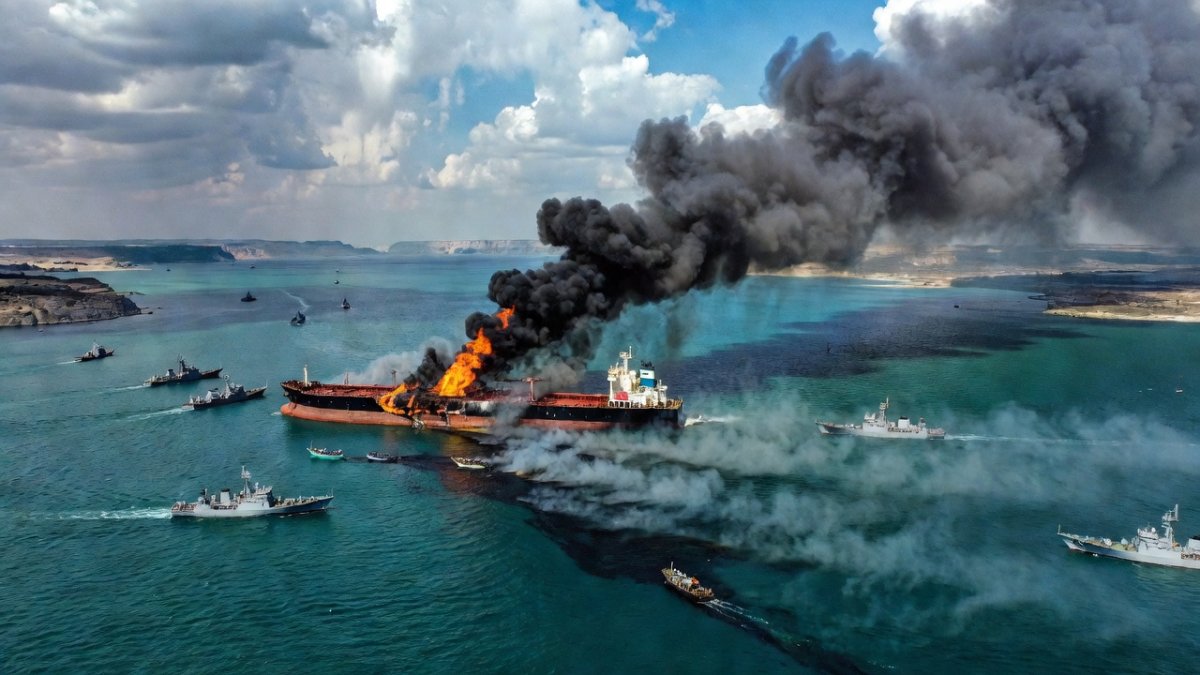
Folks, we've got another one. A tanker just exploded in the Strait of Hormuz. Today is July 26, 2026, and if you thought the situation in the Middle East couldn't get any more volatile, think again. An oil tanker struck a naval mine and went up in flames after deviating from the shipping route designated by Iranian authorities — and it turned off its radar before doing so. This isn't a drill. This is the latest flashpoint in a conflict that's sending shockwaves through global energy markets and putting the entire region on edge.
Oil Tanker Explodes in Strait of Hormuz as Iran Tensions Boil Over
Atlanta, GA — An oil tanker exploded in the Strait of Hormuz on Sunday after colliding with a naval mine, according to Iran's semi-official Tasnim News Agency. The vessel had allegedly deviated from the maritime route designated by Iranian authorities and turned off its radar system before the blast, Mehr News reported. The Islamic Revolution Guards Corps (IRGC) also intercepted six vessels for attempting what it called "illegal transit" through the strategic waterway.
The Blast: What We Know
According to Iranian state-affiliated media, the explosion occurred after the tanker left the shipping corridor that Iran has unilaterally designated for vessels transiting the strait. Defa Press, another Iranian outlet, quoted an informed source saying the tanker "deviated from the route specified by the Republic of Iran" approximately one hour before the explosion. The vessel had reportedly turned off its radar system — a move that Iranian authorities have previously warned would be treated as a hostile act.
No official confirmation has been released regarding casualties, the tanker's flag state, or the extent of the damage. Shipping companies are bracing for the worst, and environmental organizations have voiced alarm over the potential for a major oil spill in one of the world's most ecologically sensitive and strategically vital waterways. The IRGC's interception of six additional vessels on the same day suggests this was not an isolated incident but part of a broader Iranian effort to enforce its maritime claims through force.
It is worth noting that independent verification of Iranian claims has historically been difficult to obtain. The U.S. military has previously disputed Iranian accounts of similar incidents, and no Western source has independently confirmed this explosion. What is clear, however, is that the pattern of escalating maritime incidents in the region is undeniable.
Why the Strait of Hormuz Matters
Let me be blunt about this — the Strait of Hormuz is not just another shipping lane. It is the single most important energy chokepoint on the planet. At just 39 kilometers (24 miles) wide at its narrowest point, this sliver of water between Iran and Oman carries more oil than any pipeline or canal on Earth. Roughly 21 million barrels of oil — about 20% of the world's daily consumption — pass through these waters every single day.
To put that in perspective: every major economy on Earth depends on this strait staying open. Japan gets nearly all of its oil through here. China, India, South Korea — they all rely on Hormuz. When something goes wrong in this waterway, the entire global economy feels it within hours, not days. And right now, a lot of things are going wrong.
Earlier this month, the U.S. reinstated a naval blockade on maritime traffic to and from Iranian ports in the strait. On July 16, just 13 ships passed through—a fraction of the normal traffic. The New York Times reported that the blockade had "eroded" tanker traffic to historic lows. And now, with today's explosion, that number could drop even further. The strait that once saw 21 tankers a day is becoming a ghost waterway.
Oil Markets in Turmoil
If you've filled up a gas tank recently, you already know prices have been climbing. But what happened this week is another level entirely. On July 23 — just three days ago — oil prices surged past $100 per barrel for the first time since May. That spike came after Yemen's Houthi rebels, who are backed by Iran, struck two Saudi oil tankers in the Red Sea. According to Al Jazeera, oil prices increased for a fifth straight day, with Brent crude crossing the triple-digit threshold as fears mounted that shipping routes across the Middle East were becoming too dangerous to navigate.
Then came today's explosion. While markets were closed when the news broke, the writing is on the wall. Oil prices have already risen 25.79% in the past month alone and are up 38.84% year-over-year, according to Trading Economics. Brent crude stood at approximately $90.47 per barrel on July 24 — already elevated well above the pre-conflict baseline — and analysts expect a sharp spike when markets open tomorrow. Some projections suggest a jump of $5 to $10 per barrel in the coming days, pushing prices toward levels not seen since the Russia-Ukraine war sent shockwaves through energy markets in 2022.
For American consumers, this means one thing: higher prices at the pump. The national average for a gallon of gasoline has already climbed over the past month. If the Strait of Hormuz becomes even partially impassable, that number is going to climb faster and further than many can afford. This is not speculation — this is economic gravity.
Broader Middle East Context
Today's explosion did not happen in a vacuum. The U.S. and Iran are effectively at war. The United States has launched military strikes on Iranian positions, and the conflict has drawn in proxy forces across the region. The Houthis in Yemen have been striking Saudi and Israeli-linked vessels in the Red Sea. Iranian-backed militias in Iraq and Syria have targeted U.S. bases. Israel has been drawn into direct confrontations with Iranian forces.
According to CBS News, Oman and Iran have been engaged in talks about reopening the strait and restoring maritime traffic. Sources told CBS that progress has been made — but today's explosion calls that progress into serious question. If Iran is simultaneously negotiating with Oman while enforcing its maritime claims through naval mines and IRGC interceptions, it suggests a dual-track strategy: talk peace, but prepare for war.
The IRGC's role in this incident is particularly significant. The Guards have been increasingly assertive in the strait, claiming the right to designate shipping routes and intercept any vessel they deem in violation. In recent weeks, the IRGC has claimed responsibility for halting multiple tankers, with reports of two oil tankers exploding in the mined route south of the strait on July 18, and additional incidents on July 21 and July 23. This is not a one-off — it's a pattern of escalation.
What's at Stake
The stakes here are almost impossibly high. Let me lay them out for you:
Global energy security: A prolonged disruption in the Strait of Hormuz would trigger an energy crisis that makes the 1973 oil embargo look like a hiccup. Unlike the 1970s, today's global economy runs on just-in-time supply chains — there is no cushion. Every manufacturer, every airline, every shipping company, every commuter would feel the pain.
Humanitarian crisis: An estimated 20,000 seafarers remain trapped on vessels in the region, unable to leave as attacks continue. Their safety is not speculative — several ships have already been hit. The international community has been slow to respond to their plight.
Environmental disaster: Every tanker explosion carries the risk of a catastrophic oil spill. The Strait of Hormuz is home to critical marine ecosystems, including coral reefs, fisheries, and endangered species like the hawksbill turtle. A major spill would poison waters that Iran, Oman, and the UAE all depend on for drinking water desalination. The ecological damage would be measured in decades, not years.
Regional war: Each maritime incident brings the U.S. and Iran closer to a direct, full-scale military confrontation. The U.S. has already bombed Iran. Iran has already retaliated through its proxies and its minefields. The question is no longer whether this escalates further — it's when, and how badly.
The Bottom Line
Here's what you need to know. Today, an oil tanker exploded in the Strait of Hormuz. It hit a mine. The crew's fate is unknown. The IRGC intercepted half a dozen other ships on the same day. Oil is already above $100 a barrel and will likely climb higher. The strait — the most important energy waterway on Earth — is becoming a battlefield.
This is not a distant conflict that Americans can ignore. The price you pay for gas, for heating oil, for food that gets shipped across the ocean — it all runs through this 39-kilometer stretch of water. Every time a mine detonates or a tanker burns, the cost of everything goes up.
Diplomatic talks between Oman and Iran offer a glimmer of hope, but hope is not a strategy. The U.S. needs to be clear-eyed about what's happening in the Gulf and what it means for American families. This is not about foreign policy abstractions — this is about whether you can afford to drive to work next month.
The situation is fluid. We'll keep tracking it. I'll be back with updates as this story develops. For now, stay informed, stay vigilant, and call your representatives. Ask them what they're doing about the price at the pump and the ships burning in the Gulf. Because silence from Washington is not an option — not when the world's oil supply is going up in flames.
By Jessica Ali, Staff Writer
This article was produced with AI-assisted research and editorial support. Reporting is based on sources cited in the article.
What's Your Reaction?
 Like
0
Like
0
 Dislike
0
Dislike
0
 Love
0
Love
0
 Funny
0
Funny
0
 Wow
0
Wow
0
 Sad
0
Sad
0
 Angry
0
Angry
0

Editor-in-Chief at Global1.News. Atlanta-based journalist who cuts through the BS and tells it like it is. Lead anchor, host, and the voice you hear when the spin stops and the truth starts.














Comments (0)