
Lost Harris’s hawk found in Udon Thani after nearly two years
In the quiet evening of 7 November 2026, the gentle hum of a neighborhood in Muang district, Udon Thani, was broken not by traffic or market chatter but by the unexpected call of a bird of prey.
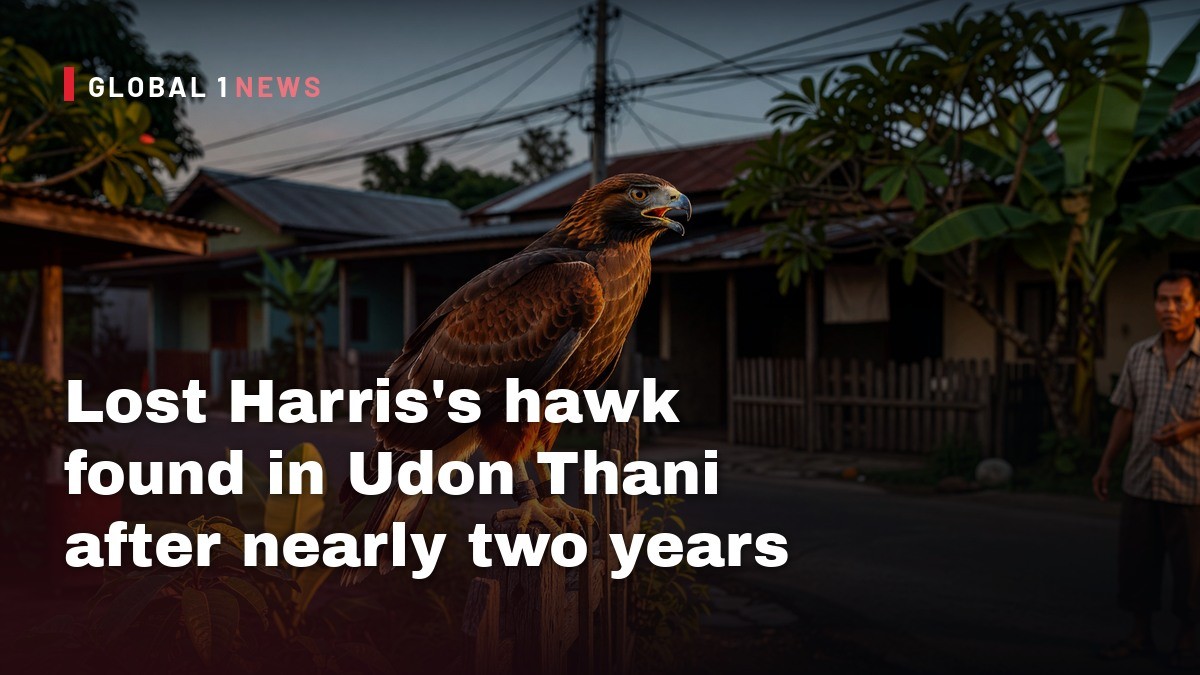
In the quiet evening of 7 November 2026, the gentle hum of a neighborhood in Muang district, Udon Thani, was broken not by traffic or market chatter but by the unexpected call of a bird of prey. A resident, Sorawee Phasuk, heard an unfamiliar bird’s cry and, guided by the keen ears of his dogs, discovered a large, tame Harris’s hawk perched calmly on a fence post. The bird’s lack of fear and its willingness to hop onto a human hand for food sparked a story that now weaves together local community spirit, the ancient art of falconry, and the compassion that underpins Thai society.
How a stray hawk found its way home
The discovery began with a simple, everyday scene: dogs barking at the back of a house in the Muang Thong community of Mak Khaeng subdistrict. When Sorawee investigated the commotion, he saw a bird that seemed more at ease than a wild raptor would be. Offering a bowl of dog food, he watched the hawk flutter onto his hand to eat, an act that revealed its unusual tameness. Recognising that the bird might be in danger if left unattended, he placed it in a dog cage for the night, ensuring its safety while he considered the next steps.
Morning brought a careful examination. Photographs taken by Sorawee were compared with online resources, confirming the species as a Harris’s hawk—a bird often associated with the practice of falconry. A small bell, an identification ring bearing a code, and a tether attached to its leg confirmed that the hawk had been raised and trained by humans, rather than being a wild bird that had simply wandered into the area.
Tracing the missing bird’s history
Armed with images and the leg tag details, Sorawee turned to local social media groups, a common avenue for community problem‑solving in Thailand. Within these networks, he uncovered old posts dating from February to September 2024 that reported a missing hawk. Those notices mentioned a location near a factory in Kumphawapi district and described a bird matching the one he now held. The overlap of the identification code and the physical description suggested that the hawk had indeed been missing for nearly two years.
Attempts to reach the owners through the telephone numbers listed in the 2024 notices proved fruitless; calls went unanswered, and the factory referenced in the posts offered no response. Undeterred, Sorawee reached out to a local Udon Thani media page, hoping that a broader public appeal might finally connect the bird with its caretaker.
The hawk’s condition and care
While the hawk’s calm demeanor was reassuring, its physical state told a quieter story. The leg tag and tether showed signs of fading and wear, and the bird appeared thin, a likely result of an extended period without proper nutrition. Sorawee noted that the hawk showed little interest in cooked rice—a staple of Thai meals—indicating that its diet required more appropriate prey. He plans to purchase fresh chicken meat to help the bird regain strength, a gesture that reflects the Thai value of caring for all living beings, whether human or animal.
This compassionate response aligns with Buddhist principles that permeate Thai culture, emphasizing kindness to all sentient life. By providing fresh meat and a safe environment, Sorawee embodies the community’s collective responsibility to look after those in need, even when they are unexpected guests.
Falconry in Thai society
The presence of a Harris’s hawk in a residential area highlights the niche yet enduring tradition of falconry in Thailand and the broader Southeast Asian region. While not as widespread as other forms of animal husbandry, falconry remains a respected practice among enthusiasts who train birds of prey for sport and cultural events. The identification ring and tether found on the hawk are typical of the equipment used by falconers to manage and monitor their birds.
In recent years, falconry has also become a point of cultural exchange, with Thai falconers participating in regional gatherings that celebrate ancient hunting techniques and the bond between human and raptor. The hawk’s return, therefore, is not merely a personal loss but a small thread in the tapestry of a living tradition that connects rural communities across borders.
Community response and the search for the owner
Since Sorawee’s online post, local residents have expressed curiosity and concern, reflecting the tight‑knit nature of Thai neighbourhoods where news travels quickly through word of mouth and social platforms. The appeal to the Muang Udon Thani media page invites anyone who recognises the hawk or possesses proof of ownership to come forward. This open call underscores a collective hope that the bird will be reunited with the person who trained and cared for it.
In Thai culture, the act of returning a lost animal carries moral weight, rooted in the Buddhist teaching of “mettā” – loving‑kindness. By facilitating the hawk’s safe return, the community not only restores a personal bond but also upholds a broader ethical standard that values honesty and compassion.
Implications for wildlife and domestic animal management
The incident raises questions about the balance between keeping raptors as domestic companions and ensuring their welfare. While the hawk was clearly accustomed to human handling, its thin appearance after a prolonged period of uncertainty suggests that such birds require consistent, specialised care. This case may prompt local authorities and animal welfare groups to consider guidelines that support falconers while protecting the health of the birds.
Moreover, the episode highlights the role of community vigilance. The dogs’ unusual barking acted as an early warning, and the resident’s willingness to investigate prevented the hawk from potentially suffering further hardship. Such grassroots involvement is essential in a country where wildlife often intersects with daily life, especially in provinces like Udon Thani that sit at the crossroads of agricultural lands and expanding industrial zones.
Looking ahead: hope for reunion
As the days pass, Sorawee continues to nurture the hawk, offering fresh meat and a safe enclosure while awaiting word from the rightful owner. The community’s collective effort—through social media, local media outreach, and personal concern—demonstrates the strength of Thai communal values in action. Whether the hawk’s owner emerges from the factory district of Kumphawapi or elsewhere, the story already serves as a reminder of the deep connections that bind people, animals, and the land.
In the spirit of Thai hospitality and Buddhist compassion, the hope remains that the hawk will soon soar again under the care of its original trainer, and that this episode will reinforce the importance of looking after all creatures, great and small, that share our world.
This article was produced with AI-assisted research and editorial support. Reporting is based on the source material cited below. Sources: Khaosod English; khaosodenglish.com; Global1.News (08 November 2026).
By Ann Srisawat, Staff Writer
What's Your Reaction?
 Like
0
 Dislike
0
 Love
0
 Funny
0
 Wow
0
 Sad
0
 Angry
0

Southeast Asia Correspondent at Global1.News. Based in Bangkok, covering Thai and Southeast Asian politics, economy, technology, and culture. Deep regional perspective on one of the world's most dynamic regions.















Comments (0)