
K-Beauty’s Brazil Push Signals a New Era of Korean Economic Statecraft
When South Korean President Lee Jae-myung traveled to São Paulo in late July 2026, the trade delegation he brought with him was a study in strategic juxtaposition.
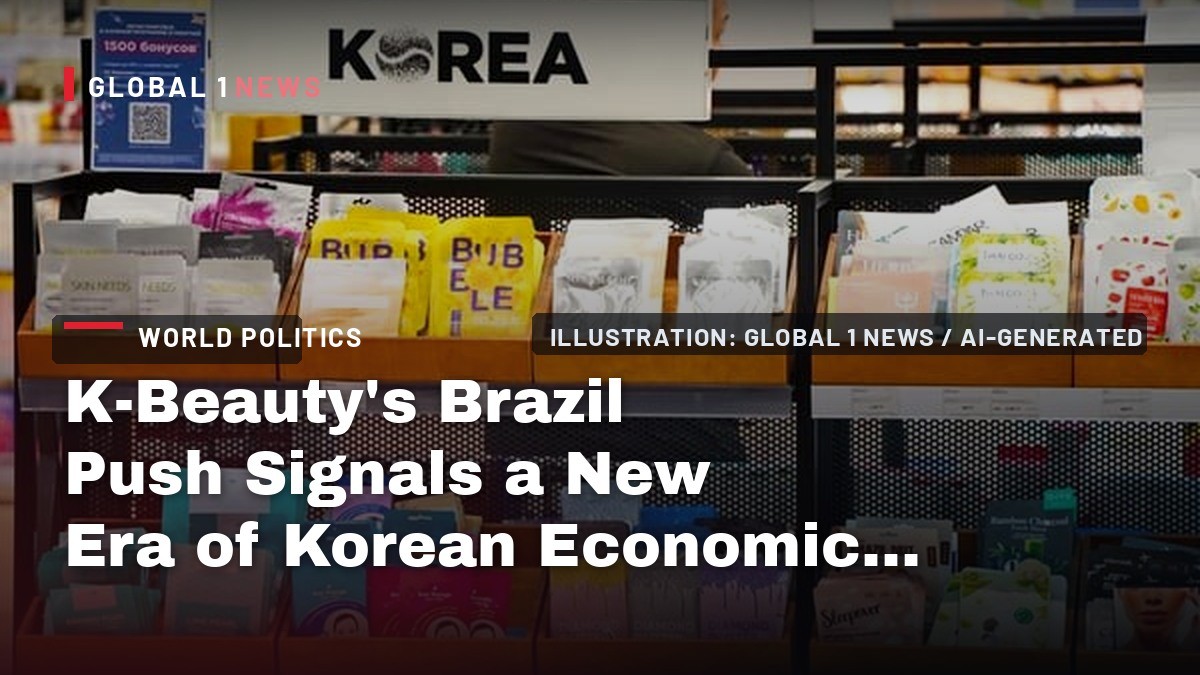
K-Beauty’s Rise to the Diplomatic Table: Lee’s Brazil Visit Converts Cultural Cachet into Commercial Statecraft
Seoul, South Korea — The inclusion of cosmetics among the three policy pillars of a state visit—alongside jet manufacturing and rare earths—signals that Seoul now treats its beauty industry as a core instrument of foreign policy, not merely a cultural byproduct. As the industry pivots away from a decade-old dependency on China, Brazil has emerged as the proving ground for a new model of Korean economic statecraft, where cultural influence is deliberately converted into regulatory agreements, trade surpluses, and strategic partnerships.
The São Paulo Agenda: Beauty Meets Heavy Industry
President Lee’s call for a deeper Brazil-South Korea partnership, articulated at a business roundtable in São Paulo on July 28, rested on three pillars: commercial aircraft, critical minerals, and K-Beauty. The first two are standard fare for any modern strategic partnership between an industrial powerhouse and a resource-rich emerging economy. The third is decidedly unconventional. Cosmetics rarely share diplomatic oxygen with jet manufacturing, yet their presence on the presidential agenda reveals the industry’s growing weight in Seoul’s foreign policy calculus.
The business delegation was matched by a parallel official channel. On July 27, First Vice Minister Roh Yong-seok of the Ministry of SMEs and Startups met with Brazil’s cosmetics association ABIHPEC and the e-commerce platform Mercado Libre. According to Roh, the parties agreed to pursue joint research and marketing initiatives that would pair Amazonian natural ingredients with South Korean cosmetic technology. Roh’s ambition was characteristically bold: he suggested such a partnership could pave the way for cosmetics to become “the world’s number one export item,” provided the industry continues to strengthen and diversify its markets. A separate two-day showcase, titled “K-Beauty Glow Big in Brazil,” ran alongside the summit, placing brands like Beauty of Joseon, d’Alba, Isntree, and Mixsoon before Brazilian retail buyers.
From THAAD Retaliation to Strategic Diversification
For all of its forward-looking ambition, K-Beauty’s entanglement with geopolitics is nothing new. The industry’s current trajectory is best understood as a direct response to the seismic shock of 2016. When Seoul agreed in July of that year to deploy the U.S. Terminal High Altitude Area Defense (THAAD) system to counter North Korean missile threats, Beijing retaliated with a campaign of economic coercion. China restricted tourism and banned imports of 19 Korean cosmetics, effectively dampening what had been K-Beauty’s dominant market.
The industry has spent the intervening decade deliberately reducing its China exposure. AmorePacific, the country’s largest cosmetics company, has publicly committed to rebalancing its China-heavy portfolio toward Western markets. Brazil represents the clearest measure of how far this diversification has now reached. It is Latin America’s largest consumer market and the world’s third-largest beauty market after the United States and China, yet historically it attracted little Korean investment, largely due to distance. That neglect is now being corrected with presidential urgency.
The Numbers Behind the Courtship
The recent surge of official attention is grounded in striking trade statistics. According to Korea Customs Service data, Korea’s cosmetics exports to Brazil jumped more than tenfold in five years, from $5.17 million in 2020 to $54.36 million in 2025. The acceleration has continued into the current year. In the first half of 2026, cosmetics exports to Latin America by Korean small and mid-sized companies rose 131.9 percent, while exports to Brazil alone surged 237.4 percent, making it the standout market even within a booming region. As one Silicon2 official noted, exports to the region “have just crossed $200 million, and the market is growing fast.”
These figures explain why the Korean state has not left the development of this opportunity solely to the companies themselves. The government has built a track for growth that predates Lee’s July visit. During a February 2026 summit between Lee and Brazilian President Luiz Inácio Lula da Silva, Korea’s Ministry of Food and Drug Safety and Brazil’s health regulator ANVISA signed a revised memorandum of understanding extending their regulatory cooperation to cosmetics for the first time. The agreement covers areas like e-labeling that determine how easily Korean products clear Brazilian borders—the unglamorous but essential infrastructure of trade.
Soft Power as a Commercial Asset
The February summit also carried a lighter kind of diplomacy. Lula, who has publicly credited Korean cosmetics for his own good looks, returned to Brasília with skincare products from LG H&H and AmorePacific. Lee, for his part, used the occasion to promise Brazilian consumers that K-Beauty “will become even more accessible.” This blending of personal anecdote and policy commitment illustrates a broader transformation underway in Korean statecraft.
K-Beauty has long been filed under soft power, a pleasant byproduct of the same Korean Wave that carried K-pop and K-dramas abroad. However, it has since become a serious economic engine in its own right. Cosmetics generated a trade surplus of more than $10 billion in 2025, or roughly 12.9 percent of South Korea’s entire $78 billion surplus. The Brazil visit demonstrates how the industry’s soft power is transforming into a commercial asset that the government now negotiates for and regulates around. K-Beauty has become an arena where the two forms of power feed into each other, where cultural influence built a demand that diplomacy is now converting into strategic and economic opportunities.
Momentum Without a Treaty
For the moment, however, the results of these dialogues resemble a buildup of momentum rather than any signed cosmetic deals. Lee and Lula agreed to push for a restart of stalled Korea-Mercosur trade talks, with an eye on the December Mercosur summit. Lula reportedly stated that the two countries “must double bilateral trade within two years.” Meanwhile, Seoul’s presidential policy chief, Kim Yong-beom, singled out cosmetics as an area where he expects substantial progress. None of this amounts to a treaty, but the overall direction is unmistakable.
The December Mercosur summit will be a critical test of whether this diplomatic courtship translates into institutional frameworks. A successful restart of Korea-Mercosur negotiations would lower tariff barriers across a bloc of some 295 million consumers, providing K-Beauty with a regulatory runway far beyond Brazil’s borders. For Korean exporters, the stakes are considerable: the industry has already demonstrated its ability to pivot from China dependency to U.S. and now Latin American markets in under a decade.
The Strategic Significance of the K-Beauty Experiment
Brazil is emblematic of what makes K-Beauty such a useful diplomatic instrument. The industry has proven adaptable, pivoting from a China dependency to U.S. and now Latin American markets in under a decade. It travels across very different consumer cultures, and its appeal has proven to have real staying power rather than fading with a single trend cycle. Unlike semiconductors or shipbuilding, which face intense competition and geopolitical scrutiny, cosmetics offer a relatively frictionless entry point for expanding economic relationships.
For Korean diplomacy, the beauty industry provides a unique bridge between the cultural appeal of Hallyu and the hard numbers of export-led growth. It allows Seoul to engage partners on terms that are mutually beneficial and politically uncontroversial—a stark contrast to the security dilemmas that have historically complicated Korea’s relationships in the region. The industry’s success in Brazil also carries lessons for other markets. If K-Beauty can thrive in a Portuguese-speaking, tropical market with distinct beauty standards and a powerful domestic cosmetics industry, it can likely adapt anywhere.
If the K-Beauty diplomatic experiment works anywhere, Brazil is where it will be proven, and Latin America is where the next chapter of Korean soft-power exports is most likely to be written. The December Mercosur summit will offer the first concrete indication of whether this momentum can be institutionalized. For now, the message from São Paulo is clear: in Korean statecraft, beauty is no longer merely ornamental—it is strategic.
This article was produced with AI-assisted research and editorial support. Sources: The Diplomat / CSIS New Perspectives on Asia (Nicole Choi, September 3, 2026).
By Prof. David Park, Staff Writer
What's Your Reaction?
 Like
0
Like
0
 Dislike
0
Dislike
0
 Love
0
Love
0
 Funny
0
Funny
0
 Wow
0
Wow
0
 Sad
0
Sad
0
 Angry
0
Angry
0
East Asia/Technology Correspondent at Global1.News. Seoul-based voice covering Korean politics, technology, business, and culture. Analyzes how technology and geopolitics intersect across East Asia.









Comments (0)