
Rupee rises 44 paise to 94.92 against U.S. dollar in early trade
The Indian rupee edged higher for the fourth consecutive session on Wednesday, October 14, 2026, tightening to 94.92 against the U.S. dollar after opening at 95.05 in the inter‑bank market.
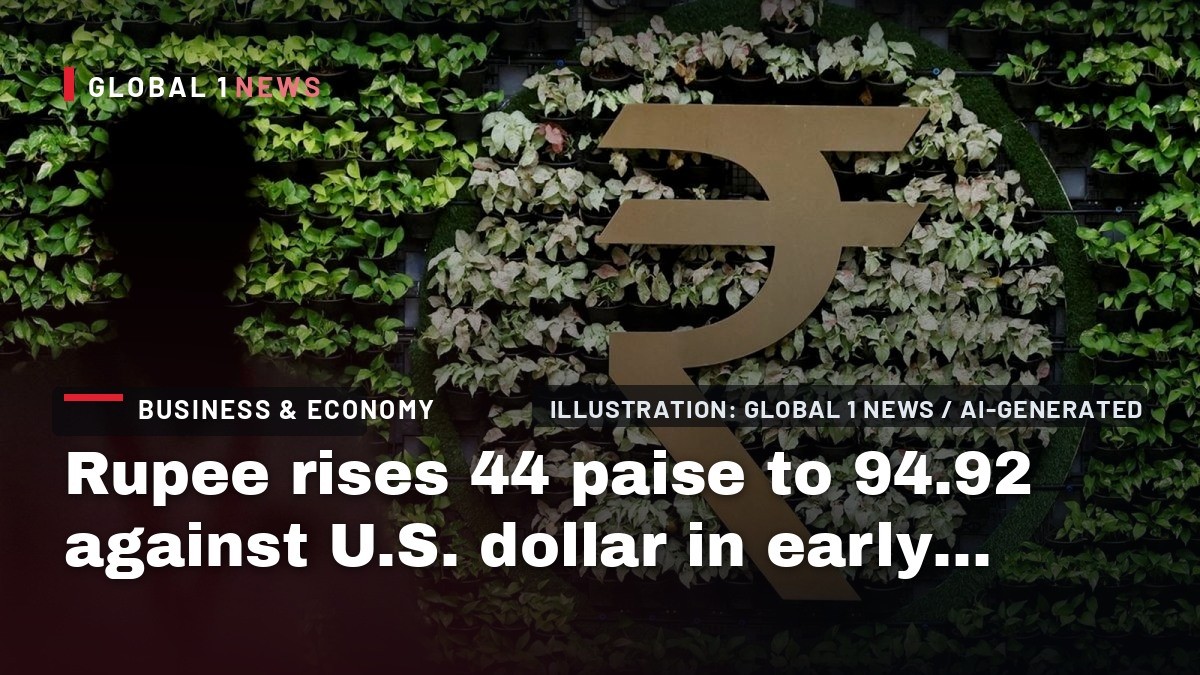
The Indian rupee edged higher for the fourth consecutive session on Wednesday, October 14, 2026, tightening to 94.92 against the U.S. dollar after opening at 95.05 in the inter‑bank market. The modest gain of 44 paise was attributed to a series of interventions by the Reserve Bank of India (RBI) aimed at easing near‑term dollar demand and curbing speculative foreign‑exchange activity. While the move signals short‑term relief, analysts caution that broader external pressures could limit further appreciation.
RBI’s tactical measures to stem volatility
Over the weekend, the RBI announced a “special window” for oil marketing companies, a step designed to divert dollar demand away from the spot market. By providing a dedicated channel for oil‑related dollar purchases, the central bank hopes to reduce pressure on the rupee that typically spikes when crude imports surge.
In parallel, the RBI tightened rules governing forex derivatives, targeting speculative bets that have historically amplified rupee swings. The bank also instructed banks to hold a 20 percent reserve for dollar purchases exceeding $2 million, a precautionary buffer intended to temper large‑scale foreign‑exchange transactions that could destabilise the market.
Impact of the interventions on market dynamics
Forex traders observed that the USD/INR pair, which had risen nearly 2 percent over the previous three trading sessions, opened on a positive note on Wednesday. The sustained move below the 95.00 threshold, they noted, opened the possibility of a further dip towards the 94.50 level, albeit with the caveat that external macro‑economic headwinds could temper any additional gains.
The rupee’s appreciation on Wednesday followed a 42‑paise rise on Tuesday, when it closed at 95.36. This sequence of gains underscores the immediate market response to the RBI’s policy announcements, suggesting that the central bank’s tools are effective in the short run, even as longer‑term fundamentals remain under pressure.
Finance Minister’s assessment of the rupee’s trajectory
Finance Minister Nirmala Sitharaman, speaking on Tuesday, highlighted that the rupee had depreciated “significantly” over the past year and a half. She reaffirmed the government’s commitment to supporting the RBI’s efforts to prevent excessive volatility, emphasizing that most of the currency’s recent turbulence stemmed from external challenges.
Ms. Sitharaman’s remarks dovetail with the RBI’s stance that macro‑economic fundamentals within the country remain sound. By framing the rupee’s recent weakness as largely driven by external factors, the ministry signals confidence in domestic policy levers while acknowledging the need for continued vigilance against speculative pressures.
External forces shaping the rupee’s outlook
The broader global environment continues to exert influence on India’s currency. The Dollar Index, a gauge of the greenback’s strength against a basket of six major currencies, was trading marginally lower by 0.06 percent at 102.11 on Wednesday. Although the dip was modest, it provided a backdrop of slight relief for the rupee.
Conversely, Brent crude, the benchmark for global oil prices, was up 0.57 percent at $106.29 a barrel in futures trade. Higher oil prices typically translate into greater dollar outflows for oil‑importing economies like India, reinforcing the RBI’s decision to create a dedicated oil‑marketing window to manage this specific source of demand.
Equity market reaction to currency movements
Domestic equity markets showed a muted response to the rupee’s modest gain. The Sensex slipped 32.96 points to 73,000.82, while the Nifty fell 32.65 points to 22,688.75 in early trade on Wednesday. The modest decline suggests that investors were more focused on corporate earnings and broader market sentiment than on short‑term currency fluctuations.
Foreign Institutional Investors (FIIs) offloaded equities worth ₹1,305.13 crore on a net basis on Tuesday, according to exchange data. While the rupee’s appreciation may have contributed to a slightly more favourable valuation environment for foreign investors, the net outflow indicates that other factors—perhaps global risk sentiment or sector‑specific concerns—were dominant drivers of capital movement.
Policy implications for the Indian financial ecosystem
The RBI’s recent actions illustrate a calibrated approach to foreign‑exchange management, balancing market‑based interventions with regulatory tightening. By targeting oil‑related dollar demand and speculative derivatives, the central bank is addressing two of the most volatile channels of rupee pressure.
For the banking sector, the 20 percent reserve requirement on large dollar purchases introduces an additional compliance layer, potentially influencing banks’ foreign‑exchange trading desks and their appetite for large‑scale dollar procurement. Over time, such measures could encourage a shift towards more diversified funding sources, reducing reliance on spot market dollar inflows.
Looking ahead: scenarios for the rupee’s path
Analysts suggest that a sustained stay below the 95.00 mark could pave the way for the rupee to test the 94.50 level, provided external shocks do not intensify. However, the persistence of global macro‑economic pressures—such as a resilient U.S. dollar, fluctuating oil prices, and geopolitical uncertainties—means that any further appreciation will likely be incremental and contingent on the RBI’s continued vigilance.
In the medium term, the effectiveness of the RBI’s special oil window and tighter derivatives regime will be judged by the volatility profile of the rupee in the coming weeks. If these tools succeed in dampening speculative spikes, they could set a precedent for future policy tools aimed at stabilising the currency without resorting to outright market interventions.
This article was produced with AI-assisted research and editorial support. Reporting is based on the source material cited below. Sources: The Hindu; thehindu.com; Global1.News (14 October 2026).
By Dr. Raj Patel, Staff Writer
What's Your Reaction?
 Like
0
Like
0
 Dislike
0
Dislike
0
 Love
0
Love
0
 Funny
0
Funny
0
 Wow
0
Wow
0
 Sad
0
Sad
0
 Angry
0
Angry
0

India/South Asia Correspondent at Global1.News. Analytical voice with a background in science and health journalism. Based in New Delhi, covering Indian politics, education, healthcare, technology, and policy. Breaks down complex data into clear, actionable reporting.















Comments (0)