
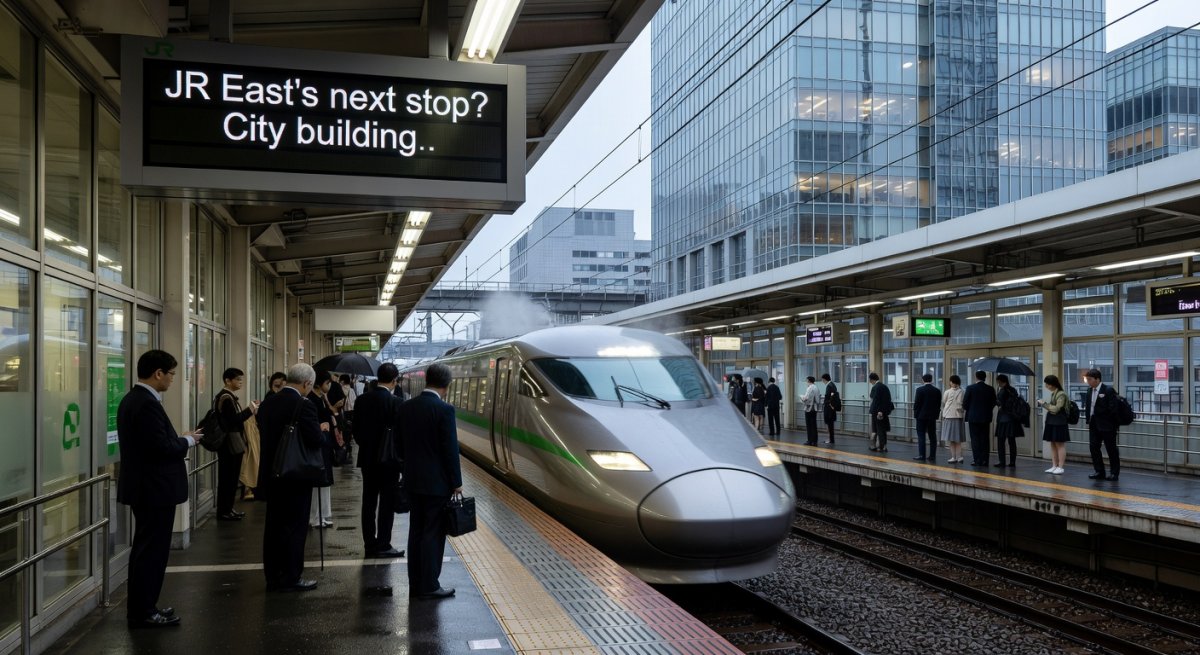
JR East's next stop? City building.
JR East's next stop? City building. From Railways to Real Estate: JR East's Strategic Pivot Since the privatization of Japanese National Railways in 1987, JR East has grown from a regional operator into a cornerstone of Japan's transportation network. The company inherited extensive lines across eastern Japan, including the Tokyo metropolitan area, and focused initially on reli
From Railways to Real Estate: JR East's Strategic Pivot
Since the privatization of Japanese National Railways in 1987, JR East has grown from a regional operator into a cornerstone of Japan's transportation network. The company inherited extensive lines across eastern Japan, including the Tokyo metropolitan area, and focused initially on reliable commuter and long-distance services. Over the decades, this foundation allowed JR East to become Japan's largest railway operator by revenue, serving millions of passengers daily while maintaining the punctuality and safety standards expected in the country.
Today, JR East is executing a clear strategic pivot away from pure reliance on rail fares. Land development, commerce, and urban redevelopment now form core pillars of its growth plan. Station areas once limited to ticket gates and platforms are being reimagined as mixed-use hubs that generate stable income streams less vulnerable to fluctuations in ridership. This approach mirrors broader trends among Japanese railway companies seeking to leverage their extensive land holdings in high-value urban zones.
The shift reflects lessons from decades of operating in a mature market. While core rail operations remain essential, JR East has expanded into retail complexes, office buildings, and residential projects tied directly to its stations. These ventures create synergies: commuters become shoppers and residents, while property income cushions the business against economic or demographic headwinds. In Japan's context, where land near transport nodes commands premium value, this model strengthens the company's long-term resilience.
Demographics Behind the Decision
Japan's population has been declining since 2010, marking a turning point after decades of growth. This national trend directly affects railway operators, as fewer residents translate into smaller pools of daily commuters. JR East, with its heavy concentration in the Kanto region, feels these pressures acutely even as Tokyo remains a magnet for younger workers.
An aging society compounds the challenge. With a rising median age, the number of regular commuters on many lines is shrinking, particularly outside peak hours. Retirees travel less frequently for work, and lower birth rates mean fewer students filling trains in the future. JR East must therefore diversify revenue to sustain infrastructure investments that support both urban mobility and regional connectivity.
The demographic reality also forces difficult choices between rural route contraction and urban corridor pressures. Many countryside lines see dwindling passengers, prompting reviews of service levels. In contrast, major urban arteries around Tokyo face capacity strains from concentrated populations and economic activity. JR East's move into real estate development targets these high-density zones, where redevelopment can capture value from ongoing urbanization while offsetting losses elsewhere in the network.
The Takanawa Gateway City Project
Tokyo's newest megadevelopment in the Greater Shinagawa Area represents JR East's most visible commitment to city building. The project transforms underutilized rail-adjacent land into a comprehensive urban district designed for the next generation of work and living patterns. Positioned to benefit from Shinagawa's role as a key gateway, it integrates seamlessly with existing transport infrastructure.
The mixed-use design incorporates offices, residences, retail facilities, and generous public spaces. This blend aims to create a self-sustaining neighborhood where people can live, work, and shop without relying solely on long commutes. Public plazas and green areas emphasize livability, aligning with Japanese urban planning priorities that value community interaction alongside commercial efficiency.
Central to the project is its integration with Takanawa Gateway Station. The new station serves as both a transit hub and the heart of the development, allowing seamless movement between rail platforms and surrounding buildings. This direct connection maximizes convenience for residents and workers while reinforcing JR East's strategy of anchoring real estate value to its rail assets in Japan's densest economic corridor.
Land Holdings as a Strategic Asset
JR East controls extensive land parcels along its rail corridors throughout eastern Japan. These holdings, often remnants of earlier infrastructure expansions, provide a ready foundation for commercial projects that integrate directly with station access. Former rail-adjacent parcels in areas such as Chiba and Saitama have been converted into mixed-use sites featuring retail and office space, allowing commuters to transition seamlessly from trains to daily activities without additional travel.
Private operators like Tokyu Corp and Hankyu Corp have maintained dedicated real estate arms for decades, developing department stores and complexes such as Tokyu department stores and Hankyu Sanbangai to capture value from passenger flows. JR East has begun applying similar principles on a larger scale, though its approach emphasizes coordination with existing rail operations rather than standalone retail ventures. In comparison, JR Central has pursued redevelopment around Shinkansen stations, creating commercial zones that leverage high-speed connectivity to draw regional visitors and support local businesses.
JR East maintains one of the largest land portfolios among Japanese railway operators, encompassing extensive trackside parcels that exceed the holdings of many private developers active in central Tokyo. This strategic advantage stems from its inheritance of former Japanese National Railways properties, allowing it to pursue integrated developments that private firms without rail access cannot easily replicate in a city where land scarcity drives intense competition.
Projects such as the redevelopment around Shinjuku, Shibuya, and Tokyo Station illustrate this edge, where JR East has leveraged air rights above operational tracks to construct multi-level complexes without expanding the urban footprint. In Tokyo's densely built environment, these vertical air rights have proven especially valuable, enabling revenue-generating structures that integrate seamlessly with station infrastructure while complying with strict zoning limits.
Regulatory Environment and Government Policy
Deregulation measures enacted over the past two decades have permitted railway operators to diversify beyond core transport services. These changes removed earlier restrictions that limited non-rail activities, enabling companies like JR East to pursue integrated property developments while maintaining safety standards. Land-use reforms and urban revitalization policies have further supported this shift by streamlining approvals for projects near stations, encouraging private investment in areas previously constrained by zoning rules.
National goals for balanced regional growth align with these reforms, directing attention toward areas outside major metropolitan centers. Policies promote transit-oriented development that links housing and commerce to rail networks, aiming to reduce disparities between urban and rural economies. JR East's initiatives reflect this framework, positioning rail operators as partners in achieving sustainable population distribution across Japan.
Implications for Japanese Cities and Regional Economies
Development patterns show a contrast between Tokyo-centric growth and efforts in regional centers. While projects in the capital benefit from high passenger volumes, similar strategies in cities such as Sendai and Niigata seek to strengthen local economies by anchoring commercial activity around stations. This approach integrates transit, housing, and commerce into single nodes, shortening daily commutes and supporting small businesses that serve both residents and travelers.
The potential for decentralized urban hubs emerges as rail operators expand their roles. By linking new residential zones directly to stations, these developments can foster self-contained communities that lessen reliance on central Tokyo. Over time, such integration may redistribute economic activity, helping regional cities retain younger workers and adapt to demographic changes common across Japan.
The evolution of "ekinaka" station retail has transformed JR East's properties into self-contained commercial hubs, beginning with modest kiosks in the postwar era and expanding into sophisticated malls like those at Tokyo and Shinjuku stations that capture commuter spending before passengers exit the gates. This model has influenced urban planning across Japan by prioritizing convenience and foot traffic within the station envelope itself.
Japan's aging building stock, much of it constructed during the rapid growth decades of the 1960s and 1970s, presents significant redevelopment opportunities for JR East around its stations. These upgrades often boost nearby property values substantially, as improved station-area infrastructure attracts higher-end tenants and residents seeking reliable transit links in cities facing demographic decline.
Challenges and Long-Term Outlook
Execution risk remains a factor in large-scale projects, where coordination between construction timelines and rail schedules can introduce delays. Real estate market cycle sensitivity adds another layer, as fluctuations in property values affect the viability of commercial components tied to station areas. Operators must weigh these variables carefully when committing resources.
Balancing core rail maintenance with new ventures requires ongoing attention to infrastructure reliability, particularly on aging lines outside urban cores. JR East continues to prioritize safety upgrades even as it explores diversification. This evolution signals a broader shift in Japan's railway industry, where companies increasingly view land assets as extensions of their transport networks rather than separate concerns. The outcome may redefine how rail operators contribute to urban form in the coming decades.
Executing large-scale real estate initiatives requires JR East to recruit specialized talent in property development and finance, areas distinct from its core railway operations and where domestic expertise remains concentrated among a limited pool of professionals. The current low interest rate environment in Japan has supported financing for ambitious projects, yet any shift toward higher rates could increase borrowing costs and slow timelines for station-adjacent builds.
Compared with international rail-plus-development models such as Hong Kong's MTR Corporation, which integrates property income more aggressively into its balance sheet, JR East faces unique regulatory and cultural constraints that limit similar flexibility while still needing to adapt proven strategies to Tokyo's context.
By Kenji Tanaka, Staff WriterThis article was produced with AI-assisted research and editorial support. Reporting is based on sources cited in the article.
What's Your Reaction?
 Like
0
Like
0
 Dislike
0
Dislike
0
 Love
0
Love
0
 Funny
0
Funny
0
 Wow
0
Wow
0
 Sad
0
Sad
0
 Angry
0
Angry
0

Japan Correspondent at Global1.News. Tokyo-based voice covering Japanese politics, technology, economy, and culture. Tracks the intersection of tradition and innovation in one of the world's most dynamic societies.















Comments (0)