
Dominica’s PM Hints at Total Abolition of Income Tax by 2028 as Flat 10% Rate Proposed for 2027
Prime Minister Roosevelt Skerrit has set the Caribbean’s political and economic circles abuzz with a bold philosophical declaration: he does not like income tax, and he is not ruling out its complete elimination for Dominican workers by 2028.
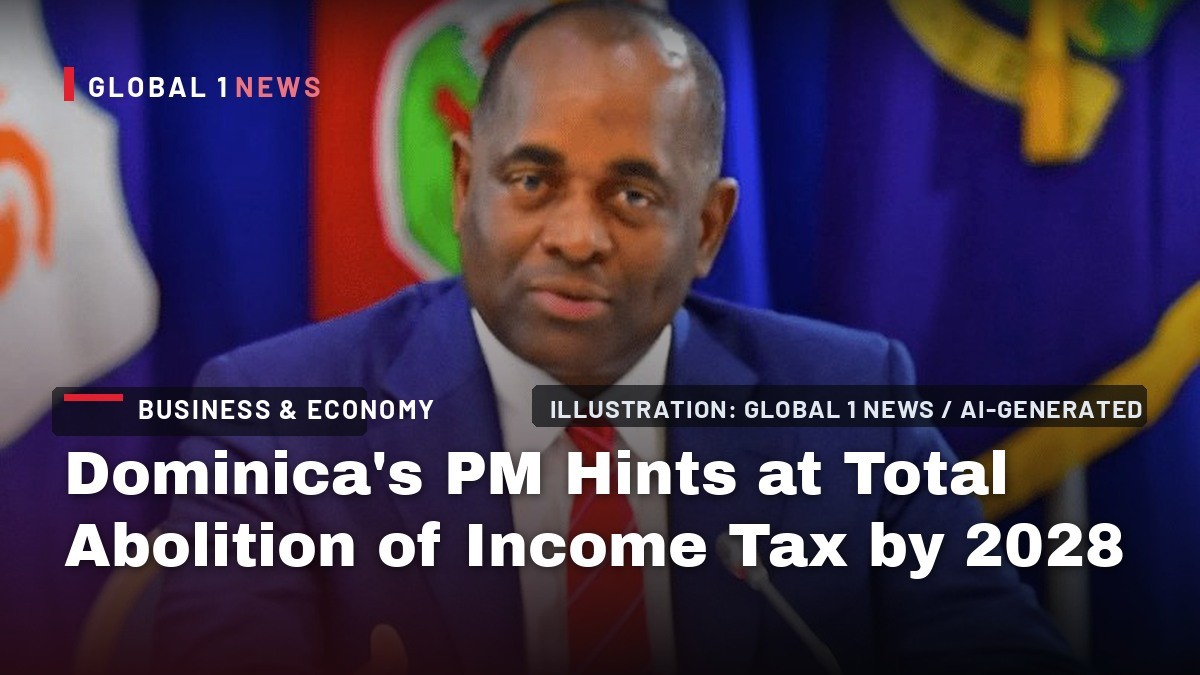
Prime Minister Roosevelt Skerrit has set the Caribbean’s political and economic circles abuzz with a bold philosophical declaration: he does not like income tax, and he is not ruling out its complete elimination for Dominican workers by 2028. Speaking at a Dominica Labour Party (DLP) town hall meeting on Tuesday night, ahead of the September 7 by-election for the Roseau North constituency, Skerrit framed the potential move as a matter of principle, arguing that citizens should be allowed to keep the fruits of their labour. The remarks come on the heels of a proposed 10 per cent flat tax rate slated for January 1, 2027, announced by Finance Minister Dr Irving McIntyre earlier this month, signalling a dramatic shift in the island’s fiscal philosophy that could have ripple effects across the Eastern Caribbean.
A Philosophical Opposition to Direct Taxation
Skerrit did not mince words when addressing supporters in the campaign setting, six days before nomination day for the Roseau North by-election. He recounted the tax landscape when the DLP first assumed office in 2000, describing a system with rates of 20 per cent, 35 per cent, and 40 per cent. “We reduced it to 15, to 25, and to 35. And we increased the tax threshold from EC$12,000 a year to EC$30,000 a year,” he said, noting that this represented the first significant change to income tax in Dominica’s modern history. The Prime Minister was keen to highlight the contrast with the interim administration of the United Workers Party (UWP) and the Dominica Freedom Party (DFP), which he said never touched the tax structure. Upon returning to office, his government continued its reduction agenda. “...they never touched it and then we decided this year to allow working people and taxpaying people to keep more money than they're earning, because for me personally, I'm not an income tax person, I do not like income tax,” Skerrit declared. His reasoning goes beyond simple political expediency. “From a philosophical standpoint, I believe that people should be allowed to keep their property that they worked for... I believe more in consumption taxes, that you pay based on what you consume is more equitable.” This preference for indirect taxation is a significant departure from the norms of many larger CARICOM states, where direct taxes on income form the backbone of government revenue.The Proposed 2027 Flat Rate and Budgetary Context
The Prime Minister’s long-term vision is anchored in the immediate proposals laid out by Finance Minister Dr Irving McIntyre during the presentation of the EC$1.15 billion national budget earlier this month. McIntyre detailed the government’s consistent efforts to reduce the income tax burden since the country’s economic recovery and the successful completion of the International Monetary Fund (IMF) supported programme from 2009. “We reduced the tax rates to 15 per cent, 25 per cent and 35 per cent. We also increased the tax-free threshold first to EC$25,000 and then to EC$30,000. We increased mortgage deductions from EC$15,000 on one property to EC$30,000 and EC$15,000 on a first and second property respectively. We allowed deductions for student loans, home and medical insurance,” McIntyre told Parliament. These measures, he argued, have removed thousands of Dominicans from the income tax net entirely, allowing families to retain a greater share of their income. However, the headline announcement was the proposal to simplify the system dramatically. “Today, despite a global environment marked by economic uncertainty, this government will again provide relief to further empower the hardworking people of Dominica. It is therefore my pleasure to propose that effective January 1, 2027, the government will replace the income tax rates of 15 per cent, 25 per cent and 35 per cent with a single, flat rate of 10 per cent,” he said. It is crucial to note that this flat rate is a proposal, not yet law, and is slated to come into force in 2027. The full abolition by 2028 remains a conditional possibility, dependent on the successful implementation of budget measures and a subsequent increase in national revenues.The CBI Factor and Economic Vulnerability
The ambitious tax agenda cannot be viewed in isolation from Dominica’s unique economic structure. As a small island developing state with a population of roughly 72,000, the country has relied heavily on its Citizenship by Investment (CBI) programme to fund infrastructure and social programmes. This revenue stream, however, has come under increasing pressure from international scrutiny and changing global standards. Skerrit’s confidence in future revenue growth appears tied to the performance of these non-tax income sources. His suggestion that the savings from tax elimination could be used to “take advantage of the tourists coming in” indicates a strategy focused on stimulating domestic consumption and the tourism sector, rather than relying on traditional direct taxation. This pivot towards consumption taxes aligns with his stated philosophy. By taxing what people spend rather than what they earn, the government hopes to encourage investment and labour force participation while capturing revenue from economic activity. However, critics within the region often point out that consumption taxes, such as VAT, can be regressive, disproportionately affecting lower-income households who spend a larger percentage of their earnings on basic goods.Regional Comparisons and the Trinidad and Tobago Lens
For Caribbean readers, particularly those in Trinidad and Tobago, the debate over direct versus indirect taxation is a familiar one. Trinidad and Tobago has historically maintained a relatively low direct tax burden compared to other CARICOM nations, relying instead on revenue from the energy sector. This has allowed for a system where personal income tax rates are comparatively modest, though the volatility of oil and gas prices has often prompted calls for tax reform to diversify the revenue base. In contrast, many other OECS states, like St Lucia and Grenada, have maintained more traditional income tax structures alongside VAT. Dominica’s proposal to move towards a flat 10 per cent rate, and potentially to zero, would place it in a unique position within the region. It would become a highly attractive jurisdiction for individual investors and skilled workers, potentially drawing talent from neighbouring islands where the tax burden is higher. The regional debate often centres on the balance between equity and growth. Proponents of low direct taxes argue that they incentivise hard work, reduce the cost of labour for businesses, and attract foreign investment. Opponents counter that they erode the social contract, reducing the funds available for health, education, and infrastructure, and shifting the burden onto the poor through consumption taxes. Skerrit’s administration is clearly betting on the former, banking on the idea that a more dynamic private sector and increased tourism will fill the fiscal gap.Political Timing and the Roseau North By-Election
The timing of Skerrit’s remarks is politically significant. With the Roseau North by-election scheduled for September 7, the DLP is seeking to galvanise its base and present a forward-looking vision. The promise of tax relief, both immediate and long-term, is a powerful campaign tool in a country where the cost of living remains a pressing concern, as it is across the Caribbean. The by-election is being closely watched as a test of the government’s popularity. The DLP has governed Dominica since 2000, with only a brief interruption by the UWP-DFP coalition. A strong showing in Roseau North would be seen as a mandate for the government’s fiscal policies, while a poor result could embolden the opposition and complicate the legislative path for the 2027 tax changes. Skerrit’s framing of the tax issue as a moral imperative—allowing people to keep what they have earned—is designed to resonate with voters who feel the pinch of rising prices for food, fuel, and housing. By linking the tax cuts to the tourism sector, he is also attempting to connect macroeconomic policy to tangible benefits for ordinary families, suggesting that the extra money in their pockets could be used to participate in the local economy.What This Means for Workers and Investors
For the average Dominican worker, the proposed changes represent a significant potential increase in take-home pay. The move from a marginal rate of up to 35 per cent to a flat 10 per cent would be transformative for higher earners, while the increased threshold and deductions have already removed many lower-income workers from the tax net entirely. If the 2028 abolition comes to fruition, Dominica would join a very small group of nations worldwide that do not levy a personal income tax. For investors, the signal is clear: Dominica is positioning itself as a low-tax, business-friendly environment. Combined with the CBI programme, which offers citizenship in exchange for investment, the island is seeking to attract capital and human resources. The stability of the Eastern Caribbean Currency Union (ECCU) and the peg to the US dollar provide additional confidence. However, the sustainability of such a policy remains the key question. The government’s ability to maintain public services without income tax revenue will depend entirely on the performance of the CBI programme and the growth of consumption tax receipts. The IMF and other international financial institutions will be watching closely, as will credit rating agencies. The success of this experiment could provide a new model for small island states, but failure could lead to a fiscal crisis that would require painful adjustments.Looking Ahead to 2027 and Beyond
The path from proposal to implementation is not without hurdles. The 2027 flat tax rate will need to be passed by Parliament, and the government will need to demonstrate that its revenue projections are realistic. The Prime Minister’s hint at full abolition by 2028 is contingent on seeing “an increase in revenues to the country,” a condition that leaves room for manoeuvre if economic circumstances deteriorate. For now, the people of Dominica have been offered a vision of a future where the state takes less from their pay packets. It is a powerful message, delivered with conviction by a leader who has dominated the island’s politics for over two decades. As the region watches the Roseau North by-election results, the broader implications of Skerrit’s tax philosophy will continue to be debated from Port of Spain to Bridgetown. The coming months will reveal whether this is a sustainable economic strategy or a politically popular gamble. By Sharon Sahatoo, Staff Writer This article was produced with AI-assisted research and editorial support. Sources: Caribbean360, CMC wire reports.What's Your Reaction?
 Like
0
Like
0
 Dislike
0
Dislike
0
 Love
0
Love
0
 Funny
0
Funny
0
 Wow
0
Wow
0
 Sad
0
Sad
0
 Angry
0
Angry
0

Sharon Sahatoo
Caribbean Correspondent at Global1.News. Based in Port of Spain, Trinidad, covering Caribbean politics, economy, energy, climate, and culture. Amplifying the voices and stories of the Caribbean region.















Comments (0)