
EU-Japan-South Korea Strategic Dialogue: Recalibrating Seoul’s Place in a Fractured Order
For much of the post–Cold War period, South Korean grand strategy rested on a relatively stable hierarchy within the international order. The alliance with the United States supplied the security foundation; around that anchor, Seoul managed relations with Japan, Europe, China, and a dense web of regional institutions. That architecture has not collapsed, but it can no longer be treated as a fixed premise. Trade access, industrial investment, defense procurement, and alliance politics are increa
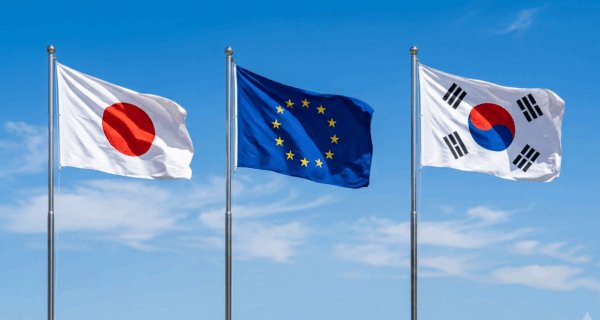
For much of the post–Cold War period, South Korean grand strategy rested on a relatively stable hierarchy within the international order. The alliance with the United States supplied the security foundation; around that anchor, Seoul managed relations with Japan, Europe, China, and a dense web of regional institutions. That architecture has not collapsed, but it can no longer be treated as a fixed premise. Trade access, industrial investment, defense procurement, and alliance politics are increasingly negotiated as a single bargaining package, and allies are no longer exempt from economic pressure simply because they are allies. The result is a strategic environment in which South Korea must deepen horizontal partnerships even as it preserves the vertical core of the U.S. alliance.
An EU–Japan–South Korea strategic dialogue, advanced in recent analysis by Gi-Wook Shin of the Seoul Forum for International Affairs and Korea University, offers one concrete response to this shift. The proposal is not a substitute for existing alliances, nor an embryonic anti-China coalition. It is a function-driven mechanism designed to reduce asymmetry among three partners whose capabilities are increasingly complementary, and to give Seoul institutional depth commensurate with its growing international weight. For Korean foreign policy, the stakes are particularly high: Japan already possesses G7 membership, a mature economic partnership with the European Union, and rapidly expanding European defense-industry ties. South Korea’s influence has expanded faster than the institutional architecture that would lock that influence into durable consultation.
South Korea’s Evolving Strategic Position
South Korea’s traditional strategy assumed that Washington would remain a predictable provider of extended deterrence and a relatively stable organizer of the wider economic order. That assumption is under strain. In 2025, the United States initially announced sharply differentiated “reciprocal” tariffs on South Korea, Japan, and the European Union. Subsequent negotiations produced a 15 percent baseline framework for all three, yet the process itself carried strategic meaning. Economic leverage, industrial policy, and security commitments were handled as linked instruments. For Seoul, the episode illustrated a broader pattern: alliance membership no longer guarantees insulation from coercive economic tools deployed by the alliance leader.
This does not diminish the indispensability of the U.S.–ROK alliance. The United States remains the only actor capable of providing extended nuclear deterrence to South Korea and Japan, and no European or Asian substitute can replicate that function in the near term. What has changed is the coexistence of dependence on U.S. power with uncertainty about U.S. policy direction. Korean policymakers must now plan for scenarios in which they are either left exposed by American retrenchment or drawn into bargains and contingencies they did not help design. Horizontal networks—among Europe, Japan, and South Korea—become valuable precisely because they help allies absorb shocks and coordinate positions without pretending to replace the U.S. security guarantee.
Korean foreign policy has long balanced alliance centrality with diversification. The difference today is the density and urgency of that diversification. Europe and Asia are building security and economic connections that would have appeared highly ambitious a decade ago. The European Union signed security and defense partnerships with Japan and South Korea in November 2024. In 2026, the EU and Japan launched a defense-industry dialogue, while the EU and South Korea signed a digital trade agreement and began implementing cooperation on maritime security, cyber and hybrid threats, information manipulation, space, and the defense industry. These steps create a foundation; they do not yet constitute a regular strategic consultation format among all three.
Four Converging Challenges
Shin’s analysis identifies four converging pressures that make trilateral coordination more than a diplomatic nicety. The first is demographic. South Korea is aging faster than any other OECD society. Japan’s working-age population has been shrinking for decades. The European Union’s fertility rate reached a new low in 2024. Demography is not an abstract social trend in this context; it directly constrains defense recruitment, industrial capacity, fiscal space, the pace of technological adoption, and the political sustainability of long-term external commitments. For the Republic of Korea, rapid aging intersects with mandatory military service, chaebol-driven industrial organization, and the fiscal burdens of eventual inter-Korean contingencies. Any serious dialogue among Seoul, Tokyo, and Brussels must treat workforce and demographic adaptation as strategic variables, not secondary social policy.
The second challenge is concentrated economic dependence on China. None of the three partners can or should pursue full decoupling. South Korea’s export structure, Japan’s production networks, and Europe’s manufacturing and green-transition supply chains all retain deep exposure to the Chinese market and to Chinese-controlled inputs. Yet interdependence has repeatedly been converted into leverage. South Korea’s experience after the THAAD deployment remains a defining reference point in Seoul’s strategic memory. European debates over economic coercion, together with Chinese export controls on gallium, germanium, and other strategic inputs, have reinforced the same lesson. De-risking, if it is to be more than rhetoric, requires shared risk maps, compatible certification regimes, co-investment in alternative suppliers, and advance consultation before national measures generate cross-border spillovers.
The third pressure is U.S. policy volatility. Extended deterrence and NATO’s centrality to European defense remain structural facts. What has eroded is confidence that American preferences will remain stable across electoral cycles or that allies will retain meaningful voice in the bargains that shape their security environment. South Korean officials must therefore prepare for a dual risk: abandonment on one side, entrapment on the other. Trilateral consultation with Japan and the EU cannot eliminate that dilemma, but it can improve the quality of information, align industrial and export-control policies, and reduce the chance that each capital improvises separately under pressure.
The fourth challenge is the collapse of the old geographic separation between European and Asian security. North Korean munitions, missiles, and troops have supported Russia’s war against Ukraine. Moscow, in turn, has extended political cover, economic support, and the prospect of military-technical know-how to Pyongyang. Developments on a European battlefield now feed back into the military balance on the Korean Peninsula. For Seoul, this linkage is not theoretical. It affects assessments of North Korean capabilities, the credibility of sanctions regimes, and the wider geometry of great-power competition in Northeast Asia. A dialogue that monitors North Korea–Russia military cooperation as a shared agenda item would reflect operational reality rather than regional symbolism.
Japan–South Korea Rapprochement Since the Nara Summit
Any EU–Japan–South Korea format depends on the quality of Japan–South Korea relations. Those relations have improved significantly. The January 2026 summit in Nara and the reciprocal summit held in South Korea in May 2026 demonstrated continuity across leadership changes—an important signal given the historical sensitivity of the relationship and the domestic political costs that leaders in both countries have sometimes paid for engagement.
Improved bilateral ties do not erase historical grievances or eliminate competition in third markets. They do, however, lower the transaction costs of trilateral coordination. Japan already maintains a mature economic partnership with the EU and is expanding defense-industry cooperation with European partners at a rapid pace. EU–South Korea relations are deepening across free-trade, digital, green, and security frameworks, yet they still lack the density and regular strategic consultation that characterize EU–Japan ties. A trilateral format would reduce that asymmetry and prevent Seoul from remaining the least institutionalized leg of a triangle whose other two sides are thickening.
From a Korean perspective, rapprochement with Tokyo also carries implications for alliance management with Washington. Trilateral U.S.–Japan–ROK coordination has been a recurring priority in recent years; a parallel Europe-facing track need not compete with that effort. On the contrary, when Seoul and Tokyo can coordinate positions on supply chains, export controls, and Russia–North Korea ties, they strengthen their collective capacity to engage the United States as more coherent partners rather than as separate petitioners.
Practical Recommendations for Trilateral Cooperation
The dialogue should begin through a Track 1.5 process involving officials, experts, and industry. An early preference for Track 1.5 is prudent: it allows agenda-setting and trust-building without the immediate rigidities of formal treaty negotiation, while still connecting government decision-makers to technical and commercial expertise. The initial agenda should remain concrete and limited.
First, the three sides should commission a joint critical minerals and supply-chain risk assessment. The point is not another generic communiqué on resilience, but a shared map of chokepoints—processing capacity, certification bottlenecks, single-source dependencies—and a realistic inventory of co-investment options. Second, they should establish regular consultation on export controls and investment screening, so that national security measures in one jurisdiction do not blindside partners in another. Third, cooperation on artificial intelligence, cyber resilience, and digital standards can build on the EU–South Korea digital trade agreement and on existing EU–Japan technology dialogues. Fourth, exchanges on demographic change and defense workforce adaptation would address a constraint that all three societies share and that military planners can no longer treat as exogenous. Fifth, shared monitoring of North Korea–Russia military cooperation would link European security data with Northeast Asian threat assessment in a systematic way.
Two design choices are essential if the initiative is to survive contact with domestic politics and great-power scrutiny. The first is that the dialogue must remain function-driven. It is not NATO, not the Quad, and not an anti-China coalition. Framing it as a containment instrument would raise unnecessary costs in Beijing, complicate domestic consensus in Seoul and parts of Europe, and distract from the practical work of risk reduction. The second is explicit complementarity with relations with Washington. Horizontal networks strengthen alliances when they help allies absorb shocks and coordinate positions; they weaken alliances when they are presented as hedging against the United States in zero-sum terms. Transparency about purpose is therefore a strategic asset, not a diplomatic courtesy.
Institutional Depth and Korean Foreign Policy
South Korea’s international weight has grown faster than its institutional depth. That gap is visible in multiple arenas: climate and digital standard-setting, defense-industrial cooperation, and the architecture of economic security. Japan’s G7 membership and denser European ties give Tokyo structural advantages in agenda-setting. Seoul has compensated through bilateral activism, middle-power diplomacy, and issue-specific coalitions, but these instruments are thinner than standing consultative formats when crises compress decision time.
An EU–Japan–South Korea dialogue would help close that gap without forcing South Korea into premature choices about bloc membership. It would also speak to domestic Korean debates about strategic autonomy. Autonomy in the Korean context has never meant equidistance between Washington and Beijing; it has meant expanding the range of partners and instruments available to a state that lives with acute security threats and deep trade exposure. Chaebol supply chains, semiconductor and battery ecosystems, shipbuilding capacity, and defense exports all give South Korea material relevance to European partners seeking diversification. Translating that relevance into regular strategic consultation is the institutional task.
Inter-Korean relations and peninsula contingencies remain the core of Seoul’s security problem set. Nothing in a Europe–Japan–Korea dialogue alters the fundamental deterrence equation. What it can do is improve the informational and industrial environment in which Korean leaders manage that equation—particularly as North Korea’s relationships with Russia and other partners evolve, and as European capitals become more direct stakeholders in the consequences of those relationships.
Strategic Significance and the Limits of Ambition
The case for trilateral dialogue rests on complementarity under constraint. Europe brings regulatory power, market scale, and accumulating experience with economic coercion and hybrid threats. Japan brings advanced industrial capacity, established European partnerships, and overlapping security concerns about maritime stability and technological leakage. South Korea brings high-end manufacturing, defense-industrial capabilities, and frontline experience with North Korean military and cyber activity. None of the three can solve demographic decline, China exposure, or U.S. uncertainty alone; each can reduce the cost of adjustment through coordination.
Ambition should remain bounded. A Track 1.5 start with a narrow, technical agenda is more likely to produce usable outputs than a grand strategic declaration. Success metrics should be practical: joint risk assessments that actually inform licensing and investment decisions; interoperable approaches to screening and certification; defense-industry dialogues that identify specific co-development or procurement frictions; and a shared factual baseline on North Korea–Russia military cooperation. If those outputs materialize, political institutionalization can follow. If they do not, elevating the format prematurely would only advertise underperformance.
For South Korea, the initiative aligns with a longer historical pattern of seeking multiple anchors while preserving the U.S. alliance as the central security guarantee. The difference in the mid-2020s is that the costs of institutional thinness have risen. Differentiated tariff shocks, supply-chain weaponization, and the erosion of geographic firebreak between European and Asian theaters all punish capitals that consult late and bilaterally rather than early and in parallel. An EU–Japan–South Korea strategic dialogue is one instrument for correcting that disadvantage. It should be pursued with academic clarity about what it can and cannot do: it can thicken horizontal resilience; it cannot replace extended deterrence; and it will matter only insofar as it remains concrete, transparent, and complementary to the alliances that still structure Korean security.
By Prof. David Park, Staff WriterThis article was produced with AI-assisted research and editorial support. Reporting is based on sources cited in the article.
What's Your Reaction?
 Like
0
Like
0
 Dislike
0
Dislike
0
 Love
0
Love
0
 Funny
0
Funny
0
 Wow
0
Wow
0
 Sad
0
Sad
0
 Angry
0
Angry
0

East Asia/Technology Correspondent at Global1.News. Seoul-based voice covering Korean politics, technology, business, and culture. Analyzes how technology and geopolitics intersect across East Asia.














Comments (0)