
Zambia Opposition Arrests Shake Post-Election Vote Count
LUSAKA — Zambia's government announced on Monday that security forces have seized weapons and arrested 11 people, including senior opposition figures, over an alleged plot to stage an armed insurrection. The announcement comes just days after last Thursday's presidential election, with votes still being counted and tensions running high in the capital. Lusaka, Zambia — Article continues...
Zambia Opposition Arrests Shake Post-Election Vote Count
LUSAKA — Zambia's government announced on Monday that security forces have seized weapons and arrested 11 people, including senior opposition figures, over an alleged plot to stage an armed insurrection. The announcement comes just days after last Thursday's presidential election, with votes still being counted and tensions running high in the capital.
Lusaka, Zambia — Article continues...
Government Details Raid and Arrests, Including Lungu Family Connection
Patrick Kangwa, Zambia's top civil servant, told reporters that the arrests were made during a raid in Lusaka, where leading opposition candidate Brian Mundubile was also found at the scene. Kangwa said those detained were connected to "military plans involving foreign nationals and illegal military training camps," and that they posed "a serious threat to state security." He said the individuals were found with "high-grade military weapons," ammunition, and other materials intended for use in an armed insurrection, and alleged that shots were fired at law enforcement officers, leading to an exchange of fire.
Among those arrested, Kangwa said, were Patrick Mwansa, the husband of Tasila Lungu, the daughter of former Zambian President Edgar Lungu, and other politicians. The suspects are being held in custody at various police stations in Lusaka, according to the government. The connection to the Lungu family adds a significant political dimension to the arrests, as Edgar Lungu remains a prominent figure in Zambian politics.
Mundubile's Account: "They Came In to Kill Us"
The government's account has been sharply disputed by Mundubile, who dismissed the accusations as "total fabrications" and alleged that security forces staged an attempt on his life during the raid on his home on Friday. In a detailed account, Mundubile described how armed personnel knocked down the gate of his home with an armoured vehicle, broke doors and windows, and opened fire. He said he and his family were present during the attack.
"They were basically shooting indiscriminately. They directed two shots towards me. Like I've always said, it was just by God's grace that I survived. So they came in to kill us," Mundubile told the BBC.
The opposition leader said former minister Mutotwe Kafwaya was shot during the raid while he and his wife were present. Mundubile said Kafwaya, whose whereabouts remain unknown, was bleeding and he urged the officers to take him to hospital. "My children saw their uncle… bleeding profusely and being dragged like an animal… 80 soldiers coming into the house, shooting indiscriminately and breaking doors and windows down is not an experience anybody would want to go through," he said. Mundubile said he and his family had not returned home since Friday and felt unsafe. He told the BBC that there was no militia at his home. "It's unfortunate that senior government officials would present themselves before the entire nation to make such falsehoods," he said in an interview with BBC Focus on Africa.
Vote Count Shows Hichilema Leading, But Opposition Claims Victory
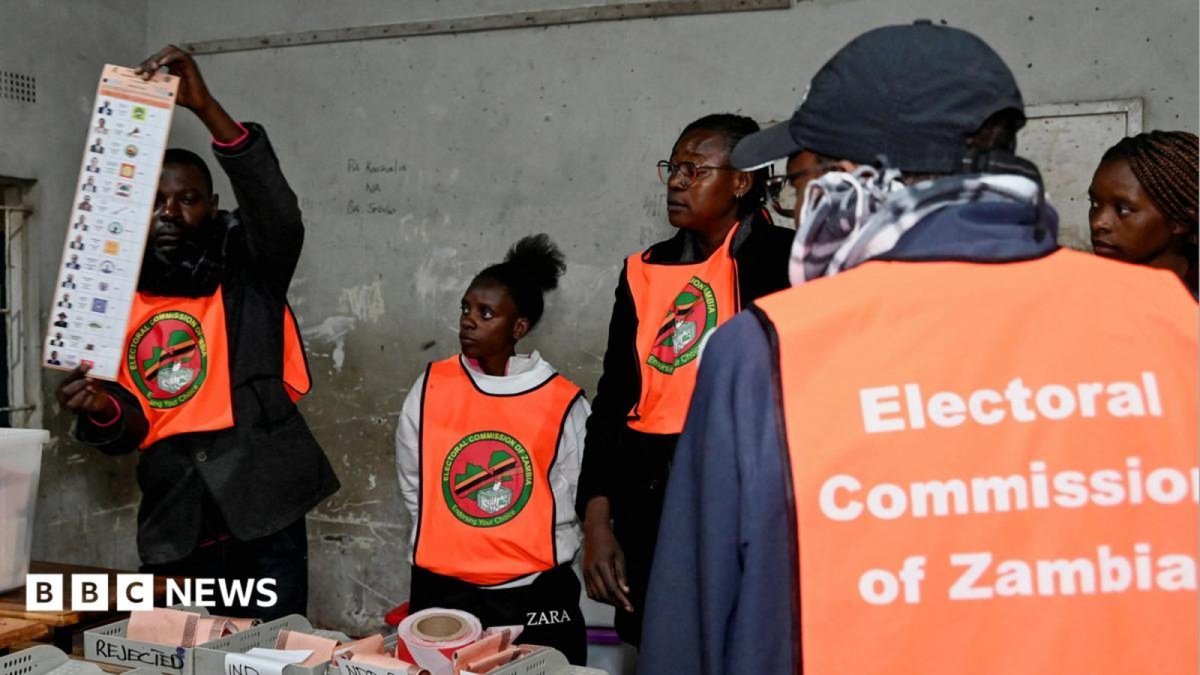
With results from more than half of the constituencies announced, Mundubile is trailing incumbent President Hakainde Hichilema, who is seeking a second five-year term. According to the latest partial results, Hichilema holds 62% of the votes, while Mundubile, one of 13 challengers in the race, has 36%. Despite trailing, the 55-year-old opposition leader had earlier claimed victory and alleged, without sharing evidence, that there had been voting irregularities in the electoral process.
Mundubile's campaign has maintained that its own parallel vote tabulation shows him in the lead, a claim the authorities have denied. Preliminary statements from observer missions described election day as largely peaceful and orderly, though they raised concerns about late electoral reforms, media freedom, and access to the media in the run-up to the poll. The competing narratives have created an atmosphere of uncertainty in Lusaka, where a heightened security presence has been reported in some parts of the capital. Zambians are now waiting for the full results to be announced, with the electoral commission having briefly suspended the counting and announcement of results on Friday.
The gap between the official tally and Mundubile's parallel count is not merely a technical disagreement—it speaks to a deeper crisis of trust in Zambia's electoral institutions. When an opposition candidate publicly rejects the official numbers and claims victory based on their own tabulation, the stage is set for a prolonged dispute that can outlast the announcement of final results. This pattern is familiar across the continent, from Kenya's 2007 post-election violence to more recent disputes in Malawi and Zimbabwe, where parallel vote tabulations have both exposed genuine irregularities and been used as a political tool to delegitimize unfavorable outcomes.
Electoral Commission Suspends Counting, Then Lifts Suspension
The political tensions have been compounded by disruptions to the electoral process itself. Zambia's electoral commission briefly suspended the counting and announcement of results on Friday, citing violence against polling staff and theft of marked ballot papers. The suspension was lifted the same day, with the commission saying the security threat had been contained.
Both the European Union (EU) and the Southern African Development Community (Sadc) observer missions have since expressed concern over the suspension of the vote counting. On Saturday, Sadc said the suspension had created "uncertainty and anxiety," while the EU mission said any such interruption should be clearly explained, legally grounded, and proportionate.
The EU mission's chief observer, Michael McNamara, said the elections took place "against a backdrop of constrained democratic space." He noted that even though the elections were "genuinely competitive," the conditions in which the candidates competed were "uneven." McNamara cited the blurring of lines between the state and the ruling party, including state media coverage being "heavily biased" to favour the ruling party. "It is important that the remaining stages of the process are conducted calmly, transparently, and in full accordance with Zambian law and the procedures in place," McNamara said.
The brief suspension of vote counting on Friday was a moment of high drama that reverberated far beyond Zambia's borders. For observer missions from the European Union and the Southern African Development Community, the interruption raised immediate red flags. The Sadc mission's statement that the suspension created "uncertainty and anxiety" was carefully worded but unmistakable in its concern. The EU's chief observer, Michael McNamara, went further, framing the elections as taking place "against a backdrop of constrained democratic space" and noting that state media coverage was "heavily biased" in favor of the ruling party. These are not neutral observations—they are warnings that the integrity of the process is in question.
Mundubile's Allegations of Military Interference and Assault
Beyond the raid, Mundubile has made a series of allegations about the electoral process, including reports of military involvement at tallying centres and irregularities involving ballot boxes. He later said he was being interrogated by Zambian army officers over two videos he released and alleged he had been assaulted while in custody, which authorities denied. The opposition leader also accused Tanzania of sending individuals to interfere in the election, an allegation the Tanzanian government firmly rejected as false and unfounded. These claims, while unsubstantiated, have added to the volatile political atmosphere in the region.
The authorities have denied all claims of vote rigging, and the electoral commission has maintained that the process is proceeding according to law. However, the combination of the raid, the arrests, and the suspension of counting has raised concerns among international observers about the integrity of the electoral process.
Regional Implications: A Test for Democracy in Southern Africa
From a West African perspective, the events unfolding in Zambia carry significant weight for the broader continent. Zambia has long been regarded as a beacon of democratic stability in Southern Africa, having peacefully transferred power between rival parties on multiple occasions since the early 1990s. The current crisis, with its competing narratives of insurrection plots and state violence, threatens to undermine that reputation.
The arrest of Patrick Mwansa, husband of Tasila Lungu, injects a deeply personal dimension into what is already a fraught political moment. Edgar Lungu, who ruled Zambia from 2015 to 2021, remains a towering figure in the country's politics, and his family's entanglement in an alleged insurrection plot will inevitably be read through a partisan lens. For many Zambians, the image of security forces raiding the home of a leading opposition candidate—while a relative of a former head of state is taken into custody—evokes memories of past political crackdowns that the country had hoped to leave behind.
The government's framing of the arrests as a necessary response to a credible security threat stands in stark contrast to the opposition's portrayal of state overreach. Kangwa's assertion that those detained were linked to "military plans involving foreign nationals and illegal military training camps" is a serious allegation, but the lack of publicly available evidence has left room for skepticism. In a region where accusations of coup plotting have sometimes been used to sideline political rivals, the burden of proof will be critical. The coming days will test whether the authorities can substantiate their claims in a transparent manner, or whether the arrests will be seen as an attempt to intimidate the opposition during a delicate electoral period.
For the region, the handling of this post-election period will be closely watched. The EU and Sadc observer missions have both called for calm and transparency, and their statements reflect a broader concern about the erosion of democratic norms. The coming days, as full results are announced and the political situation develops, will be critical in determining whether Zambia can navigate this crisis without further escalation. The heightened security presence in Lusaka and the unresolved questions surrounding the raid suggest that the path forward remains uncertain. Zambians, who have shown resilience in the face of political challenges before, now face a test of their democratic institutions and the commitment of their leaders to peaceful, lawful processes.
As the continent watches, the hope is that Zambia's democratic foundations will hold, and that the rule of law will prevail over the politics of fear and division.
This article was produced with AI-assisted research and editorial support. Sources: BBC News.
By Amara Diop, Staff Writer
What's Your Reaction?
 Like
0
Like
0
 Dislike
0
Dislike
0
 Love
0
Love
0
 Funny
0
Funny
0
 Wow
0
Wow
0
 Sad
0
Sad
0
 Angry
0
Angry
0

West Africa/Sahel Correspondent at Global1.News. Dakar-based journalist covering politics, security, climate, and development across Francophone and Anglophone West Africa. Tells the stories of a region undergoing profound transformation.












Comments (0)