
Israel Braces for a 100-Millimetre Storm. In Gaza, 950,000 People Live Where It Will Fall.
Israel's Meteorological Service has issued an orange flood warning for the coast, the Carmel and the Judean Foothills through Saturday night, with more than 100 millimetres of rain forecast. In Gaza, nearly 950,000 displaced Palestinians live in areas exposed to moderate or high flood risk.
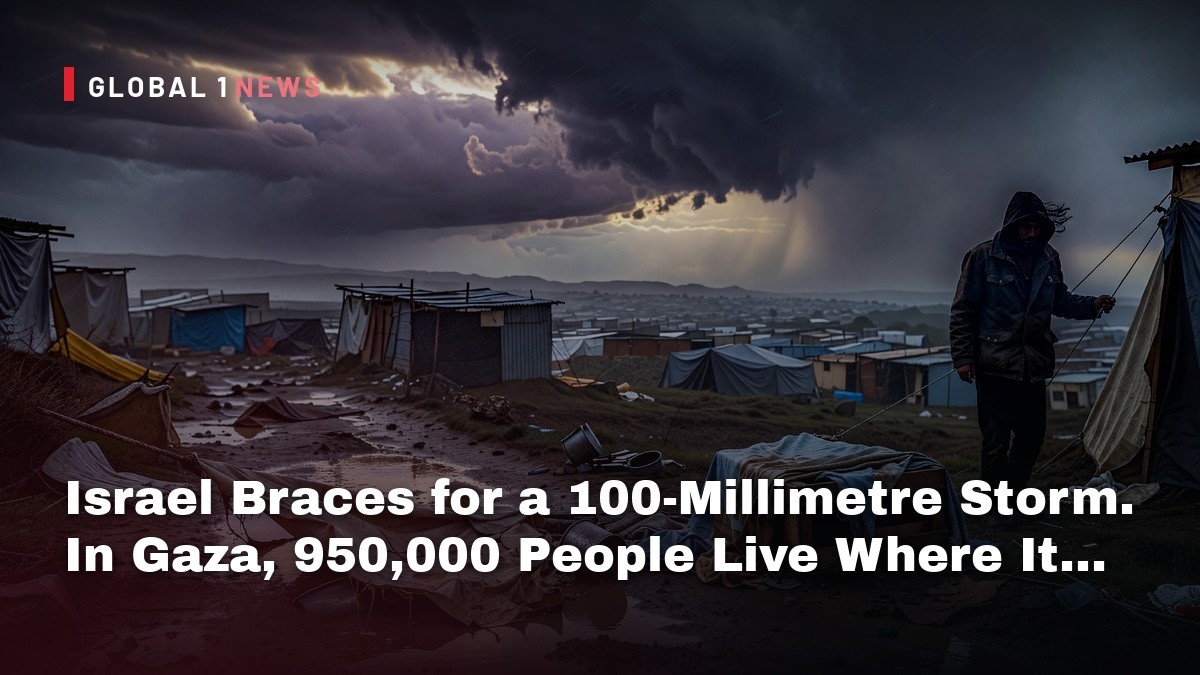
A storm system is due to reach its peak over Israel on Saturday morning, with forecasters warning of more than 100 millimetres of rain across wide areas, flooded roads and flash floods in the desert wadis. The same system is aimed at the Gaza Strip, where nearly 950,000 displaced Palestinians are living in places the United Nations classifies as exposed to moderate or high flood risk. Gaza's government media office says roughly 867,000 of the territory's displaced are in deteriorating tents.
Israel Braces for a 100-Millimetre Storm. In Gaza, 950,000 People Live Where It Will Fall.
JERUSALEM — The warnings went out in colour, and each colour describes a different way the water arrives.
The Warning, in Three Colours
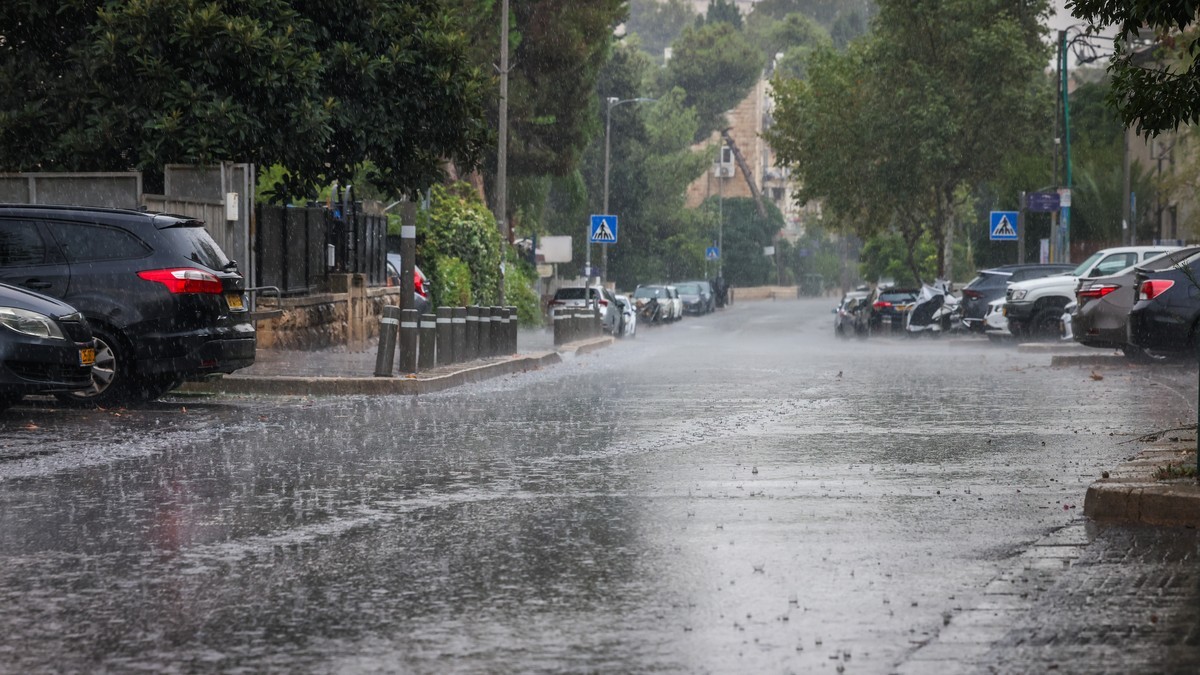
Israel's Meteorological Service, a division of the Transportation and Road Safety Ministry, issued an orange warning for flooding that runs until 10 p.m. on Saturday. It covers the Carmel region, the northern, central and southern coastal areas, and the Judean Foothills. A separate yellow warning for flash floods covers the northern Judean Desert and the Dead Sea area, also through 10 p.m. Saturday. A third yellow warning for thunderstorms covers northern and central Israel, the Mediterranean Sea and the northern Negev. The Jerusalem Post reported the alerts at 10:51 p.m. on Friday. Alongside them, the service issued an orange warning for dangerous swimming conditions in the Mediterranean from 10 p.m. Friday to 10 p.m. Saturday, with significant wave heights of 1.2 to 1.9 metres and waves expected to keep building.
Where the Rain Has Not Arrived Yet
By Friday evening, much of the coast was still waiting. Ynet reported that rainfall along large parts of Israel's coastline remained relatively light through Friday, with the heaviest showers falling further east. The highest total of the day was at Mavo Hama in the southern Golan Heights, at 13 millimetres. Ashdod recorded 10 millimetres, with similar amounts at Ashhar in the Lower Galilee, Alonim near Yokneam and Mevo Dotan in the northwestern West Bank. Jerusalem and Haifa each recorded four millimetres. The Tel Aviv metropolitan area stayed completely dry. Forecasters described that as temporary, with the main body of the system due late Friday night and into Saturday morning.
Saturday Morning Is the Test
That is when the arithmetic changes. The service expects the storm to peak on Saturday morning, when several places along the coast could take tens of millimetres of rain within a few hours. Accumulated totals are forecast to exceed 100 millimetres along the coastal plain and in other areas, with a genuine risk of significant urban flooding from the Tel Aviv metropolitan area south towards Ashkelon. Strong westerly winds are expected across much of the country, and temperatures will sit below the seasonal average. Local showers continue into Sunday in the north and centre, weakening through the afternoon, and the rain is expected to stop by Monday. The flash-flood risk in the Judean Desert and around the Dead Sea runs through the weekend.
A Highway Closed and a Railway Cut in Half
The storm is arriving in the middle of a scheduled engineering shutdown on the country's busiest road. Israel Electric Corporation crews are replacing high-voltage cables that cross the Ayalon Highway, Route 20, and the adjacent railway tracks, work coordinated with the Israel Police, Ayalon Highways and security forces. Route 20 closes completely in two windows: from 11:30 p.m. on Thursday 5 November until 4 p.m. on Friday 6 November, and again from 11 p.m. on Saturday 7 November until 5 a.m. on Sunday 8 November. Northbound traffic is blocked from the Glilot East Interchange to Seven Stars, with the Route 5 ramp closed; southbound traffic is blocked from HaMa'apilim to Glilot East. Israel Railways will run a split schedule on Friday and Saturday night, with free shuttle buses bridging the gaps and normal service from 4 a.m. Sunday.
What Last November Looked Like
Israel has a recent measure of what this much water does. In November 2025, heavy rain caused widespread flooding across the country, forced road closures in the north and south and led to twelve people being rescued from vehicles, eight of them in Ashkelon, where at least 70 millimetres fell. This autumn has already produced its own rehearsal. Flooding disrupted voting in southern Israel at the end of October, the Nahal Darga wadi flooded and was closed with no reopening date, and the Israel Nature and Parks Authority has kept the Nahal Mishmar and Nahal Tamar trails shut since 2 November. Ein Gedi Nature Reserve is only partly open, and Nahal Arugot is closed for safety work. Ten students of a pre-military academy died in a flash flood in Nahal Tzafit in 2018, a disaster that still shapes how the authorities treat these warnings.
The Same Storm, a Different Country
Lebanon is on the same map. Its Directorate of Environment and Meteorology describes a low-pressure system centred over the Black Sea, accompanied by relatively cold air masses, pushing unstable and rainy weather across Lebanon and the eastern Mediterranean basin until Sunday midday. Saturday is forecast as cloudy with fog over the highlands, temperatures below their seasonal averages, and scattered rain that will at times be heavy, accompanied by thunderstorms and active winds, with rising sea waves. Sunday brings more fog and scattered morning rain before the weather gradually stabilises by evening. Monday is expected to be cold and below average over the mountains and inland, with temperatures recovering on Tuesday.
Beirut's Rainfall, and the Debris Zahle Is Still Clearing
The official rainfall table shows how unevenly this autumn has landed. Cumulative rainfall to date stands at 109.4 millimetres in Tripoli against an average-to-date of 81, and 81.2 millimetres in Zahle against an average of 44. Beirut is behind its own norm, at 56.4 millimetres against 74. The same 24-hour period last year was far drier: 19.9 millimetres in Tripoli, 7.6 in Beirut and 3.8 in Zahle. Wind figures have moved between bulletins, with an earlier forecast warning of gusts to 65 km/h and waves up to two metres, while the directorate's Friday evening bulletin puts surface winds south-westerly at 15 to 40 km/h with a rough sea. In Zahle, the municipality said on Thursday that it had spent a week clearing the last storm's damage — gravel and dust swept onto roads by floods, culverts and drainage channels cleared of sediment, the Baradoni river bed cleaned, broken branches pruned and flood-damaged sidewalks on Tal Shiha Road repaired.

Nine Hundred and Fifty Thousand People in the Flood Zone
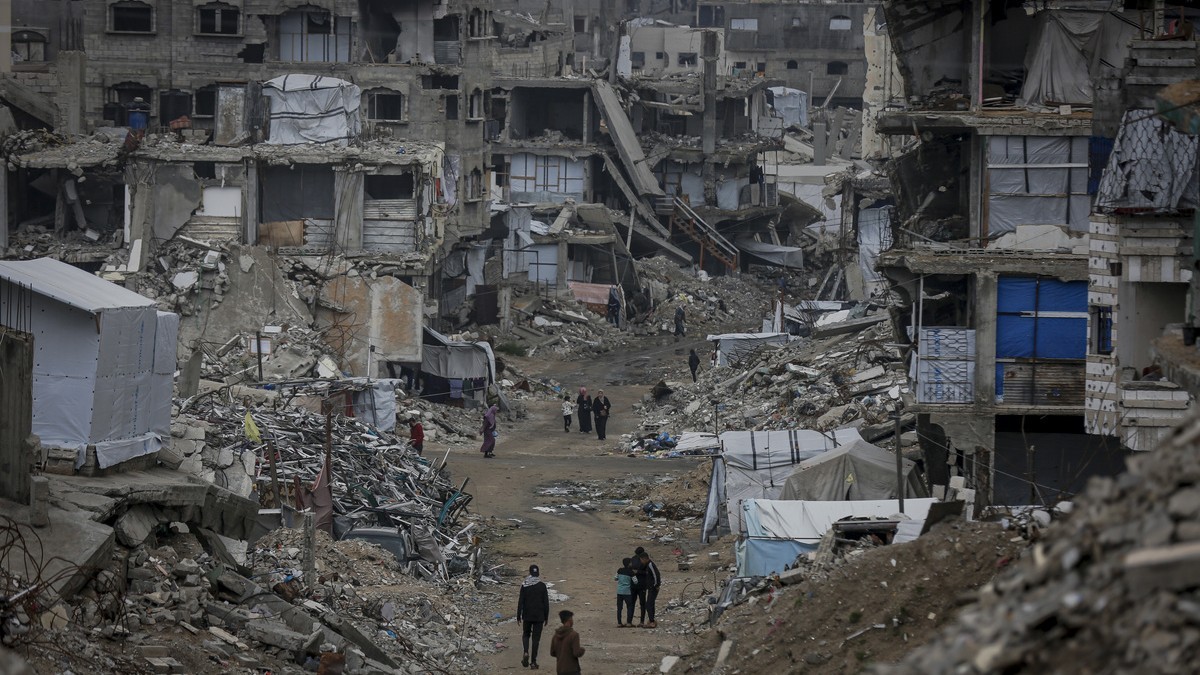
The numbers in Gaza are of a different order. The UN humanitarian office reported on 15 October that approximately 950,000 displaced Palestinians were living in locations exposed to moderate or high flood risk, including more than 400,000 in places classified as highly vulnerable. Around 44,000 people are sheltering in more than 2,300 structurally unsafe buildings that could partially collapse under severe weather, and 294,250 families require shelter assistance ahead of the rainy season. Gaza's government media office said in August that more than 2.15 million displaced Palestinians are living across the enclave, including roughly 867,000 in deteriorating tents and more than one million in shelter centres. Gaza's Winter Emergency Committee has counted about 200,000 worn-out tents still housing hundreds of thousands of people.
Seventy per Cent of the Equipment Is Gone
The people who would normally answer a flood call have largely lost the tools to do it. Roughly 70 per cent of municipalities' primary operational equipment and 90 per cent of Civil Defence rescue equipment have been destroyed, according to the Winter Emergency Committee, leaving only a handful of ageing vacuum tankers and a limited number of portable water pumps to clear drainage and reach families. The committee has identified about 7,800 tents in particularly hazardous places — dry riverbeds, rainwater collection ponds and exposed coastal ground — that it says need urgent relocation, along with roughly 2,000 cracked buildings at risk of collapse. Field surveys reported this week found that more than 162,000 of approximately 270,000 displacement tents are severely damaged or unusable. Available winter supplies are estimated to cover about 18 per cent of the families assessed as needing them.
What the Civil Defence Told Families to Do
With the system hours away, Gaza's Civil Defence issued instructions that read like a household checklist for a disaster it cannot prevent. Families should secure plastic sheeting and tent pegs, build earthen barriers around their shelters, dig drainage channels where it is safe to do so, secure loose metal roofing and raise mattresses and belongings above ground level. It warned people not to remain inside severely damaged buildings and not to pitch tents beside cracked walls, and urged families to move to safer ground wherever that is possible. It also appealed to humanitarian organisations, local institutions and community groups to provide safer shelter before the rain arrives. The UN said this week that gunfire had damaged tents at a displacement site in northern Rafah, forcing a humanitarian partner that had been working on flood control to leave the area.
What the Police Asked, and What It Means in the Tents
Israeli police have asked the public to avoid non-essential travel over the weekend, to stay away from wadi beds and flood channels, and to keep out of basements, underground car parks and lifts during heavy downpours. Israel Fire and Rescue Services said 102 emergency call centres would be significantly reinforced, with crews deployed in the field, and its warning was blunt: "Do not cross a flooded road, whether on foot or by vehicle — this is a real life-threatening danger." For most Israelis that means a wet weekend, a closed highway and a disrupted train. For the families in the tents, the same forecast is the difference between a bad night and a lost shelter, and the equipment that would normally help them is mostly rubble.
By Jessica Ali, Staff Writer
This article was produced with AI-assisted research and editorial support. Cover: Global 1 News editorial image. Photographs: Yossi Zamir/Flash90 via The Jerusalem Post; Anadolu Agency via Middle East Monitor; Daily Beirut. Sources: The Jerusalem Post, Ynet, JFeed, Wire Israel, The Times of Israel, Israel Police, Israel Fire and Rescue Services, the Israel Meteorological Service, Israel Nature and Parks Authority, Lebanon's Directorate of Environment and Meteorology, Daily Beirut, Anadolu Agency, Middle East Monitor, SAFA, Daily Sabah, and the UN Office for the Coordination of Humanitarian Affairs via UN News.
What's Your Reaction?
 Like
0
 Dislike
0
 Love
0
 Funny
0
 Wow
0
 Sad
0
 Angry
0

Editor-in-Chief at Global1.News. Atlanta-based journalist who cuts through the BS and tells it like it is. Lead anchor, host, and the voice you hear when the spin stops and the truth starts.













Comments (0)