
China's August Data Exposes a Two-Speed Economy as Demand Stalls
China's August activity data laid bare a two-speed economy: industrial output rose 5.2% while retail sales grew just 0.4% and fixed-asset investment fell 7.2%. Beijing is answering with payment discipline and bond issuance rather than broad stimulus.
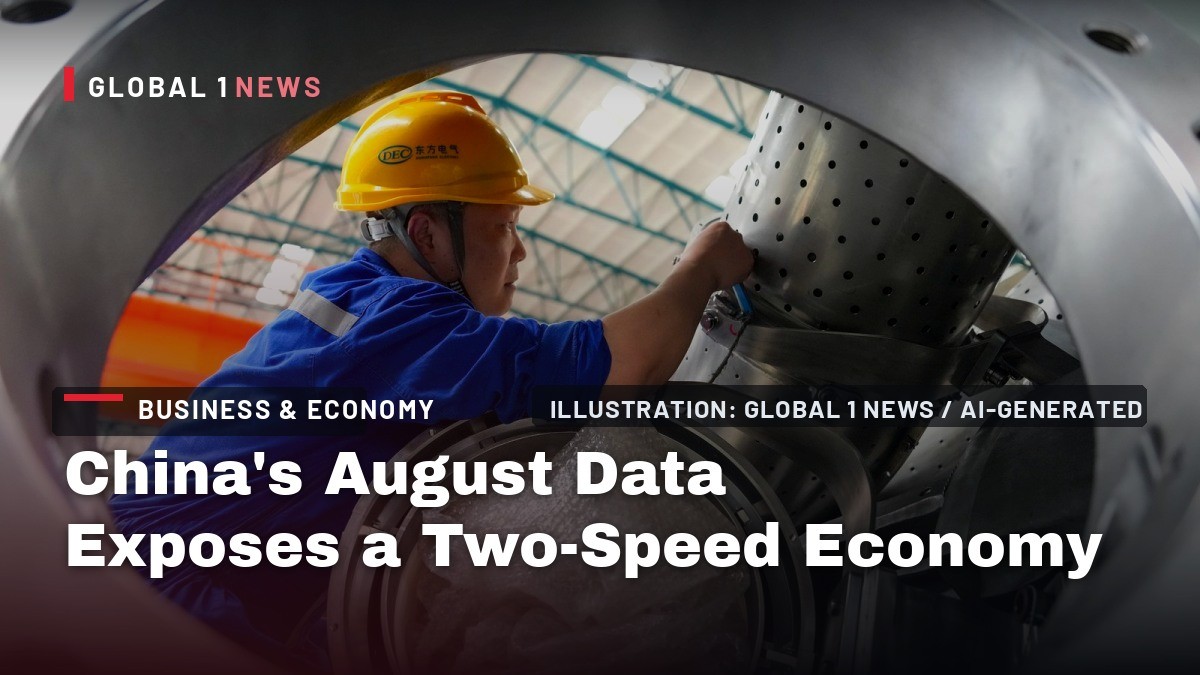
Factories Are Humming While Households Pull Back
China's economy is running on two engines at very different speeds, and the bulletin released on Tuesday morning made the gap impossible to explain away. Factory output beat expectations. Consumer spending missed them by half. Both numbers came from the same agency, on the same day, in the same release.
The National Bureau of Statistics reported that industrial output rose 5.2 per cent in August from a year earlier, accelerating from 4.5 per cent in July and beating the 4.8 per cent economists had pencilled in. Retail sales, the standard gauge of household demand, grew just 0.4 per cent, down from 0.6 per cent the previous month and well short of forecasts clustered between 0.7 and 0.8 per cent.
For a leadership that has spent three years promising to rebalance the economy away from investment and exports and toward consumption, August is an uncomfortable scorecard. On this evidence, the rebalancing is going backward.
The Numbers Behind the Split
Fixed-asset investment, the catch-all measure for infrastructure, manufacturing and property construction, fell 7.2 per cent in the January-to-August period compared with the same stretch last year. That is worse than the 6.7 per cent decline recorded through July, and it means the contraction has deepened every month since spring. Economists surveyed by Wind had expected a 7.19 per cent drop, so the miss was small in isolation. The direction of travel is what matters.
Property remains the heaviest drag. Real estate investment slumped 19.9 per cent over the first eight months, steepening from 19.2 per cent through July, while sales of new homes by floor area contracted 12.1 per cent. New home prices extended their declines again, according to a separate release, signalling a housing market still trapped in a five-year downturn with no visible floor.
The labour market offered no comfort either. The surveyed urban unemployment rate ticked up to 5.3 per cent from 5.2 per cent in July, an increase the statistics bureau attributed to the summer graduation season.
Credit tells the same story from the banking side. New yuan loans expanded by only 60 billion yuan (US$8.95 billion) in August, against forecasts of roughly 400 billion yuan and down from 590 billion yuan a year earlier, while outstanding loan growth slowed to a record-low 4.9 per cent.
Strip away the month and the picture barely improves. Gross domestic product grew 4.3 per cent in the second quarter, the slowest pace since late 2022, after 5 per cent in the first. Beijing's official target for the year remains 4.5 to 5 per cent, a range that now depends heavily on the fourth quarter.
Why Consumption Keeps Missing the Forecast
Retail sales at 0.4 per cent growth are not a soft patch. They are close to stagnation, and they have now undershot consensus repeatedly through the year.
Part of the explanation is arithmetic. The appliance and electronics trade-in subsidy programme that lifted 2025 sales is fading, and its boost is no longer there to flatter the base. The deeper cause is the one Beijing has struggled to move: households are cautious because their largest asset is still losing value and their income expectations remain fragile.
The statistics bureau's own language was unusually blunt. In its English-language release it warned that the adverse impact of the external environment had intensified and described the imbalance between strong supply and weak demand as acute. That is not the phrasing of an agency that believes policy is winning.
Zhiwei Zhang, president and chief economist at Pinpoint Asset Management, summed up the divergence: resilient industrial production is contrasting with rising unemployment and weak consumption and investment, with no clear sign yet of stronger fiscal spending.
The Investment Depression Beijing Will Not Name
Investment is where the policy confusion is most visible. The National Development and Reform Commission has spent the past month urging faster disbursement of fiscal funds and quicker progress on major construction projects, a tacit admission that the pipeline is stalling.
Officially, the statistics bureau blames adverse weather and companies adopting a more cautious approach as the economy transitions toward new growth drivers. There is a policy subtext officials rarely state directly. The campaign against cutthroat, self-defeating competition, known domestically as involution, is deliberately squeezing the low-return, capacity-heavy investment that once padded the headline. J.P. Morgan analysts have framed the collapse in investment growth as a question of whether that campaign is working too well. The honest answer is that Beijing is trying to subtract low-quality investment while adding high-quality investment, and the first half of that trade is arriving far faster than the second.
The Export Valve Is Now Load-Bearing
What has kept the headline growth number inside the target range is trade, and August's customs data was spectacular. Exports rose 25 per cent year on year in US dollar terms, accelerating from 23.9 per cent in July. Imports jumped 28.2 per cent, driven overwhelmingly by technology imports tied to the artificial intelligence build-out.
The trade surplus widened to US$119.09 billion in August, the fourth consecutive month above US$100 billion, taking the January-to-August surplus to US$805.51 billion and putting China on track to top US$1 trillion for a second straight year. High-tech product exports rose 42.9 per cent over the first eight months. Semiconductor export values more than doubled even as volumes grew only 4.1 per cent, and automobile exports rose more than 50 per cent in both value and volume.
The destination mix is as revealing as the totals. Exports to the United States jumped 34.4 per cent, flattered by a weak base after last year's tariff shock. Shipments to the European Union grew 6.6 per cent, while exports to Southeast Asia rose 30.2 per cent and to Latin America 17.5 per cent. The global market share gains are concentrated in emerging markets, exactly where Japanese and European manufacturers have been losing ground.
Goldman Sachs published a report on Monday that quantifies where this is heading. The bank projects the average export market share of Chinese companies will rise to 31 per cent by 2035 from 18 per cent this year, with revenue growing 3.6-fold, based on a study of 40 global companies across 11 sectors. Analyst Trina Chen said markets had yet to price in that opportunity, while acknowledging a harder path as competition shifts into segments where incumbents' moats are widest.
Zhang Yuhan, principal economist at the Conference Board's China Centre, drew the connection that Chinese policymakers prefer to leave implicit: the domestic slowdown and the globalisation of Chinese industrial capacity are increasingly two sides of the same story, with significant implications for outbound investment, trade relations and manufacturing competition worldwide.
Beijing's Answer Is Discipline, Not Stimulus
Faced with this split, Beijing has chosen to fix the plumbing rather than open the taps. On Monday, officials unveiled a State Council circular containing ten measures to force large companies to pay their smaller suppliers on time, in cash, and within 60 days of delivery.
Cao Yuanyuan, director of financial markets at the People's Bank of China, said some large enterprises were capable of paying on time but refused to do so, forcing cash-strapped suppliers to borrow from banks and effectively absorb the bigger companies' financing costs. At the end of June, outstanding loans to small and micro enterprises stood at 38.5 trillion yuan (US$5.73 trillion), having grown at an average annual pace of 20 per cent since 2020.
The new rules order central and state-owned enterprises to lead by example, discourage payment through commercial drafts, and promise public naming of repeat offenders. Firms that cut their accounts payable significantly will get preferential treatment in bond issuance. The automobile sector has already been through the wringer: the industry ministry and the market regulator issued a notice on September 7 capping supplier payment terms at 60 days from acceptance inspection and requiring semi-annual compliance reporting.
Macro policy is following the same instinct, only more cautiously. Beijing has accelerated government bond issuance and expanded loan-interest subsidies for small private businesses and consumers, while the central bank has pledged support without signalling an explicit rate cut. That restraint is deliberate. Analysts widely expect Beijing to avoid a large stimulus package as long as export growth is strong enough to keep annual GDP inside the target range.
Raymond Yeung, China economist at ANZ Research, has argued that September represents an important policy window to revive business confidence ahead of October's Golden Week holidays, with more fiscal support needed but a policy rate cut remaining unlikely.
The forecasters are split on whether the worst has passed. Xu Tianchen of the Economist Intelligence Unit called August a possible intra-year bottom and said he did not consider additional stimulus necessary. Ding Shuang, chief economist for Greater China and North Asia at Standard Chartered, kept his full-year forecast at 4.6 per cent, betting on faster fiscal spending in the fourth quarter. Oxford Economics is less sanguine, estimating third-quarter growth at 4.3 per cent.
Where Japan Fits In
For Tokyo, China's demand problem stopped being an abstraction some time ago. Japan's five largest chipmaking equipment makers - Tokyo Electron, Advantest, Screen Holdings, Disco and Kokusai Electric - reported combined China sales of 1.47 trillion yen (US$9.11 billion) in the fiscal year ended March 31, a decline of about 12 per cent and the first drop on record, with front-end wafer-fabrication tools down nearly 20 per cent.
Trade friction is compounding the demand weakness. On September 7, China's commerce ministry imposed preliminary anti-dumping measures on Japanese dichlorosilane, a chemical used in semiconductor manufacturing, requiring importers to lodge cash deposits of 99.2 per cent for Shin-Etsu Chemical and for other Japanese producers, and 80.8 per cent for Denal Silane.
And yet Japan's own export machine is running hot for a different reason. Exports rose 23.2 per cent in July to a record 11.51 trillion yen, the strongest gain since October 2022, powered by semiconductor and data-centre demand and a yen trading around 158 to the dollar. Imports hit a record too, leaving a trade deficit of 634.5 billion yen (about US$4 billion). The Bank of Japan, which held its policy rate at around 1 per cent on July 31 - a level unseen in 31 years - raised its fiscal 2026 growth forecast to 0.6 per cent and expects inflation to run clearly above 2 per cent in the second half of the fiscal year, explicitly citing AI-related demand.
That is the divergence that matters for Asia. Japan is tightening into an AI-driven export upcycle while China eases into a demand slump. The S&P Global Japan manufacturing index rose to 54.9 in August, an eighth straight month of expansion, with export orders growing at the fastest pace since early 2018. The gap between the two economies is now less about who is growing faster than about what is doing the growing: capital spending on compute in one case, subsidy-supported industrial output in the other.
Japanese corporate planners should read the August data as a warning about the reliability of their China revenue line rather than a signal of collapse. CBRE's 2026 Japan outlook already flags the risk that continued Tokyo-Beijing tensions could dampen inbound demand and stall exports to China. A Chinese consumer who will not buy a washing machine is not going to buy a Japanese one either.
What to Watch For
Four dates matter over the next six weeks. The 81st United Nations General Assembly debate opens on September 22, where China will press its case on trade and technology restrictions while Europe pushes for a rebalancing of its own deficit. October's Golden Week holidays are the demand test ANZ has identified as the trigger for any additional fiscal move. Third-quarter GDP lands in mid-October, and will decide whether the intra-year bottom call or Oxford Economics' 4.3 per cent estimate is closer to the truth. The December Central Economic Work Conference then sets the tone for 2027.
Two variables could break the current equilibrium. The first is whether property investment stops falling at a double-digit pace; without that, no amount of payment discipline will persuade private firms to spend. The second is whether the export surge survives. A 25 per cent export growth rate is not a durable substitute for domestic demand, and the trade surplus now exceeds US$800 billion on a year-to-date basis. That figure invites retaliation, and the United States and Europe have already shown appetite for it.
The political logic holding this together is uncomfortable. Beijing can tolerate weak consumption as long as factories keep running and exports keep clearing. But every month that retail sales grow less than half a per cent is another month of deflationary pressure and another month in which the rebalancing Beijing promised simply does not happen. The factory floor and the household budget are now telling two different stories about the same economy, and only one of them can be right.
By Kenji Tanaka, Staff Writer
This article was produced with AI-assisted research and editorial support. Sources: South China Morning Post, Reuters, CNBC, China Daily, National Bureau of Statistics of China, General Administration of Customs of China, Goldman Sachs Research, Nikkei Asia, Bank of Japan, Japan Ministry of Finance, Conference Board, Oxford Economics, ANZ Research, Standard Chartered.
What's Your Reaction?
 Like
0
Like
0
 Dislike
0
Dislike
0
 Love
0
Love
0
 Funny
0
Funny
0
 Wow
0
Wow
0
 Sad
0
Sad
0
 Angry
0
Angry
0

Japan Correspondent at Global1.News. Tokyo-based voice covering Japanese politics, technology, economy, and culture. Tracks the intersection of tradition and innovation in one of the world's most dynamic societies.















Comments (0)