
Zhu Rongji’s Funeral and the Politics of Memory in Xi’s China
A Controlled Farewell in the Heart of Beijing Flags at government sites across Beijing are flying at half-mast, and security vehicles are parked in the city’s core, as China observes the passing of former Premier Zhu Rongji.
A Controlled Farewell in the Heart of Beijing
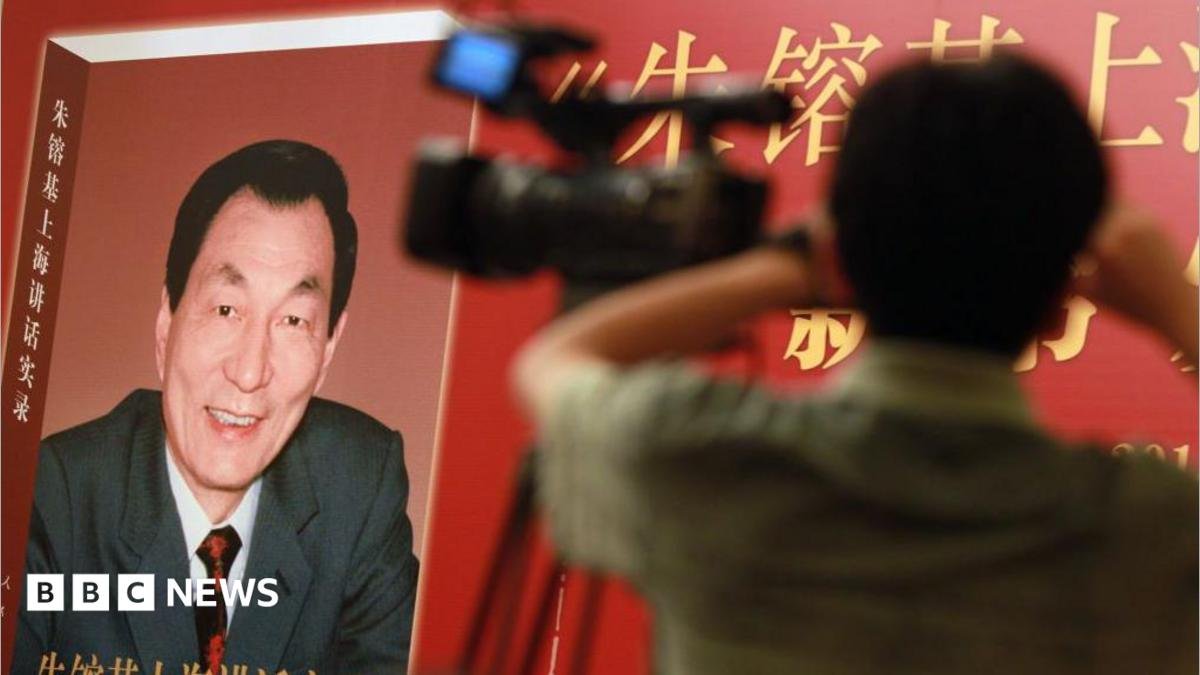
Flags at government sites across Beijing are flying at half-mast, and security vehicles are parked in the city’s core, as China observes the passing of former Premier Zhu Rongji. The 97-year-old architect of China’s most aggressive market reforms died of an illness last week and was cremated on Tuesday at the Babaoshan Revolutionary Cemetery, an exclusive resting place reserved for the party’s highest-ranking officials. The ceremony, attended by senior leaders including President Xi Jinping, was deliberately kept low-key, with no footage released to the public.
The restraint is not accidental. While state media have hailed Zhu as an “outstanding member of the Chinese Communist Party” and a “time-tested and loyal Communist fighter,” the leadership in Beijing is acutely aware that public mourning for his era can quickly morph into veiled criticism of the current government under Xi. The decision to contain the narrative around Zhu’s death—both physically and digitally—reveals a strategic calculus that extends far beyond the funeral cortege, touching on the very foundations of the party’s legitimacy and its control over historical memory.
The Ghosts of 1976 and 1989: Why Mourning Is a Security Issue
The party’s apprehension is rooted in precedent. The deaths of former Premier Zhou Enlai in 1976 and former CCP General Secretary Hu Yaobang in 1989 triggered widespread public outpourings of grief that rapidly escalated into political protests, culminating in the bloody Tiananmen Square crackdown. For the current leadership, the funeral of a reformist premier is not merely a ceremonial occasion; it is a potential flashpoint for mass mobilization.
This historical memory explains the heavy security presence and the absence of any public viewing. The state is walking a tightrope: it must honor a man who is revered for pulling China into the global economy, while simultaneously ensuring that the grief does not become a referendum on the present. The censorship of online content, including the removal of an essay by economist Zhao Jian from WeChat the day after it was published, underscores the sensitivity. Zhao’s piece, which fondly recalled an era when people were “properly poor” but saw a clear future ahead, was deemed too dangerous to remain in the public domain.
Zhu Rongji: The Reformer Who Dismantled the Old Order
Zhu Rongji served as premier from 1998 to 2003, a period that defined modern China’s economic trajectory. Alongside President Jiang Zemin, who became party chief in 1989 and president in 1993, Zhu pushed through a series of painful structural changes. These included shuttering chronically unprofitable state firms, dismantling the old housing system in favor of a commercial property market, weathering the Asian financial crisis of the late 1990s, and securing China’s accession to the World Trade Organization in 2001.
His style was as memorable as his policies. Zhu once labelled rogue bankers as “half-wits” and described the flood dykes lining the Yangtze River as “flimsy and porous as tofu dregs.” At a 1999 news conference with US President Bill Clinton, he deployed deadpan humour to dismiss allegations of political donations, quipping that with $146 billion in foreign exchange reserves, he would have donated at least $10 billion if such contributions were effective, not a paltry $300,000. This candour, a stark contrast to the carefully choreographed leadership style of today, is precisely what captivates Chinese audiences and fuels nostalgia.
The Nostalgia Trap: Mourning a Different Future
The passing of Zhu and Jiang, two leaders from the same era, has triggered a wave of nostalgia among many Chinese for a time when the country appeared to be heading in a different direction—one that seemed to promise greater openness to the world and more personal freedom. A state media documentary about Jiang’s life shows him banging on tables one minute and erupting in laughter the next. Circulating on social media is a picture of Jiang laughing with Zhu, accompanied by praise for their candid communication: “They told the truth, shouldered the responsibility and spared no effort in serving the people.”
This public affection stands in stark opposition to the current administration’s approach. President Xi has exerted greater central control and pressed a state-driven economic policy focused on technological autonomy and strategic industries. The nostalgia for the 1990s and early 2000s—an era of private entrepreneurship and wealth creation—implicitly critiques the present, where slower growth, plummeting house prices, high youth unemployment, and sluggish factory output have replaced the days of double-digit expansion.
Xi’s Counter-Narrative: Continuity and Struggle
In a 40-minute speech on Monday commemorating the birth centenary of Jiang Zemin, Xi sought to co-opt the legacy of these reformers. He called on the party to carry forward Jiang’s legacy, presenting the current leadership as the continuation of his political and ideological project. “On the new journey ahead, we must heighten our sense of vigilance against potential dangers,” Xi said, urging the party to “proactively meet the major tests posed by high winds and rushing waters, or even by raging storms.”
Notably, Xi also praised Jiang’s crackdown on a reformist Shanghai newspaper in 1989 after it voiced support for the pro-democracy demonstrations that culminated in the Tiananmen Square massacre. This is a deliberate re-framing: the party is not merely mourning two dead leaders; it is actively constructing a unified historical narrative that legitimizes the current leadership’s path. As Kerry Brown, Professor of Chinese Studies and Director of the Law China Institute at King’s College London, notes, “Xi is committed to the great renaissance of the Chinese nation. He’s trying to put forward a unified historic narrative—any idea that their leadership offered or suggested a different future path will not be allowed a public airing. Instead, their lives will be knitted into the narrative that everything they did transformed China into what it is now, rather than dwell on any other ‘What If’s’.”
The Digital Iron Curtain: Censorship as a Tool of Legitimacy
The censorship of Zhao Jian’s essay is a microcosm of a broader strategy. Zhao’s reflection—that “there were no smartphones then, no short-form videos and no screens filled by the purveyors of anxiety. The sky was blue, life moved slowly and people could say what they really thought”—was removed within 24 hours. The essay’s crime was not factual inaccuracy but emotional resonance. It tapped into a collective sentiment that the current era, despite its “material abundance” and “skylines bristling with high-rises,” has left many feeling empty.
This digital containment is not merely about suppressing dissent; it is about controlling the emotional register of public discourse. The party has long feared the unpredictable nature of mass grief. By censoring nostalgic reflections, the state aims to prevent the formation of a collective memory that could serve as a rallying point for opposition. The contrast between Zhu’s blunt, accessible style and the current leadership’s carefully managed image is a vulnerability that the party cannot afford to leave unaddressed.
Strategic Implications: Memory, Legitimacy, and Global Standing
The handling of Zhu Rongji’s funeral offers a window into the Xi-era leadership’s approach to governance. It reveals a regime that is simultaneously confident in its control and anxious about its legitimacy. The decision to keep the funeral low-key and censor online mourning suggests that the party views public sentiment as a potential threat rather than a source of support. This is a significant departure from the era Zhu helped create, when economic performance was the primary source of legitimacy.
The strategic implications are profound. Domestically, the suppression of nostalgia risks deepening the disconnect between the party and a populace that remembers a time when hard work reliably led to improvement. Zhao Jian’s poignant question—“do we feel so empty inside?”—encapsulates a widespread malaise that economic statistics cannot capture. Internationally, the contrast between Zhu’s era of global integration and Xi’s emphasis on technological autonomy and strategic industries signals a fundamental shift in China’s relationship with the world. The passing of Zhu and Jiang marks the definitive end of the breakneck reforms of the 1990s and early 2000s, and with it, the era of unquestioning openness to global trade.
As China faces slower economic growth and demographic decline, the party’s reliance on control rather than inspiration may prove to be its greatest vulnerability. The ghosts of 1976 and 1989 serve as a warning: when the state suppresses public mourning, it does not eliminate grief; it merely drives it underground, where it can fester and grow. For Xi, the challenge is not just to honor the dead, but to convince the living that the future they are being offered is worth the sacrifices of the past. The censorship of Zhu’s legacy suggests that, for now, the party does not trust its own people to make that judgment.
This article was produced with AI-assisted research and editorial support. Sources: BBC News.
By Prof. Marcus Chen, Staff Writer
What's Your Reaction?
 Like
0
Like
0
 Dislike
0
Dislike
0
 Love
0
Love
0
 Funny
0
Funny
0
 Wow
0
Wow
0
 Sad
0
Sad
0
 Angry
0
Angry
0

World Politics Analyst at Global1.News. Based in Beijing, covering US-China relations, global trade, and geopolitical strategy. Brings deep analytical perspective to the power dynamics shaping international affairs.











Comments (0)