
World's First 16-MW Floating Wind Platform Goes Online at China's Lufeng Oilfield
CNOOC has switched on Haiyou Anlan, the world's first 16-megawatt tension-leg floating wind platform, at the Lufeng oilfield. Connected by a 4.3-km subsea cable, it will generate 54 million kWh a year, saving 15,000 cubic meters of fuel oil and cutting 35,000 tonnes of CO2 annually.
CNOOC's activation of the Haiyou Anlan 16-megawatt tension-leg floating wind platform at the Lufeng oilfield establishes a new benchmark for deep-water renewables in the Asia Pacific. The unit's integration into an offshore oil and gas grid demonstrates how floating wind can decarbonize energy-intensive operations in waters previously considered too challenging. This advance arrives as Japan and other regional players expand their own floating wind ambitions into exclusive economic zones.
World's First 16-MW Floating Wind Platform Goes Online at China's Lufeng Oilfield
Tokyo, Japan - Aug 6, 2026 - CNOOC announced on Thursday that the Haiyou Anlan tension-leg platform had been connected to the Lufeng oilfield power grid and had begun supplying green electricity. The installation, located 136 km offshore in 136 m of water, sets records for operating depth, distance from shore, and single-unit capacity among tension-leg floating wind platforms. The milestone underscores how floating wind technology is moving from demonstration to operational use in support of existing energy infrastructure.
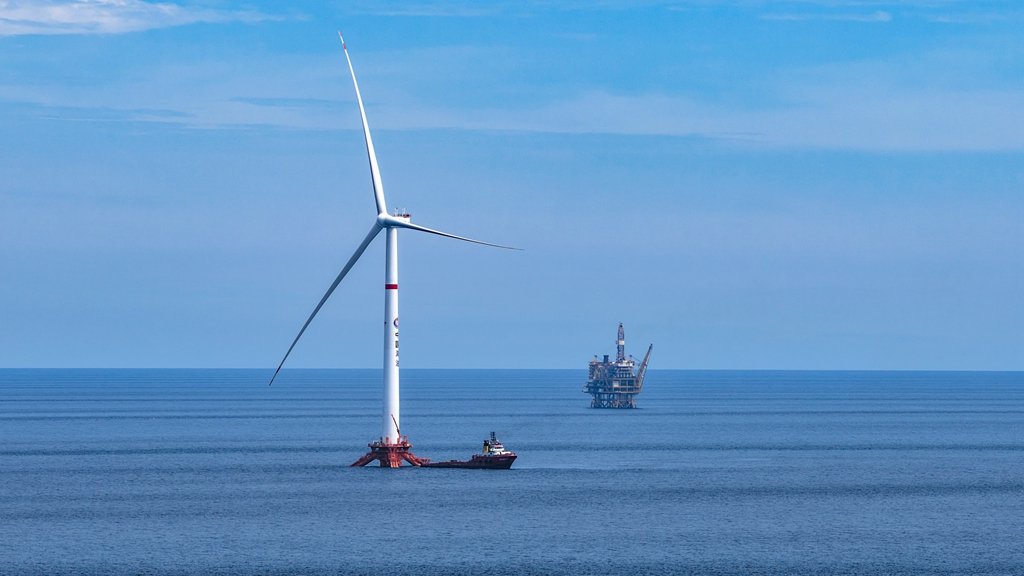
CNOOC Switches On World-First 16-MW Floating Wind Platform
The platform left Gaolan Port in Zhuhai on June 28, 2026, and stands more than 307 m tall while weighing nearly 8,000 tonnes. It carries a 16-MW turbine engineered to survive typhoons with sustained winds up to 220 km/h and carries a 25-year design life. Electricity reaches the oilfield facilities through a 4.3-km subsea cable.
CNOOC reports that the unit is expected to produce 54 million kWh of electricity each year. That output will displace roughly 15,000 cubic meters of fuel oil and avoid about 35,000 tonnes of carbon dioxide emissions annually. The project marks the first time a tension-leg floating wind platform of this scale has entered commercial service anywhere.
How a Tension-Leg Platform Tames Deep Water
A tension-leg floating wind platform uses an upper floating structure, a seabed anchoring foundation, and a taut mooring system to maintain position. The design keeps vertical motion minimal even in severe sea states, making it suitable for water depths where fixed-bottom foundations become impractical. Engineers describe the technology as the most technically demanding among floating wind concepts because of the precision required in the mooring system.
The Lufeng installation broke through several international patent barriers, according to project statements, and established a new technical pathway for deep-sea wind equipment. The platform's ability to operate in 136 m of water while remaining stable under Category 17 typhoon conditions demonstrates the maturity of the tension-leg approach for commercial deployment.
At 136 m depth the Lufeng site sits at the shallower end of the range where floating technology becomes necessary. This location allows direct comparison with fixed-bottom projects while proving the mooring system in real typhoon exposure. Data from the first operational year will clarify how much additional depth can be reached with the same basic design.
Tension-leg platforms require exact tensioning during installation to avoid resonance with wave periods. The successful connection at Lufeng indicates that Chinese contractors have mastered those procedures at commercial scale. Future projects can draw on this experience to shorten installation windows and lower costs.
The 307 m overall height and 8,000-tonne weight of the unit reflect the engineering trade-offs needed for stability in deep water. Heavier foundations and longer tendons increase material demands yet enable larger turbines. This balance will influence how developers size arrays in Japan's deeper EEZ zones.
Wind Power for an Oilfield: A New Multi-Energy Model
CNOOC combined the floating wind unit with conventional fuel generation and battery storage to create a coordinated multi-energy system at the oilfield. The arrangement allows a high share of renewable electricity to serve offshore platforms directly. Company officials present the approach as a scalable template for pairing oil and gas operations with new energy sources.
The 4.3-km subsea cable links the turbine directly to the oilfield network, avoiding the longer export cables required for shore-connected farms. This short distance cuts transmission losses and simplifies permitting. Similar configurations could be replicated at other remote fields where distance from land makes full grid ties uneconomic.
Storage capacity within the multi-energy system helps smooth output variations caused by wind lulls or typhoon shutdowns. The combination supports continuous platform operations without oversized backup generators. Over time the model may extend to hydrogen production or other energy carriers if battery economics improve.
China's Offshore Wind Push in Numbers
China's total installed wind capacity surpassed 660 GW as of May 2026, reflecting more than 17 percent growth year on year. Offshore wind reached 47 GW, accounting for 78 percent of all new offshore wind capacity added globally in the period. The country holds more than half of the worldwide offshore wind market and plans to add up to 63 GW of additional offshore capacity in coming years.
The 47 GW offshore total already exceeds the combined offshore fleets of Europe and the United States. Growth has been driven by coastal provinces that set aggressive renewable targets and by central policies favoring domestic turbine supply chains. The Lufeng unit adds a new dimension by proving technology for waters beyond the continental shelf.
Annual additions of this magnitude create steady demand for installation vessels and specialized components. Chinese yards have responded by scaling up production of large nacelles and blades suited to typhoon conditions. This manufacturing depth supports both domestic projects and potential export of complete floating platforms.
Why the Milestone Matters for Japan's Floating Wind Push
Japan's revised Renewable Energy Sea Area Utilization Act took effect on April 1, 2026, opening offshore wind development into the exclusive economic zone. The change expanded eligible sea area from roughly 430,000 square km of territorial waters to more than 4 million square km of EEZ. METI now designates call-for-bid zones with government-led environmental scoping, and most of the new area lies in deep water where only floating wind is viable.
Japan targets 10 GW of offshore wind by 2030 and 30-45 GW by 2040 as part of its net-zero pathway for 2050. The narrow continental shelf around the Japanese archipelago limits fixed-bottom opportunities, making floating platforms essential. The Lufeng demonstration provides a reference point for the technical and supply-chain requirements Japan will face as it moves into 100-300 m depths.
Japan's EEZ zones will require turbines rated for similar typhoon conditions as those at Lufeng. The 16-MW capacity and 25-year design life shown by Haiyou Anlan align closely with the scale needed to meet Japan's 2040 targets. Domestic developers can study mooring performance data to refine their own platform concepts.
The call-for-bid process gives METI greater control over project siting and environmental studies. This centralized approach may shorten permitting compared with earlier rounds limited to territorial waters. Yet developers still face the challenge of building local supply chains capable of delivering floating units at competitive cost.
Cooperation with experienced operators such as CNOOC could accelerate learning curves for Japanese firms. Technology partnerships that preserve strategic autonomy remain a priority for METI. The Lufeng project illustrates both the opportunities and the competitive pressures that will shape Japan's floating wind rollout.
Asia-Pacific Rivalry and the Deep-Sea Supply Chain
Norway's Hywind Tampen project, commissioned in 2022 with eleven 8.6-MW turbines, remains the main prior example of floating wind serving oil and gas facilities. China's single 16-MW unit now exceeds the capacity of any individual Hywind turbine while operating in comparable or greater depths. The achievement underscores intensifying competition in floating wind technology across the Asia-Pacific region.
Chinese dominance in offshore wind manufacturing extends to specialized components such as large-diameter mooring chains and dynamic cables. Japanese developers must decide whether to import these items or invest in local production. The choice will affect both project costs and the degree of technology transfer achieved.
What to Watch For
Attention now turns to whether CNOOC will replicate the multi-energy model at additional oilfields and whether other Chinese operators will adopt similar tension-leg designs. In Japan, the first METI-designated EEZ bidding rounds are expected to clarify project economics and local-content requirements. Industry observers will also monitor how quickly supply chains outside China can deliver comparable 15-MW-class floating units at competitive cost.
Further milestones include the performance data from Haiyou Anlan during the upcoming typhoon season and any announcements on additional deep-water projects in the South China Sea. These developments will shape both technology standards and competitive positioning for floating wind across the Asia Pacific through the remainder of the decade.
Japan's first EEZ auctions will reveal how bidders value the deeper-water resource and what local-content thresholds METI sets. Successful bids will trigger supply-chain investments that could narrow the current gap with Chinese capabilities. The pace of these auctions will determine whether Japan meets its 2030 target.
Additional Chinese projects in the South China Sea would further validate the tension-leg pathway and could establish de-facto standards for mooring systems and turbine ratings. International developers will study these outcomes when planning entries into the same basins. The interplay between Chinese scale and Japanese policy will define the Asia-Pacific floating wind market for years ahead.
By Kenji Tanaka, Staff Writer
This article was produced with AI-assisted research and editorial support. Reporting is based on sources cited in the article.
What's Your Reaction?
 Like
0
Like
0
 Dislike
0
Dislike
0
 Love
0
Love
0
 Funny
0
Funny
0
 Wow
0
Wow
0
 Sad
0
Sad
0
 Angry
0
Angry
0

Japan Correspondent at Global1.News. Tokyo-based voice covering Japanese politics, technology, economy, and culture. Tracks the intersection of tradition and innovation in one of the world's most dynamic societies.














Comments (0)