
Has Life in North Korea Changed Since 2013?
Book Launch Raises Timely Questions on North Korea Engagement Jerome Sauvage, who served as United Nations Resident Coordinator in Pyongyang from 2009 to 2013, launched his memoir “Witness to North Korea” last month. Discussions with Wall Street Journal Beijing Bureau Chief Jonathan Cheng and NK News correspondent Alannah Hill centered on whether the account of day-to-day diplomacy and humanitarian work remains relevant today. Stimson Center Fellow Frank Aum described the book as an examination
Book Launch Raises Timely Questions on North Korea Engagement
Jerome Sauvage, who served as United Nations Resident Coordinator in Pyongyang from 2009 to 2013, launched his memoir “Witness to North Korea” last month. Discussions with Wall Street Journal Beijing Bureau Chief Jonathan Cheng and NK News correspondent Alannah Hill centered on whether the account of day-to-day diplomacy and humanitarian work remains relevant today. Stimson Center Fellow Frank Aum described the book as an examination of “what it actually means to engage with the DPRK – not in the abstract language of policy briefs, but through the granular, often maddening, reality of day-to-day diplomacy and humanitarian work.” Sauvage acknowledges that conditions have evolved since his departure, yet he identifies persistent structural gaps that continue to shape ordinary lives in the Democratic People’s Republic of Korea.
Marketization and the Limits of Available Data
Observers note signs of marketization, including a reported rise in mobile phone subscribers, the emergence of a middle class with disposable income, and new facilities such as ski resorts. These developments reflect monetization trends that have altered parts of the previously closed economy. At the same time, data collection has deteriorated sharply. In 2020 North Korea cited the COVID-19 pandemic to bar entry to several EU-member embassies and most international assistance programs. Resident UN agencies and international NGOs have not returned. The last national population census, an essential source of demographic information, dates to the period before Sauvage left in 2013. Without updated surveys, assessments of social conditions rely increasingly on indirect indicators and limited external observations.
The expansion of market activity in North Korea creates a structural tension between pragmatic economic adaptation and the regime’s imperative to maintain political control. Monetization allows households to secure food and consumer goods outside state distribution channels, yet it simultaneously erodes the ideological claim that the state alone provides for its citizens. This dynamic forces authorities to tolerate informal networks while periodically reasserting oversight through surveillance and selective crackdowns, producing an uneasy equilibrium in which economic agency coexists with political constraint.
Mobile phone penetration functions simultaneously as an instrument of state monitoring and a marker of emerging consumption patterns. Expanded connectivity enables authorities to track movements and communications more effectively than in earlier decades, yet it also transmits information about price differentials and external developments that can undermine official narratives. The resulting information environment therefore strengthens regime capacity in some domains while introducing new vectors of social comparison that the leadership cannot fully contain.
The absence of a national census since 2013 compounds these uncertainties for external actors. Without reliable demographic baselines, United Nations agencies and South Korean planners lack the granular data required to design targeted agricultural or health interventions, forcing reliance on fragmentary satellite imagery and defector testimony. This information vacuum elevates the risk that policy assumptions will diverge from actual conditions on the ground, reducing the precision of both humanitarian programming and strategic assessments.
Food Security Remains a National Challenge
Kim Jong Un’s February 2026 admission that agricultural production remains inadequate and that decades of rural policy have fallen short echoes concerns documented during Sauvage’s tenure. Humanitarian agencies then worked with North Korean institutions to raise output, improve maternal and child nutrition, and support communities facing chronic shortages. Current policy emphasis has shifted toward livestock, dairy farming, and regional development, yet the core objective—securing sufficient nutritious food—has not changed. Workplaces once permitted daytime foraging in the hills because the government recognized an ongoing “food problem.” Today’s rural modernization program similarly concedes that food security constitutes a continuing national priority rather than a resolved legacy issue.
North Korea’s recurring food deficits trace to the systemic breakdown of the public distribution system in the 1990s, after which households turned to private cultivation and cross-border trade. Successive aid cycles from international donors temporarily alleviated acute shortfalls but never restored the state’s capacity to guarantee adequate nutrition nationwide. The pattern established then—periodic external assistance punctuated by renewed shortages—continues to shape both domestic policy and external calculations about when and how to offer support.
Kim Jong Un’s February 2026 acknowledgment that agricultural output remains insufficient carries particular weight because it publicly concedes the limits of self-reliance rhetoric. Such admissions historically precede adjustments in resource allocation or appeals for external inputs. By framing rural shortcomings as a continuing national priority rather than a resolved legacy, the statement signals that food security will remain a central test of regime legitimacy for the foreseeable future.
The rural modernization program’s emphasis on livestock and regional infrastructure reflects a strategic calculation that visible investment can reinforce regime survival even if aggregate caloric availability stays constrained. For humanitarian planners and South Korean policymakers, this approach complicates decisions about food aid: assistance that bypasses official channels risks being viewed as subversive, while aid routed through state structures may subsidize projects whose primary purpose is political consolidation rather than nutritional improvement.
Health Infrastructure and Persistent Service Gaps
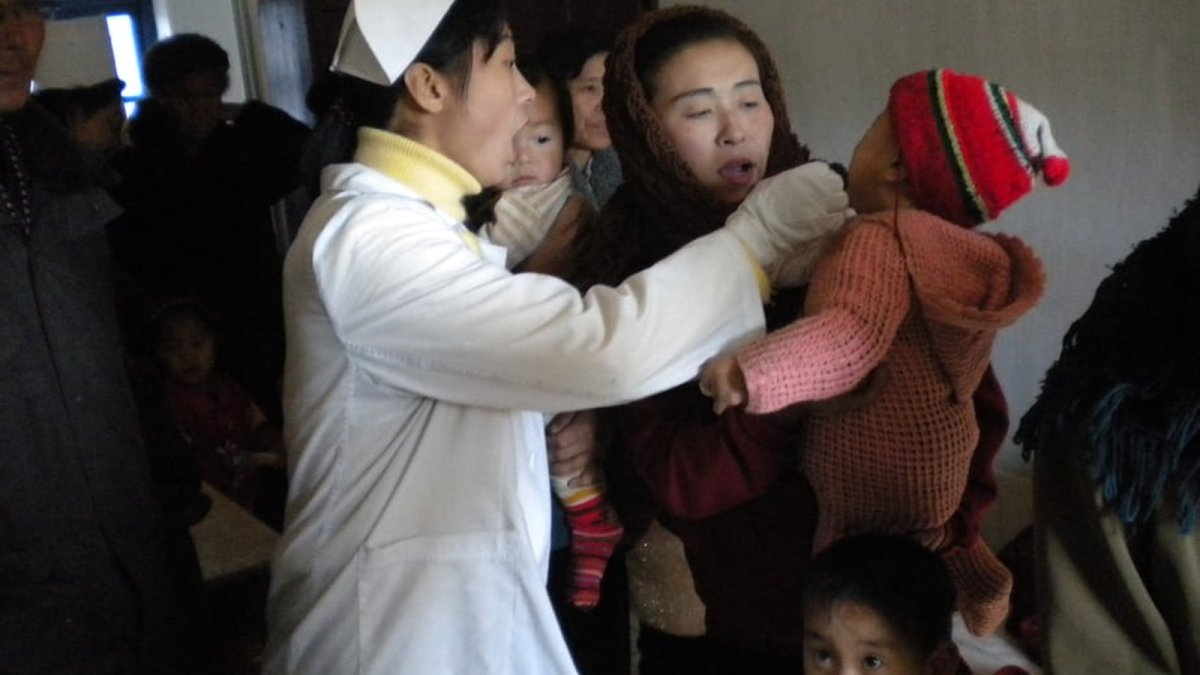
Authors Joon Hee Han and Yo Han Lee, in their January 2026 article “North Korea’s 2025 Health Revolution,” document heavy investment in new hospitals and health facilities. Questions persist, however, about foundational inputs such as medicines, trained personnel, reliable electricity, and sustainable financing. During Sauvage’s years in Pyongyang, UN teams repeatedly observed that physical infrastructure alone could not improve outcomes without parallel advances in equipment, pharmaceuticals, professional training, and institutional capacity. Aside from high-profile projects in the capital, these constraints appear unchanged. A Russian court ordered more than thirty North Korean nationals to undergo tuberculosis treatment in Moscow in 2024 and 2025, confirming both labor flows into Russia and an apparent outbreak among overseas workers. Tuberculosis was already recognized as a major public health threat between 2009 and 2013; its continued prevalence underscores enduring weaknesses in detection, treatment, and prevention systems.
Tuberculosis serves as a sentinel indicator because its control requires precisely the inputs—consistent drug supply, trained personnel, reliable electricity for diagnostics, and functioning referral systems—that North Korea’s health apparatus has historically lacked. Sustained prevalence therefore reveals weaknesses that extend beyond any single disease to the broader architecture of service delivery. When cases appear among overseas workers, they expose gaps in pre-departure screening and post-return follow-up that domestic statistics alone cannot capture.
The 2024–2025 Moscow court orders illustrate how labor export schemes intersect with disease surveillance failures. Workers sent abroad receive limited medical oversight, and upon repatriation they re-enter a system whose diagnostic capacity remains uneven outside major urban centers. This pattern underscores the structural preference for constructing visible facilities while underinvesting in the recurrent costs of medicines, training, and maintenance that determine actual health outcomes.
International health cooperation consequently faces a persistent dilemma. Programs modeled on GAVI or WHO frameworks depend on verifiable delivery and monitoring, yet the contraction of resident agencies has removed the on-site presence required for such verification. Without renewed channels for technical assistance that address supply chains and workforce development rather than infrastructure alone, external support risks reinforcing the very imbalances between visible construction and functional capacity that have characterized the sector for decades.
Technical Cooperation and the Sanctions-Engagement Dilemma
North Korea’s reluctance to accept technical assistance from the United Nations, NGOs, and certain bilateral donors coincides with tighter international restrictions that complicate operational access. Sauvage stresses that engagement is neither a concession to the regime nor an endorsement of its policies; it constitutes a practical channel for delivering expertise and maintaining communication in an isolated state. The current debate over sanctions exemptions, NGO licensing, and humanitarian carve-outs indicates that this tension remains unresolved. International agencies still link North Korea to global standards through civil aviation coordination, vaccination programs, and drug control, yet their reduced ability to monitor activities on the ground limits effectiveness. Technical assistance, Sauvage argues, should be viewed as a tool to support populations rather than a political reward.
Implications for Seoul and International Posture
These observations carry direct relevance for South Korea’s inter-Korean policy and for the broader sanctions-versus-humanitarian-engagement debate. Seoul has historically weighed the risks of legitimizing Pyongyang against the imperative to address documented humanitarian needs. UN agencies once provided a neutral platform for cooperation on agriculture, health, and census work; their absence removes one modest avenue for confidence-building measures. Sauvage concludes that isolation has not eliminated North Korea’s requirements; it has merely made external responses more difficult. The fundamental questions—how to balance sanctions with humanitarian principles, how to reach vulnerable groups while respecting international law, and how to preserve dialogue channels—continue to define the international community’s posture toward the peninsula. Sustained, principled engagement remains one of the few practical instruments for improving conditions for ordinary North Koreans while keeping lines of communication open in one of the world’s most isolated states.
South Korea’s engagement dilemma oscillates between conservative administrations that prioritize sanctions enforcement and progressive governments that seek incremental confidence-building through humanitarian channels. Each shift alters the domestic political space available for food or medical assistance, yet neither posture has resolved the underlying tension between maintaining pressure on the regime and addressing documented civilian needs. The absence of resident UN agencies removes a relatively insulated platform that previously allowed limited cooperation insulated from direct bilateral friction.
United Nations Security Council resolutions contain humanitarian exemptions, but their practical application requires case-by-case approvals that have grown more cumbersome as sanctions lists expanded. This procedural thickening raises transaction costs for NGOs and UN entities, discouraging smaller-scale projects even when legal carve-outs exist. Sauvage’s insistence that technical assistance constitutes a practical channel rather than a political reward therefore highlights the need for clearer, standing exemption mechanisms that do not require repeated political negotiation.
For the next South Korean administration and its trilateral partners, these constraints imply that any renewed engagement strategy must address both the sanctions architecture and the operational vacuum left by departed agencies. Preserving dialogue channels through multilateral health or agricultural programs could provide low-visibility avenues for coordination with Washington and Tokyo while testing whether modest, monitored cooperation can improve conditions for vulnerable populations without legitimizing broader regime behavior.
By Prof. David Park, Staff WriterThis article was produced with AI-assisted research and editorial support. Reporting is based on sources cited in the article.
What's Your Reaction?
 Like
0
Like
0
 Dislike
0
Dislike
0
 Love
0
Love
0
 Funny
0
Funny
0
 Wow
0
Wow
0
 Sad
0
Sad
0
 Angry
0
Angry
0

East Asia/Technology Correspondent at Global1.News. Seoul-based voice covering Korean politics, technology, business, and culture. Analyzes how technology and geopolitics intersect across East Asia.













Comments (0)