
US Orders Defense Industry to Drop Chinese Rare Earths
Washington has ordered American arms manufacturers to phase out Chinese rare earths, ending routine waivers that kept Pentagon supply lines moving. China controls 90 per cent of processed rare earths and has tightened export controls, adding MP Materials and USA Rare Earth to its list. Analysts c...
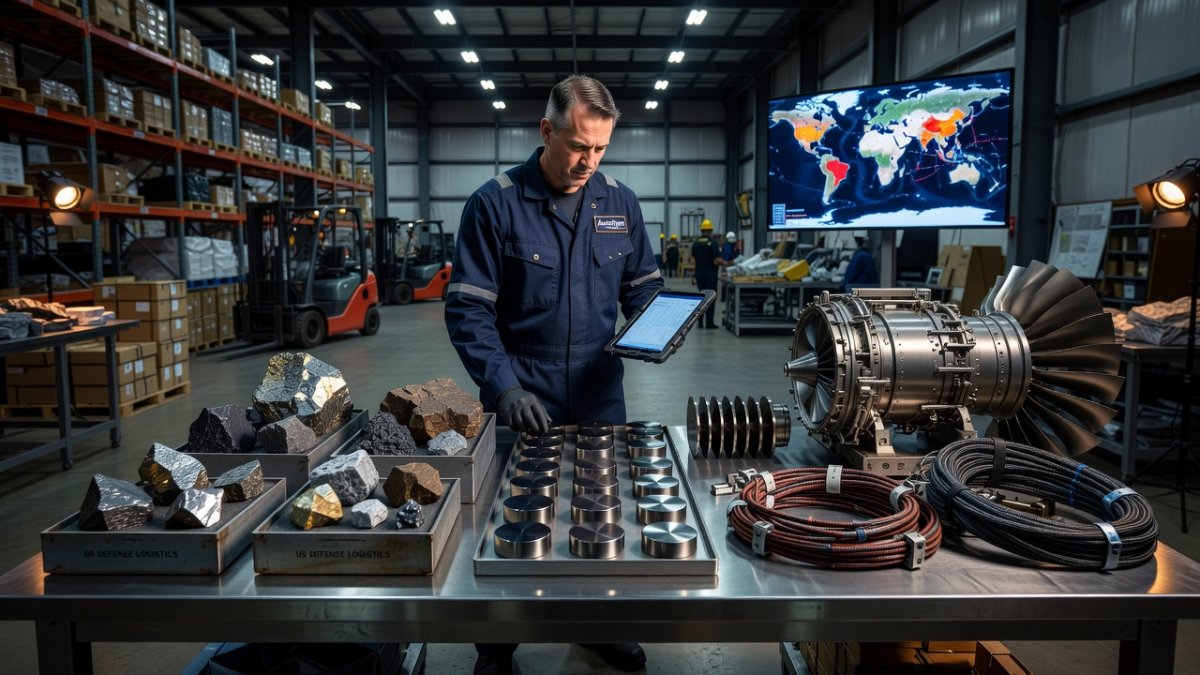
US Orders Defense Industry to Drop Chinese Rare Earths
Washington has served notice that the era of routine waivers for Chinese rare earths in American weapons is over. A July 20 executive order signed by President Donald Trump requires major US arms manufacturers to trace their multi-tier supply chains and actively phase out Chinese rare earths, tightening the conditions under which the Department of Defence can issue waivers for defence-critical imports from China, Russia, Iran and North Korea.
Far from a radical policy shift, industry observers in both Washington and Beijing describe the directive as a long-overdue enforcement crackdown — designed, in the words of one supply-chain analyst, to deliver "short-term contractor pain for long-term national security gain." For China watchers, the order marks another turn in the strategic minerals contest that has quietly become one of the defining economic battlegrounds of the US-China rivalry.
What the Executive Order Actually Changes
US defence procurement rules already prohibit sourcing "covered materials" — from rare earth magnets to newly added inputs like gallium and germanium — from adversary states. But because China controls roughly 90 per cent of global processed rare earths and two-thirds of mining capacity, the Pentagon has routinely granted waivers to keep military production lines moving. Beginning next year, those routine exemptions will end.
Contractors seeking waivers must now submit formal mitigation plans proving "exhaustive efforts" to source compliant materials, detailing explicit steps to phase out non-compliant suppliers and setting strict implementation timelines. The order also mandates comprehensive supply-chain mapping within 180 days, requiring companies to trace components "from raw materials to end products."
A White House statement acknowledged the scale of the problem: "Despite long-standing prohibitions on the use of sensitive materials sourced from geopolitical adversaries, supply-chain resilience and domestic production have been historically underprioritised."
Beijing's Stranglehold on the Supply Chain
China's dominance is not in mining alone — it is in the midstream. According to the US Geological Survey's Mineral Commodity Summaries, China remains one of the leading foreign suppliers for several covered materials, including tantalum, tungsten, gallium and germanium. The United States relies entirely on imports for materials like gallium and tantalum, while its net import reliance for tungsten exceeded 50 per cent of apparent consumption in 2025.
Heavy rare earths such as dysprosium and terbium are vital for high-performance permanent magnets that underpin US defence technology, from radar arrays and missile guidance units to advanced propulsion systems. The concentration of refining capacity inside China means even minerals sourced elsewhere often pass through Chinese processing before reaching American factories.
For Beijing, the leverage is deliberate. China has dramatically tightened export controls on rare earths since last year, and just one month before the order, added 10 US firms — including rare earth specialists MP Materials and USA Rare Earth — to its export control list. Washington has complained it is still not receiving sufficient critical mineral exports from China despite the trade truce struck in Busan last year.
The timing is no accident. China's export-control architecture has been built incrementally — from the first gallium and germanium restrictions to successive rounds covering rare earth processing technologies and magnet production. Each step has been calibrated to target the precise nodes of the supply chain where Chinese refining is hardest to replace, and where American defence production is most exposed. The result is a bargaining position that Beijing can dial up or down without ever formally severing trade.
Analysts: Manageable Pain, Not Strategic Panic
Eugene Gholz, an associate professor of political science at the University of Notre Dame and a former senior adviser to the US deputy assistant secretary of defence for manufacturing and industrial base policy, framed the order as enforcement rather than innovation. "The executive order is about finally enforcing laws that have been on the books for a while," he said. "It is not a major policy shift. There is a bipartisan consensus in the United States in favour of limited decoupling from China on critical materials supply."
Cory Combs, head of supply-chain research at advisory firm Trivium China, said the order raised the bar for waivers to force technical diversification and stimulate non-Chinese supply growth. "To the extent it works, it is designed to be 'short-term contractor pain for long-term national security gain'," Combs said.
Gholz argued the market adjustments were manageable and would not compromise current military readiness. Government and defence demand for many critical materials is a small fraction of overall demand, he noted, and non-adversarial suppliers could meet military needs if Washington were prepared to absorb higher costs. "This executive order has to do with sourcing for production of weapons in the future. It also is unlikely to impact readiness. It may cause some production timelines for the future to slip, but probably not much if at all."
The Traceability Problem No Law Can Fix Overnight
The hardest hurdle is visibility. Courtney Weatherby, a fellow at the Stimson Centre's energy, water and sustainability programme, highlighted two bottlenecks: the administrative burden of tracing deep-tier supply chains, and the practical difficulty of finding feasible non-Chinese alternatives.
Weatherby said a primary obstacle on the supply side lay in China's midstream refining, where critical minerals from disparate sources are blended into mixed batches, making it hard to trace the origin of a single raw material. "In the short term, the informational gaps may pose challenges to companies seeking to meet requested levels of traceability," she said. "In the long term, it could pose challenges in terms of pricing and deliverable timelines if waivers are not approved due to potentially higher costs and lower availability of limited alternative sources."
The main hurdle for major defence primes is structural: they rarely buy critical minerals directly, forcing procurement teams to trace complex, lower-tier supply chains. Gholz viewed this administrative audit as "manageable" within months rather than years — but Weatherby cautioned that sourcing was only half the battle. Beijing's stranglehold on processing and refining techniques requires a scale of investment that will not materialise quickly. "That will take time and investment," she said.
What This Means for the US-China Strategic Competition
The order lands at a moment of acute American supply pressure. The United States is rushing to restock ammunition drained by its war with Iran and scale up output of strategic bombers and missiles — precisely the platforms that depend on rare earth magnets and gallium-based electronics. A supply-chain squeeze in the middle of a rearmament drive is the risk Washington is accepting in exchange for long-term resilience.
Combs, however, cautioned that the defence sector alone is too small to drive the kind of large-scale investment needed for genuine diversification. "Though we do expect it'll help transfer some value from contractors to select existing non-Chinese suppliers, which will be a boost to the latter's financial health," he said. The US' first strategic imperative is to diversify military supply chains; commercial supply diversification, despite all the political focus, is in practice a secondary and much longer-term objective.
From Beijing's perspective, the order is proof that its export-control strategy is working as intended. Every American effort to trace, substitute or stockpile is a validation that Chinese rare earths are indispensable — and that the leverage Beijing has built through years of industrial policy is now a central instrument of statecraft. The Busan trade truce lowered the temperature on tariffs, but the minerals front has never been about tariffs alone.
What to Watch For
The first deadline to watch is the 180-day supply-chain mapping requirement, which will force contractors to expose exactly how deep Chinese material runs through their platforms. The second is next year's end to routine waivers, which will test whether alternative suppliers — in Australia, Canada, the US itself and increasingly Southeast Asia — can scale fast enough to absorb demand.
For Japan and the wider Asia-Pacific, the stakes are immediate: Tokyo has its own rare earth dependence and has watched China's export controls with mounting unease, while Southeast Asian producers are positioning to capture any diversification that US policy triggers. The Philippines, Vietnam and Indonesia are all courting processing investment as the strategic minerals map is redrawn.
The deeper question is whether any of this changes the fundamental equation. China still controls the processing bottleneck, and no executive order can conjure a rival refining industry into existence overnight. What the order does do is force the hard conversation Washington has avoided for a decade: how much is strategic independence from Chinese minerals actually worth, and who pays for it? The answer will be written in waiver applications, quarterly earnings and the price of a kilogram of dysprosium — long before it appears in any policy speech.
For the Asia-Pacific region, the ripple effects are already visible. Japan, South Korea and the European Union are all watching the American experiment closely, weighing whether to adopt similar traceability mandates or to seek their own exemptions and stockpiles. The order's real significance may ultimately be diplomatic: by forcing its own contractors to map every tier of the minerals supply chain, Washington is also handing Beijing a detailed picture of where Western dependence is deepest — and where the next round of export controls could bite hardest.
By Kenji Tanaka, China Correspondent
This article was produced with AI-assisted research and editorial support. Reporting is based on sources cited in the article.
What's Your Reaction?
 Like
0
Like
0
 Dislike
0
Dislike
0
 Love
0
Love
0
 Funny
0
Funny
0
 Wow
0
Wow
0
 Sad
0
Sad
0
 Angry
0
Angry
0

Japan Correspondent at Global1.News. Tokyo-based voice covering Japanese politics, technology, economy, and culture. Tracks the intersection of tradition and innovation in one of the world's most dynamic societies.















Comments (0)