
Russia Jails Indigenous Buryat Activist 20 Years in Absentia
In a stark demonstration of Moscow’s expanding use of the military‑court system to suppress dissent, a Chita military court sentenced Indigenous Buryat activist Marina Khankhalaeva to twenty years in prison in absentia on Friday.
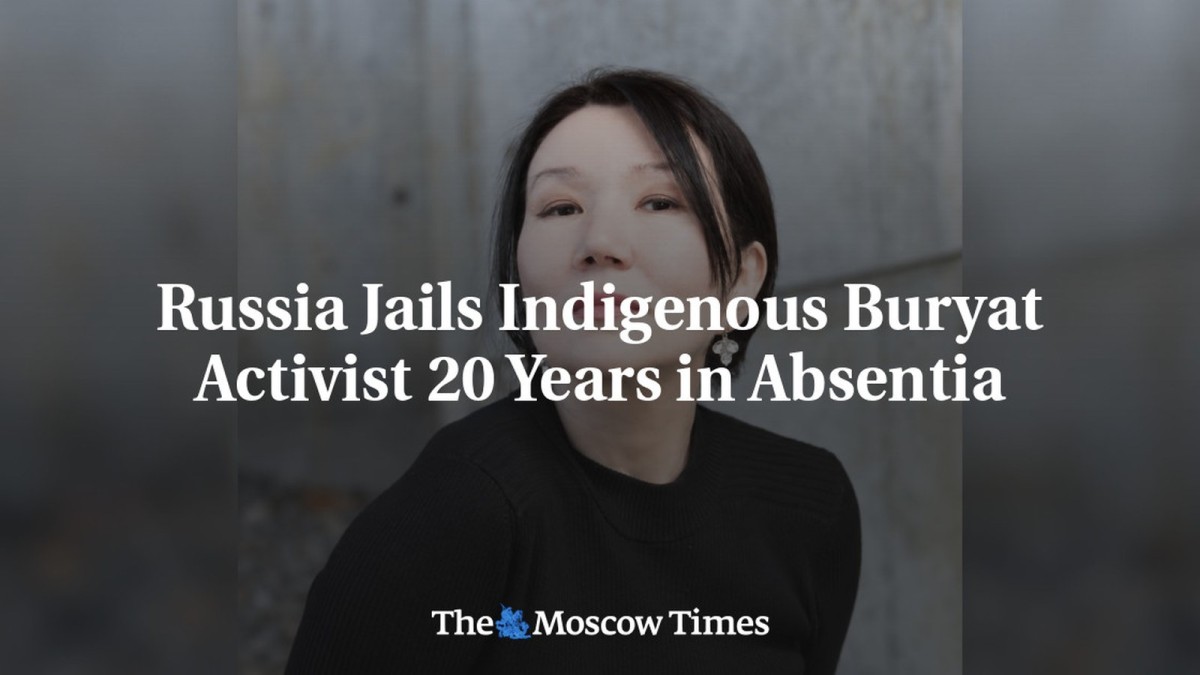
In a stark demonstration of Moscow’s expanding use of the military‑court system to suppress dissent, a Chita military court sentenced Indigenous Buryat activist Marina Khankhalaeva to twenty years in prison in absentia on Friday. The verdict, announced by Buryatia’s Interior Ministry, marks the latest escalation in a campaign that targets ethnic and de‑colonial movements across the Russian Federation, and it underscores the Kremlin’s willingness to weaponise terrorism and extremism statutes against political opponents.
Background on the sentencing
The court, part of the Zabaikalsky region’s military‑justice apparatus, found Khankhalaeva guilty of “organising an extremist group” and “participating in a terrorist organisation.” Russian authorities framed the charges as “active anti‑state activities” aimed at Buryatia’s secession, adding that her conduct allegedly incited “social and ethnic discord.” The ruling, issued in August, remained undisclosed until the Interior Ministry’s public announcement on 2 October 2026.
Khankhalaeva, a 53‑year‑old opera singer now based in the United States, responded that she learned of the sentence only through media reports. She described the verdict as “high praise” for her movement, interpreting the harsh penalty as proof that her advocacy reflects “the truth.” Her statements, relayed to The Moscow Times, highlight a pattern whereby activists double‑down after state repression, using the Kremlin’s own accusations as a rallying point for supporters.
The movement behind the activist
Marina Khankhalaeva is the founder of Tusgaar Buryad‑Mongolia, an exiled organisation that campaigns for the independence of the Siberian republic of Buryatia. The group’s platform is explicitly non‑violent; Khankhalaeva insists that it “never called for violence” and seeks to achieve its goals through peaceful means. Nevertheless, the movement has become a target of Russia’s security apparatus, being listed among 172 ethnic, Indigenous rights and de‑colonial organisations designated as “terrorist” in 2024.
In addition to the terrorist label, Tusgaar Buryad‑Mongolia was added to the “extremist” register earlier in 2024, allegedly for its alleged ties to a non‑existent “Anti‑Russian Separatist Movement.” The dual designation reflects a broader strategy: by branding groups both extremist and terrorist, the Kremlin expands the legal tools available to prosecute activists, restrict financing, and justify surveillance.
Geopolitical context of Buryatia
Buryatia, a resource‑rich region of roughly 970,000 inhabitants, shares a border of over 1,000 kilometres with Mongolia. Approximately one‑third of its population identifies as Buryat, a Mongolic Indigenous group with distinct cultural and linguistic traditions. The region’s strategic location and natural wealth have long made it a focal point for Moscow’s central‑regional power dynamics.
The push for independence, while still marginal in terms of popular support, has gained visibility in recent years, particularly after the fifth anniversary of the full‑scale invasion of Ukraine. Khankhalaeva noted a growing number of supporters for Buryat independence, a trend she attributes to the broader disenchantment with the Kremlin’s war and its domestic repercussions.
Legal mechanisms and the use of military courts
The sentencing of Khankhalaeva by a military court underscores a significant shift in Russia’s judicial landscape. Traditionally, civilian courts handled terrorism and extremism cases, but the Kremlin has increasingly routed politically sensitive prosecutions through military tribunals, which operate with reduced procedural safeguards and limited public oversight. This move aligns with a pattern observed since the war in Ukraine, where the state has expanded the remit of military justice to encompass a wider array of domestic dissent.
By trying Khankhalaeva in absentia, the authorities circumvent the logistical challenges of apprehending an overseas activist while still delivering a punitive verdict that can be used to restrict her travel, freeze assets, and criminalise any domestic supporters who might assist her. The absentia sentence also serves a symbolic function, signalling to other Indigenous and regional activists the reach of Moscow’s security apparatus.
Impact on Indigenous and ethnic activism
The designation of Tusgaar Buryad‑Mongolia as both extremist and terrorist reflects an intensifying crackdown on Indigenous rights groups across the Federation. The 2024 list of 172 organisations, which includes a broad spectrum of ethnic, Indigenous and de‑colonial entities, demonstrates a systematic effort to delegitimise and criminalise advocacy that challenges the Kremlin’s narrative of a unified Russian nation‑state.
For Buryat activists, the sentencing amplifies the risk of surveillance, arrest, and social ostracism. It also threatens the cultural preservation efforts that often accompany Indigenous activism, as the state’s branding of such groups as security threats can justify restrictions on language, education, and cultural expression under the pretext of combating extremism.
Repercussions for independent journalism
The Moscow Times, which reported on the sentencing, has itself been subjected to increasing repression. Earlier in 2026, the Prosecutor General’s Office labelled the outlet as an “undesirable” organisation, criminalising its operations and exposing its staff to prosecution. This follows a prior designation as a “foreign agent,” a label used to stigmatise and constrain independent media.
The pattern of targeting both activists and the journalists who cover them illustrates a broader Kremlin strategy: to control the narrative surrounding dissent and to deter external scrutiny. By branding reporting on cases like Khankhalaeva’s as “discrediting” the leadership, the state seeks to delegitimize external accounts and to intimidate domestic journalists who might otherwise amplify Indigenous grievances.
Implications for Kremlin stability and foreign policy
The sentencing of an Indigenous activist on terrorism charges signals the Kremlin’s willingness to extend its security narrative to the farthest reaches of the Russian Federation. By conflating regional independence movements with terrorism, Moscow aims to deter any fragmentation that could undermine its authority, especially in resource‑rich border regions that are strategically important for energy exports and geopolitical leverage.
Internationally, the case adds to a growing list of human‑rights concerns that shape Russia’s diplomatic posture. Western governments and human‑rights organisations have repeatedly condemned the use of anti‑extremism legislation to silence dissent. While the Kremlin has historically dismissed such criticism as interference, the accumulation of high‑profile cases—such as Khankhalaeva’s—could further isolate Russia on the global stage, especially as the war in Ukraine continues to dominate foreign‑policy calculations.
This article was produced with AI-assisted research and editorial support. Reporting is based on the source material cited below. Sources: The Moscow Times; themoscowtimes.com; Global1.News (04 October 2026).
By Irina Volkov, Staff Writer
What's Your Reaction?
 Like
0
Like
0
 Dislike
0
Dislike
0
 Love
0
Love
0
 Funny
0
Funny
0
 Wow
0
Wow
0
 Sad
0
Sad
0
 Angry
0
Angry
0
Russia/Eastern Europe Correspondent at Global1.News. Covering Russian politics, energy, security, and the shifting dynamics of the post-Soviet space. Provides clear-eyed analysis on one of the world's most opaque regions.











Comments (0)