
WestJet Flight Attendants End Strike with Tentative Agreement
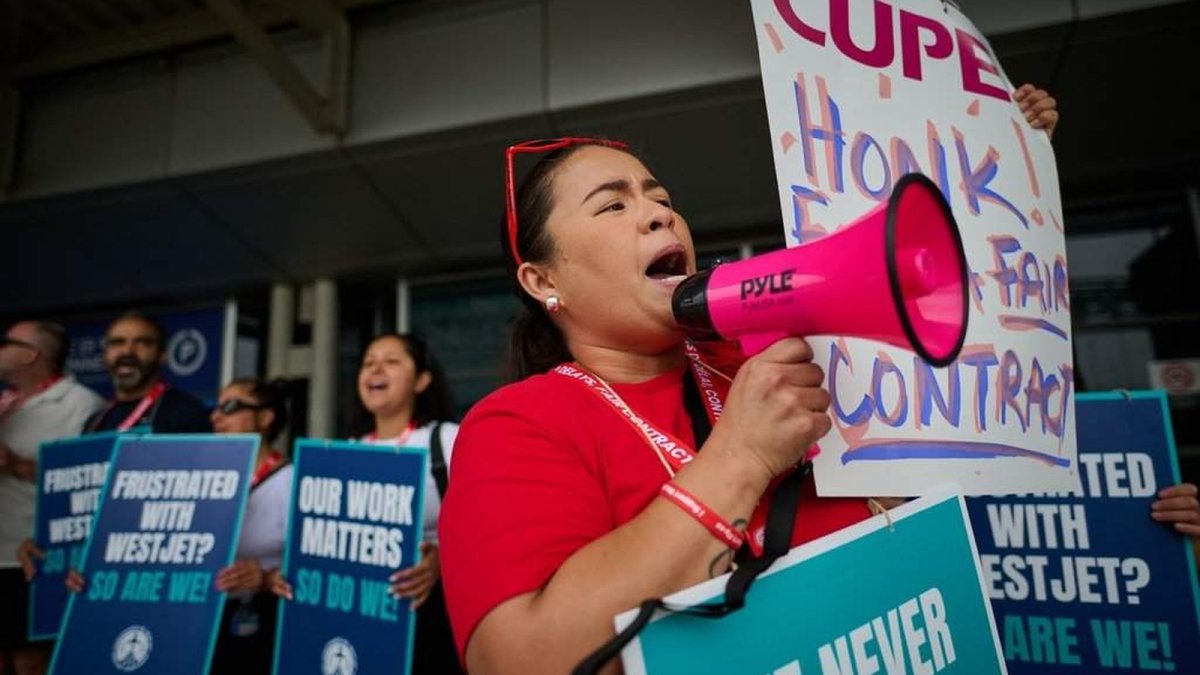
WestJet flight attendants end strike with tentative agreement Calgary, Alberta – Aug. 3, 2026 — CUPE Local 8125 and WestJet reached a tentative agreement early Monday morning, bringing an immediate end to the flight attendants' strike that began just after midnight Mountain Time on Sunday.
WestJet flight attendants end strike with tentative agreement
Calgary, Alberta – Aug. 3, 2026 — CUPE Local 8125 and WestJet reached a tentative agreement early Monday morning, bringing an immediate end to the flight attendants' strike that began just after midnight Mountain Time on Sunday. The deal still requires ratification by union members, and the airline cautioned that a full return to service will take time.
Resolution reached overnight
The union announced at 4:15 a.m. on August 3 that all picketing activities must cease. CUPE Local 8125 stated the tentative deal ended the work stoppage that had halted most WestJet operations. WestJet chief executive Alexis von Hoensbroech said the agreement reflects the hard work and professionalism of cabin crew.
The union represents about 4,400 flight attendants at the Calgary-based carrier, Canada's second-largest airline. Members voted 99 per cent in favour of a strike mandate last month, and the two sides had been negotiating since September 2025. A union website counter showed 213 days that WestJet cabin crew had gone without a valid collective agreement when the walkout began.
Core issues in the dispute
The central disagreement involved compensation for ground duties such as boarding passengers, completing safety checks and managing delays. Flight attendants argued they performed up to 35 hours of unpaid work each month under the existing block-hour pay model, in which pay starts when a plane leaves the gate and ends when it arrives at the next one. "Boarding, safety sweeps, assisting passengers, and ground delays are entirely on our dime," flight attendants wrote on a union campaign website.
WestJet said cabin crew earn between C$28 and C$58 per hour under that model, which it described as the standard pay approach for cabin crews across North America. The company's final offer included a 13 per cent pay increase effective October 1 and retroactive to January 1, 2026, followed by 2.5 per cent annual increases through 2029, plus a "duty pay premium" covering all duty hours. WestJet described the premium as additional pay for all hours worked, designed to solve the union's claim of unpaid work, and said it was equivalent to another 12 per cent salary increase.
Alia Hussain, president of CUPE Local 8125, said the union had been clear about what needed to change and had worked hard to reach a fair deal. Neither side released details of the tentative agreement on Monday, but the union said members should refer to their email for ratification information.
Scale of weekend disruption
WestJet suspended all 737 and 787 flights on Sunday after last-minute talks collapsed. Aviation analytics firm Cirium counted 615 flight cancellations as of mid-morning Sunday, while The New York Times reported 645 cancellations since Friday and the airline acknowledged about 600 flights were down by Sunday morning. Roughly 250,000 travellers were affected during the August long weekend, according to the airline.
WestJet had begun winding down operations on Saturday in anticipation of the walkout, parking aircraft and urging passengers to check flight status before heading to the airport. The sudden halt in mainline service during a peak holiday period left travellers scrambling for alternatives on one of the busiest weekends of the summer travel season. Some passengers reported difficulty reaching the airline's customer service department and confusion about rebooking options. The disruption extended well beyond domestic routes: flights to the United States, Europe and Asia were also affected, according to The New York Times.
Regional WestJet Encore Q400 flights and codeshare services continued without interruption, but the grounding of the carrier's primary narrow-body and wide-body fleets meant the bulk of scheduled departures could not proceed. WestJet said all impacted guests would be refunded or reaccommodated as applicable.
Passenger recovery and safety requirements
Canadian airline passenger rules require carriers to rebook passengers on the next available flight, including on competitor airlines, or provide a full refund when a flight is cancelled. Air Passenger Rights, a non-profit consumer group, cautioned that travellers who pre-emptively rebooked or cancelled on their own may not qualify for compensation, and that passengers who arrange their own alternatives before the airline can respond risk losing eligibility for further remedies.
Even with the strike over, flights are not expected to take off immediately. Professor Ian Lee of Carleton University's Sprott School of Business said the airline faces an elaborate safety process before it can resume a full schedule. "When the strike ends, people don't send the plane back out on the runway," he told Global News, noting that every aircraft and its parts must be rechecked and that the disruption carries substantial costs for the carrier.
WestJet has said the suspension of 737 and 787 flights was to last at least until August 5, though it could be extended. Travellers whose flights were cancelled should monitor airline communications for rebooking options or refunds while the carrier works to restore service across its network of more than 130 destinations.
Pattern in Canadian airline labour relations
The path to the walkout was short and deliberate: the union issued a 72-hour strike notice on Thursday, with the earliest possible strike date set for Sunday, and WestJet responded with a lockout notice of its own. Federal Labour Minister Patty Hajdu described the strike as a "disappointing development" and urged both sides to keep working toward a deal, arguing that "a strike or lockout does not mean an agreement can't be reached." She did not say Ottawa would intervene, and the union's WestJet division said it hoped the government would stay out of the bargaining process.
The dispute fits a broader pattern in Canadian aviation. Flight attendants at Air Canada staged a four-day strike in August 2025 over similar compensation structure concerns, and the federal government's intervention in that dispute was ultimately defied by the workers before a settlement was reached. Labour analysts have pointed to the block-hour pay model as a recurring flashpoint across the sector as cabin crew push for pay that covers the full span of their duties.
WestJet, majority owned by Onex Corp. and carrying roughly 30 per cent of Canada's domestic market, flies to more than 130 Canadian and international destinations. The resolution of this dispute removes a significant source of travel uncertainty heading into the final weeks of the summer season, though the financial fallout of the long-weekend grounding will take time to measure.
What happens next
The tentative agreement must still be ratified by union members through a vote, and details have been sent to members by email. The union said all picketing activities must cease effective immediately, and both sides have pledged to work on restoring service.
Even after ratification, WestJet faces a phased return to full operations because of required safety inspections, crew scheduling and the repositioning of aircraft grounded across its network. For the roughly 250,000 travellers affected over the holiday weekend, the immediate priority remains rebooking and refunds — and, for many, patience as one of Canada's largest airlines works to get its planes back in the air.
By Alex Thompson, Staff Writer
This article was produced with AI-assisted research and editorial support. Reporting is based on sources cited in the article.
What's Your Reaction?
 Like
0
Like
0
 Dislike
0
Dislike
0
 Love
0
Love
0
 Funny
0
Funny
0
 Wow
0
Wow
0
 Sad
0
Sad
0
 Angry
0
Angry
0

Canada Correspondent at Global1.News. Based in Toronto, covering Canadian politics, energy, trade, and US-Canada relations. Provides the Canadian perspective on North American and global affairs.















Comments (0)