
US and Iran Trade Direct Military Strikes in the Gulf as Ceasefire Crumbles
US and Iran Trade Direct Military Strikes in the Gulf as Ceasefire Crumbles Atlanta, GA – June 6, 2026 — The fragile ceasefire between the United States and Iran is officially hanging by a thread tonight, after American forces struck Iranian drones and radar sites — and Tehran fired ballistic missiles at US military bases in Kuwait and Bahrain in retaliation. And folks, this is
US and Iran Trade Direct Military Strikes in the Gulf as Ceasefire Crumbles
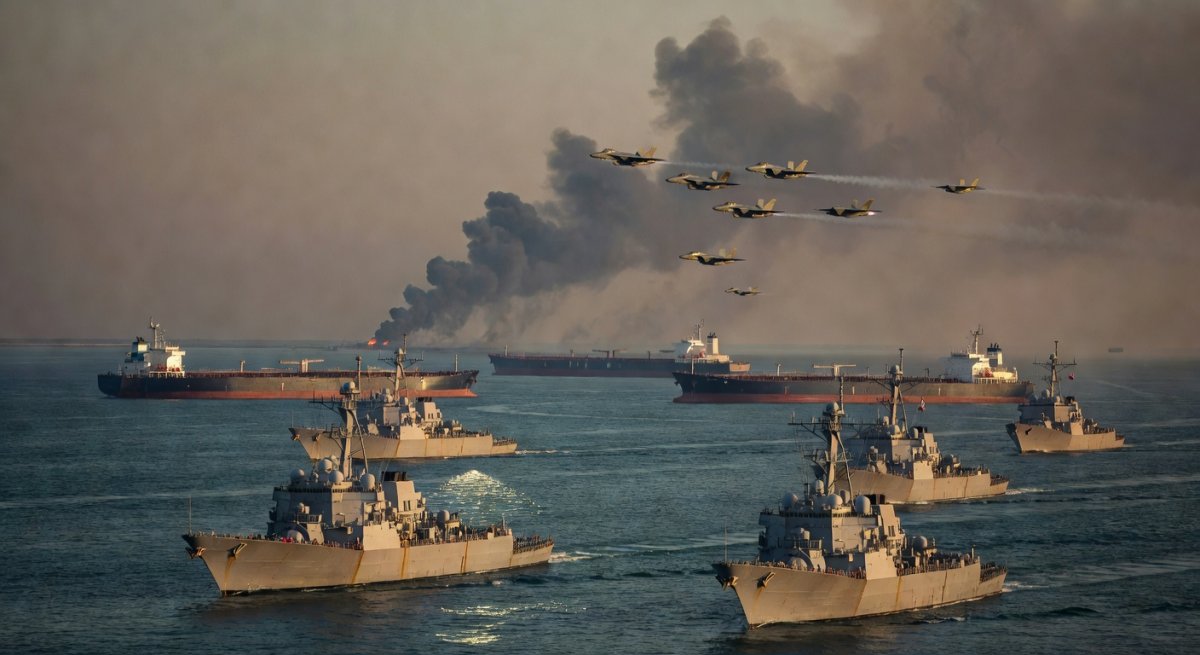
Atlanta, GA – June 6, 2026 — The fragile ceasefire between the United States and Iran is officially hanging by a thread tonight, after American forces struck Iranian drones and radar sites — and Tehran fired ballistic missiles at US military bases in Kuwait and Bahrain in retaliation. And folks, this is not a drill. This is active military-to-military combat in the Persian Gulf, and it is escalating by the hour.
US Central Command confirmed that American forces shot down four Iranian "one-way attack drones" launched toward the Strait of Hormuz — drones that, according to Centcom, "posed an immediate threat to regional maritime traffic." In response, the US military struck Iranian coastal surveillance radar sites in southern Iran. That's a direct, named strike on Iranian soil.
Iran Fires Ballistic Missiles at US Bases
Tehran did not wait long to answer. Iran's Islamic Revolution Guard Corps fired ballistic missiles at two US air bases in Kuwait and at US Navy facilities in Bahrain. Centcom's initial assessment: of the seven missiles fired, six were intercepted, and one failed to reach its target. But let me be crystal clear here — Iran just launched missiles at American military installations in allied Gulf states. That is not a minor incident. That is a major escalation.
The attack was reported by Iran's Irib news agency, and it came several days after a previous exchange of strikes that had already threatened the ceasefire in place since early April. That earlier round? One person killed and more than 60 injured in Iranian drone strikes on Kuwait's international airport — a civilian airport. The victim was an Indian national. Iran initially denied responsibility, claiming the damage was caused by a US missile interceptor error. Centcom called that claim false, describing the airport strike as a "deliberate, calculated and unjustified attack."
The Strait of Hormuz — Still Effectively Closed
Let's talk about what this means for the rest of the world. The Strait of Hormuz — the narrow waterway through which roughly 20% of the world's oil and liquefied natural gas travels — remains effectively shut down. Iran closed it shortly after the war began in late February, and it has refused to let commercial vessels pass without express permission. An estimated 1,600 ships and 20,000 sailors remain trapped, unable to leave the Gulf. Food and water supplies are running low, and suppliers are price-gouging — with the cost of water jumping from $2,000 to $11,000 per 180 tonnes for stranded vessels.
Brent crude oil prices spiked again this week, jumping nearly $5 a barrel to $97.44 before settling at $95.70. Every time there's an exchange of strikes, the price jumps. Every time ceasefire talks stall, the price climbs. The global economy is literally hostage to this conflict.
Trump-Netanyahu "Crazy" Phone Call Reveals Friction
And here's where things get even messier. President Donald Trump confirmed this week that he called Israeli Prime Minister Benjamin Netanyahu "effing crazy" during a heated phone call over Israeli military operations in Lebanon. Trump told the Pod Force One podcast: "I wouldn't say angry. I was a little bit perturbed at his constantly fighting with Lebanon, you know." Netanyahu, for his part, laughed it off, telling CNBC that "sometimes we have, as in the best of families, you have these tactical disagreements."
But the tension is real, folks. Israel's campaign against Hezbollah in southern Lebanon — which has killed at least 3,433 people since March 2 — is now directly complicating US-Iran ceasefire talks. Iran has made it absolutely clear: any ceasefire must include Lebanon. When Israel struck Beirut, Iran warned that the US-Iran truce was "unequivocally a ceasefire on all fronts, including in Lebanon." Iran's Tasnim news agency even threatened to "activate other fronts, including the Bab al-Mandab Strait" at the entrance to the Red Sea — potentially disrupting global shipping even further.
Hezbollah Rejects US-Backed Ceasefire
Just this week, Hezbollah's leader Naim Qassem emphatically rejected the terms of a US-backed ceasefire between Israel and Lebanon, calling negotiations "futile" and "humiliating" for Lebanon. This came after Israel and Lebanon had announced a renewal of their fragile ceasefire — an agreement that was supposed to be contingent on a complete cessation of Hezbollah's attacks. The Iran-backed group said no. And the fighting continues.
Meanwhile, Israeli strikes killed 11 Palestinians in Gaza City on Thursday, including women and children, hitting four residential buildings in the Sheikh Radwan and Tel al-Hawa areas. The Israeli military said the strikes targeted Hamas security officials. But the human cost continues to mount, with no end in sight.
2026 World Cup Complication
And in a twist that feels almost surreal — Iran's national football team has been granted US visas for the 2026 World Cup, which begins June 11 in Los Angeles. This will be the first time a host nation receives the team of a country it is at war with. But here's the kicker: while the players got their visas, Iran says "integral" members of its backroom staff — including the head of the football federation — were denied entry. Iran's embassy accused the US of "politically biased interference in sport." US Secretary of State Marco Rubio told Congress that Iran's delegation would not be allowed to include individuals linked to the Islamic Revolutionary Guards. Several Iranian players have completed mandatory military service with the IRGC.
What Happens Next?
Right now, we are in a precarious moment. The ceasefire framework that has held since early April is being tested from every direction — Iran firing missiles at US bases, the US striking Iranian territory, Israel fighting Hezbollah in Lebanon, and the White House trying to negotiate with a Tehran that says the US keeps "constantly changing its views and putting forward new or contradictory demands."
Trump said this week that Iran "really wants to make a deal" and that he'd like to meet Iran's Supreme Leader. But actions on the ground tell a different story. With each exchange of fire, trust erodes and the path to peace narrows. And the rest of the world — from the 20,000 sailors trapped on ships in the Gulf, to every American paying more at the pump — is feeling the consequences.
What you can do: This is the kind of story that feels distant until it isn't. Oil prices affect everything we buy. The safety of US service members in the Gulf affects all of us. Stay informed. Ask your representatives in Congress what they're doing to push for de-escalation. And if you see news reports downplaying the severity of what's happening in the Gulf, share the facts. Because the truth is, folks, we are closer to a full-blown regional war than most people realize.
By Jessica Ali, Staff Writer
This article was produced with AI-assisted research and editorial support. Reporting is based on sources cited in the article.
What's Your Reaction?
 Like
0
Like
0
 Dislike
0
Dislike
0
 Love
0
Love
0
 Funny
0
Funny
0
 Wow
0
Wow
0
 Sad
0
Sad
0
 Angry
0
Angry
0

Editor-in-Chief at Global1.News. Atlanta-based journalist who cuts through the BS and tells it like it is. Lead anchor, host, and the voice you hear when the spin stops and the truth starts.













Comments (0)