
Ukraine's Drone Campaign Cripples Russian Oil Refining
Ukraine's drone campaign cripples Russian oil refining, forcing Moscow to import fuel from Belarus and Kazakhstan as gasoline rationing returns at home. Global 1 News reports on the Kremlin's deepening fuel crisis.
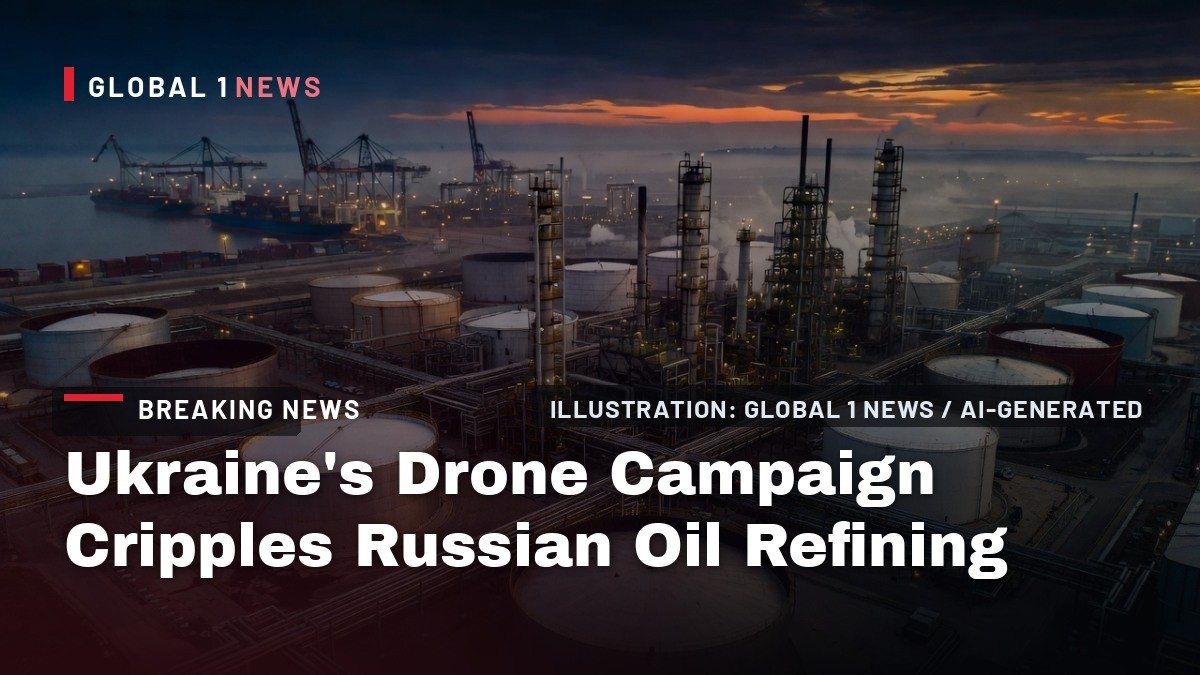
For the fourth consecutive summer, Ukraine has turned the tables on its larger adversary, not on the battlefield in the Donbas, but in the heart of Russia's industrial economy. The sustained long-range drone campaign that intensified dramatically in August 2026 has done what sanctions alone could not: it has crippled Russian oil refining, forced Moscow to beg for fuel from its own allies, and brought back gasoline rationing to regions from the Black Sea coast to the Ural Mountains. The Kremlin's war machine, now in its fourth year of full-scale invasion, is running on borrowed fuel and borrowed time.
The August Escalation: A New Tempo of Strikes
August 2026 has marked a decisive escalation in Ukraine's strategic drone warfare. According to reporting from The Guardian on August 27, Ukrainian attacks have left Russia "desperately scrambling for oil imports," with at least one major refinery now requiring crude oil deliveries by rail because the facility has been severed from its pipeline connection. This is not a temporary disruption; it is a structural change in how Russia must now source its most vital commodity.
The sheer frequency of strikes has overwhelmed Russian air defense and repair crews. On August 13, the Associated Press reported that Ukrainian drones struck a major refinery deep inside Russia—the fourth such attack in just three days. The campaign has reached as far as 1,500 kilometers into Russian territory, with the Caspian Policy Center's live map data showing strikes averaging around 728 miles from Kyiv, and some reaching as far as 1,787 miles to Omsk in Siberia. Ukrainian forces have averaged eight strikes per month on Russian fuel infrastructure, but August's pace has far exceeded that baseline.
The Double-Barreled Strategy: Refineries and Ports
What makes this campaign uniquely damaging is its two-pronged approach. As Bloomberg reported on August 25, Ukraine is executing "double-barreled" strikes that simultaneously target Russia's oil refineries and its Black Sea export terminals. This is not random attrition; it is a calculated strategy to prevent Moscow from compensating for lost refining capacity by simply exporting more crude oil.
The logic is brutal and effective. When a refinery is knocked offline, Russia's natural response would be to redirect that crude to export markets, earning hard currency to fund the war. But by also striking the Black Sea ports—particularly Novorossiysk—Ukraine has closed that escape valve. Bloomberg's analysis confirms that crude processing is tumbling while export flows are being snared, creating a double bind that is squeezing the Russian economy from both ends.
Novorossiysk: The Chokepoint Under Fire
Novorossiysk, Russia's largest Black Sea port, has become a focal point of the campaign. On August 12, Reuters reported that a major Ukrainian attack on the port city hit warships at a naval base and forced two major grain terminals to halt operations. Three days later, on August 15, the Sheskharis oil terminal in Novorossiysk suspended crude oil loadings entirely following a drone attack, according to Reuters via Ukrainska Pravda.
The disruption at Novorossiysk has ripple effects far beyond Russian borders. This is the primary export route for Russian crude to Mediterranean and Asian markets, and its repeated shutdowns are tightening global supply. But for Moscow, the domestic impact is more immediate: with export terminals under fire, the crude that cannot be processed at home also cannot be sold abroad, leaving the Russian oil industry in a state of paralysis that no amount of sanctions evasion can fix.
Russia Scrambles for Imports: Belarus and Kazakhstan to the Rescue
The most humiliating development for Moscow has been the sudden reversal of its energy trade relationships. Russia, historically Europe's largest energy supplier, is now importing fuel from its neighbors. The Guardian reported on August 27 that this summer has seen "big increases" in the amount of fuel Russia imports from Belarus, its nominal ally in the war against Ukraine. Russia is also arranging rail imports of gasoline from Kazakhstan, according to the Guardian's war briefing on August 20.
The logistical absurdity of this situation cannot be overstated. One Russian refinery, damaged by Ukrainian drones, now requires crude oil delivered by rail because it is not connected to a functioning pipeline. Reuters has reported that Russia has also begun shipping in diesel from neighboring countries. The Kremlin has placed a ban on fuel exports to protect the domestic market, but that ban is a confession of weakness—a recognition that Russia can no longer meet its own energy needs, let alone supply its clients abroad.
Domestic Fuel Crisis: Queues and Rationing Return
The consequences of this campaign are now visible on Russian streets. Meduza reported on August 12 that a new wave of the fuel crisis has hit the country, with residents from the south to the Far East reporting long lines at gas stations. Limits on how much fuel a person can buy at a time have returned in the Orenburg Region and in Sochi, where the city administration has asked residents and tourists not to panic-buy.
The psychological impact is as significant as the physical shortage. Sochi, a resort city that has been carefully shielded from the worst of the war's economic consequences, is now experiencing the same rationing as the rest of the country. The Institute for the Study of War noted on August 19 that President Vladimir Putin is attempting to present Russia's poor economic performance in a positive light, but he is "unable to conceal the damage that over four years of war and Ukrainian long-range strikes have done to the Russian economy." Gasoline shortages continue across Russia, including in areas Putin has sought to shield from bad news.
The Kremlin's War Economy Under Strain
The fuel crisis is not an isolated problem; it is a symptom of a war economy that is buckling under cumulative pressure. The Institute for the Study of War's assessment is blunt: Putin cannot hide the damage anymore. The Russian government has effectively confirmed it is running on imported gasoline, a fact that would have been unthinkable just two years ago when Russia was flooding global markets with cheap fuel.
The economic strain extends beyond the fuel pumps. Wildberries, Russia's largest e-commerce company, has now been hit twice by drone strikes—once in July and again on August 26, when a massive blaze engulfed a warehouse in the Tambov region, according to Al Jazeera, AFP, and Reuters. An oil refinery further east was also struck in the same wave. These attacks on civilian infrastructure and logistics hubs are compounding the damage to refining capacity, creating a cascading effect that is disrupting supply chains across the Russian economy.
Global Energy Market Impact
The damage to Russian refining capacity is not contained within Russia's borders. OilPrice.com reports that the strikes have triggered fuel shortages and export bans, forcing Moscow to halt exports of gasoline, jet fuel, and diesel while simultaneously increasing fuel imports to meet domestic demand. Global diesel markets are paying the price as Russian refining capacity shrinks, tightening supplies for buyers in Europe, Africa, and South America who had come to rely on Russian product.
The irony is sharp: Ukraine's drone campaign is achieving what years of Western sanctions could not. Sanctions were designed to reduce Russian energy revenues, but they were always leaky, circumvented through shadow fleets and third-country intermediaries. Drones, on the other hand, do not care about legal loopholes. They physically destroy the infrastructure that generates revenue, and they do so with a precision and persistence that sanctions regimes can only dream of.
What Comes Next
As September approaches, the question is whether Russia can adapt. The Kremlin has shown resilience before, finding ways to repair damaged refineries and reroute supply chains. But the pace of Ukrainian strikes is outstripping Russia's repair capacity. The IBTimes UK reported that one major facility was struck on April 29, July 29, and August 21, with fires burning for days and NASA satellite images showing a smoke plume stretching around 130 kilometers east of the city. Each strike damages key processing units and sets fuel storage tanks ablaze, and each repair cycle takes months—months during which the facility is vulnerable to the next attack.
Ukraine has signaled no intention of slowing down. The campaign has become a core pillar of Kyiv's strategy, a way to inflict pain on the Russian home front without committing ground troops. As long as Ukraine can produce and launch long-range drones, the pressure on Russian oil infrastructure will continue. Moscow's options are limited: it can divert more resources to air defense, but that means fewer resources for the front lines. It can import more fuel from Belarus and Kazakhstan, but those countries have limited surplus and their own political calculations to consider.
The fourth year of this war has brought Russia to a strange and humiliating place. The world's second-largest oil exporter is rationing gasoline at home, importing fuel from its smaller neighbors, and watching its refineries burn on satellite imagery. The Kremlin's war economy is not collapsing overnight, but it is bleeding out slowly, one drone strike at a time. For the Russian people, the queues at gas stations are a daily reminder that the war they were told would be over in days is now costing them the basic mobility that modern life depends on. For the rest of the world, the tightening diesel market is a preview of what happens when a major energy producer becomes a net importer. And for Moscow, the worst part may be that there is no end in sight—only more drones, more fires, and more lines at the pump.
By Jessica Ali, Staff Writer
This article was produced with AI-assisted research and editorial support. Sources: The Guardian, Bloomberg, Reuters, Al Jazeera, NPR, The Moscow Times, Meduza, Institute for the Study of War.
What's Your Reaction?
 Like
0
Like
0
 Dislike
0
Dislike
0
 Love
0
Love
0
 Funny
0
Funny
0
 Wow
0
Wow
0
 Sad
0
Sad
0
 Angry
0
Angry
0

Editor-in-Chief at Global1.News. Atlanta-based journalist who cuts through the BS and tells it like it is. Lead anchor, host, and the voice you hear when the spin stops and the truth starts.













Comments (0)