
Tung Chee-hwa, Hong Kong's First Post-Handover Leader, Dies at 89
The man who stood at the helm of Hong Kong during its most turbulent transition from British colony to Chinese Special Administrative Region has passed away.
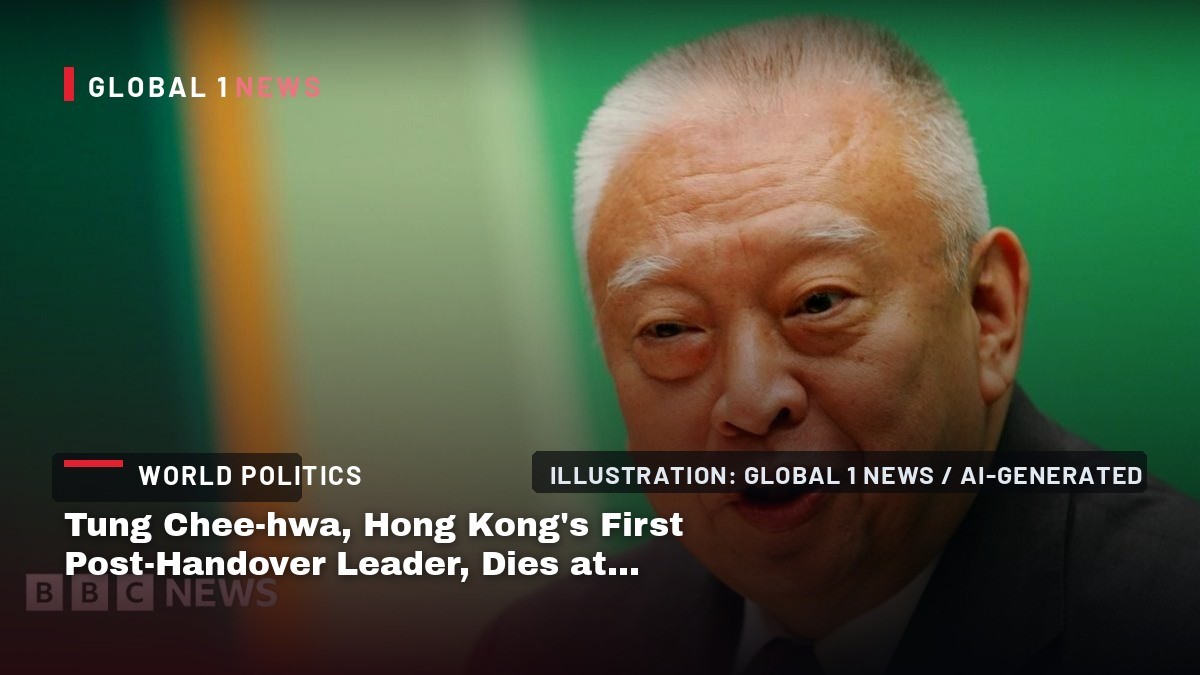
The man who stood at the helm of Hong Kong during its most turbulent transition from British colony to Chinese Special Administrative Region has passed away. Tung Chee-hwa, the city's first chief executive following the 1997 handover, died on the night of Tuesday, 8 September 2026, at the age of 89, surrounded by loved ones, local media reported. His office described him as a man "devoted to his country and its people," a sentiment echoed by Beijing's official eulogies, yet his legacy remains a complex tapestry of economic crisis, public health emergencies, and a political evolution that ultimately reshaped the city's relationship with the mainland.
A Shipping Scion Chosen for a Historic Role
Born in Shanghai in 1937, Tung Chee-hwa's early life was steeped in the maritime commerce that defined his family's fortune. He graduated with a mechanical engineering degree from Liverpool University in the UK before moving to the United States, where he spent nearly a decade working at General Electric. In 1969, he relocated to Hong Kong to join his father's shipping conglomerate, Orient Overseas, eventually taking the reins in 1979. This business pedigree, however, was not his primary qualification for the highest political office in the land. His political career began modestly in 1992 when he was appointed a member of the executive council under the last British Governor, Chris Patten.
Despite having little political experience, Tung was widely believed to have been handpicked by Beijing to lead Hong Kong after the handover. He was viewed as a loyalist, a perception solidified after China's state-run banks helped rescue his family business during a global shipping slump in the mid-1980s. The most potent symbol of this endorsement came in January 1996, during a reception at the Great Hall of the People in Beijing. China's then-president, Jiang Zemin, deliberately walked across a packed room to shake Tung's hand—a widely photographed gesture that famously signalled Beijing's unequivocal backing for the top job. It was a moment that defined Tung's political identity before he ever took office, casting him not merely as an administrator but as a trusted agent of the central government.
The 1997 Handover and the Weight of Expectations
Tung Chee-hwa took over the reins from Chris Patten in July 1997, when the UK handed Hong Kong back to China, ending more than 150 years of British control. The ceremony itself was a global spectacle, marking the end of an empire and the beginning of a new experiment in "One Country, Two Systems"—a framework promising Hong Kong a high degree of autonomy, its own legal system, and a way of life distinct from the mainland for 50 years. Tung was the man tasked with making this unprecedented arrangement work, stepping into a role that required balancing the expectations of a skeptical Hong Kong public, a watchful international community, and a Beijing leadership keen to assert its sovereignty.
The weight of this responsibility was immediate and crushing. The Asian Financial Crisis hit shortly after Tung took over, sending home prices diving and plunging the territory into a deep recession. The economic optimism that accompanied the handover evaporated quickly, replaced by anxiety over negative equity, rising unemployment, and a sense that the new administration was struggling to navigate the storm. Tung's government was also beset by a series of public health challenges, including a bird flu outbreak from 1997 to 2002 that led to the culling of millions of chickens, and the 2003 outbreak of Sars, also known as Severe Acute Respiratory Syndrome, which killed hundreds in Hong Kong and exposed vulnerabilities in the city's healthcare infrastructure and crisis management.
The July 2003 Protest and the Fracturing of a Mandate
While economic and health crises tested Tung's administrative competence, his biggest political challenge was yet to come. In July 2003, during his second term, half a million Hongkongers took to the streets to protest against a proposed national security law, legislation they feared would threaten their civic rights and erode the freedoms guaranteed under the "One Country, Two Systems" principle. The sheer scale of the demonstration—the largest in Hong Kong's history at that point—was a seismic shock to Tung's administration and to Beijing. It represented a profound disconnect between the central government's security priorities and the public's perception of their own liberties.
The protest was a watershed moment, forcing Tung's administration to abandon the proposed legislation following the massive outcry. The retreat was a humiliating political defeat for Tung, exposing the limits of his authority and the fragility of the post-handover consensus. It also contributed directly to his political demise. In March 2005, Tung stepped down as chief executive. At the time, his declining health was cited as the official reason for his resignation, but some observers and political analysts said he was pressured by Beijing to step down, having become a liability in the face of sustained public opposition. The ambiguity surrounding his departure—health versus political expediency—remains a point of historical contention, emblematic of the opaque nature of Beijing's decision-making regarding Hong Kong.
A Loyalist's Second Act in Beijing's Corridors of Power
Following his resignation, Tung did not fade into obscurity. Instead, he transitioned to a prominent role on the national stage, serving as one of many vice-chairmen of the Chinese People's Political Consultative Conference (CPPCC), China's top political advisory body, for four consecutive terms. This position, while largely ceremonial, was a significant honour that underscored his continued loyalty to the Communist Party of China. It allowed him to remain a figure of influence, albeit one operating firmly within the parameters of the party-state system, offering counsel on Hong Kong affairs from a position of unwavering allegiance to Beijing.
Tung's last public outing was in July 2021, at an event marking the 100th anniversary of the founding of the Chinese Communist Party in Beijing. His presence at the celebrations was a poignant reminder of his enduring symbolic value to the party. He underwent heart surgery months later, according to reports, and largely retreated from public life thereafter. His death at 89 closes a chapter on a generation of leaders who were tasked with bridging the gap between a colonial past and a socialist future, a task that proved far more fraught than many had anticipated.
Official Tributes and the Shadow of 2020
In the wake of his death, tributes have poured in from both sides of the political spectrum, albeit with markedly different emphases. Hong Kong's former chief executives have paid their respects. Leung Chun-ying, who led the city between 2012 and 2017, described Tung as a "benevolent" leader who "won people over with reason." Carrie Lam, who was the chief executive from 2017 to 2022, said Tung's leadership made "a historic contribution with lasting benefits." China's state news agency Xinhua called Tung a "renowned patriot, distinguished social activist, close friend of the Communist Party of China," a formulaic yet significant designation that places him firmly within the pantheon of trusted allies.
These tributes, however, exist in the shadow of the 2020 national security law, which Beijing ultimately imposed on Hong Kong after years of political unrest. Authorities have argued the law is necessary to maintain stability and combat separatist activities, but critics have called it "the end of Hong Kong," arguing it has created a climate of fear and dismantled the very civic freedoms that the 2003 protesters sought to protect. The contrast between Tung's 2003 retreat and Beijing's 2020 imposition is stark, illustrating a fundamental shift in the central government's approach to Hong Kong—from a willingness to accommodate public sentiment to a determination to enforce its security agenda regardless of local opposition.
Strategic Analysis: The Evolution of Beijing's Hong Kong Policy
Tung Chee-hwa's life and career offer a strategic lens through which to view the evolution of Beijing's approach to Hong Kong. His selection in 1996 reflected an era of cautious optimism, where Beijing believed a loyalist business magnate could manage the transition while reassuring the international community of Hong Kong's continued autonomy. The subsequent crises of his tenure, however, revealed the inherent tensions in this approach. The 2003 protests demonstrated that a significant portion of Hong Kong's populace was unwilling to accept the securitization of their rights, forcing Beijing to recalibrate its strategy.
The trajectory from Tung's handpicked leadership to the 2020 national security law represents a hardening of Beijing's stance. The central government learned from the perceived failures of Tung's era—that conciliation and retreat in the face of mass protests only emboldened opposition forces. The imposition of the national security law, therefore, can be seen as a direct response to the perceived inadequacies of the "One Country, Two Systems" framework as it was originally practiced. For Beijing, Tung's tenure was a lesson in the dangers of allowing Hong Kong's political space to be dominated by voices hostile to the central government. The second-order implications for Hong Kong's political future are profound: the era of mass mobilization and legislative retreat is over, replaced by a legal and security architecture designed to ensure that no future chief executive faces the challenges that defined Tung's time in office.
A Legacy of Contradiction and Transition
For Western observers, Tung's legacy is a cautionary tale about the limits of autonomy under Chinese rule. His tenure is often cited as the moment when the promise of "One Country, Two Systems" began to fray, replaced by a growing realization that Beijing's tolerance for dissent was finite. The 2003 protest, the abandonment of the security bill, and his subsequent resignation are frequently framed as a missed opportunity for a more liberal path. Conversely, for Beijing, Tung is remembered as a patriot who served his country during a difficult transition, a man whose loyalty was never in question even when his political acumen was.
Tung Chee-hwa's death marks the end of an era, but the contradictions of his legacy live on. He was a man caught between two worlds—the capitalist dynamism of Hong Kong and the authoritarian imperatives of the party-state. He is survived by his wife and three children. His story is not merely a personal biography but a mirror reflecting the complex, often painful, evolution of Hong Kong's relationship with mainland China over the past three decades. As the city continues to navigate its future under the 2020 security law, the memory of Tung's tenure serves as a reminder of a time when the path forward seemed less predetermined, and the outcome of the great experiment far more uncertain.
By Prof. Marcus Chen, Staff Writer
This article was produced with AI-assisted research and editorial support. Sources: BBC News — 'Hong Kong's first leader after British handover dies' (9 September 2026), https://www.bbc.co.uk/news/articles/cn457lq938jo.
What's Your Reaction?
 Like
0
Like
0
 Dislike
0
Dislike
0
 Love
0
Love
0
 Funny
0
Funny
0
 Wow
0
Wow
0
 Sad
0
Sad
0
 Angry
0
Angry
0

World Politics Analyst at Global1.News. Based in Beijing, covering US-China relations, global trade, and geopolitical strategy. Brings deep analytical perspective to the power dynamics shaping international affairs.












Comments (0)