
They're Selling Texas a 2.5-Gigawatt Nuclear Plant — the First Gigawatt Is Gas
Blue Energy and GE Vernova Hitachi signed an agreement to advance a 2.5-gigawatt gas-plus-nuclear power plant in Victoria, Texas — one gigawatt of gas turbines by 2030 and 1.5 gigawatts of small modular reactors from 2032. A hosting founder on the gas bridge and the execution risk nobody's pricing.
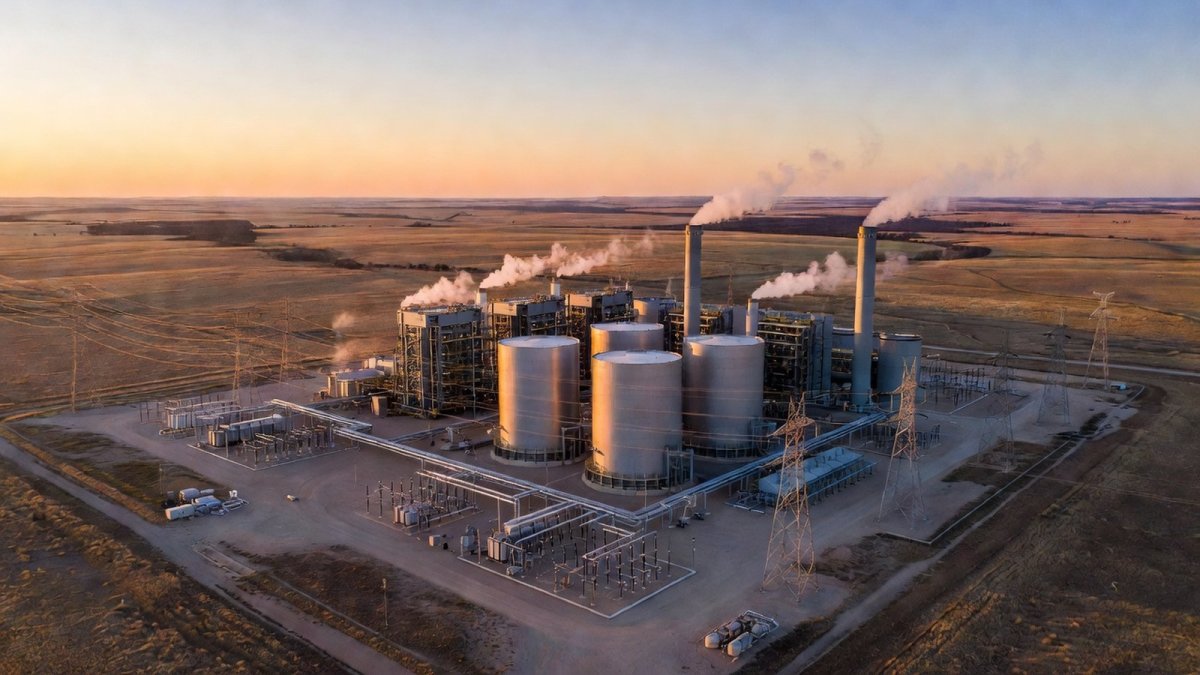
They're Selling Texas a 2.5-Gigawatt Nuclear Plant — the First Gigawatt Is Gas
Let me tell you something that's been sitting with me since Thursday morning, when the press releases started landing. I've been running hosting infrastructure for over a decade, and I've watched this AI buildout promise me a lot of miracle power. Gas turbines. Fuel cells. Grid upgrades. Solar farms. Small modular reactors. Every few months, another headline tells us the power problem is solved, and every few months, the physics of permitting and construction remind us it isn't.
So when Blue Energy and GE Vernova Hitachi Nuclear Energy signed an agreement on August 13 to advance a 2.5-gigawatt gas-plus-nuclear power plant in Victoria, Texas, I read the whole thing twice. Because buried in that announcement is the most honest structure I've seen from the nuclear-for-AI crowd in years. It's also, if you read it the wrong way, one of the most dangerous headlines in the buildout. Both readings are true. Ent?
The News — A Signing, Not a Ribbon-Cutting
Here's what actually happened. Blue Energy — a Chevy Chase, Maryland deployment platform that wants to turn nuclear into "a financeable, repeatable product" — signed an agreement with GE Vernova Hitachi Nuclear Energy (GVH) to move the Victoria project from concept into engineering design, licensing, and safety analysis. That's it. That's the milestone. No construction permit. No equipment orders. No final investment decision, which both companies say won't come until 2027.
But don't let the modesty fool you. For a sector that generates far more press releases than operating reactors, moving from announced intent to an active engineering program is a real step. The turbines were already reserved — Blue Energy locked in two GE Vernova 7HA.02 gas turbines back in May. What changed on August 13 is that the project now has a formal engineering and licensing phase, a named reactor partner, and a schedule the market can actually model.
The Deal Anatomy — A Gas Bridge to a Nuclear Future
Here's the structure, and this is the part that matters. The project is 2.5 gigawatts on paper, but it's really two different power plants on two different timelines.
Phase one is gas. Two GE Vernova 7HA.02 turbines — the workhorses of the H-class fleet — will deliver about 1 gigawatt to a nearby data center starting in 2030. That's real, bankable, proven technology. You can buy an H-class gas turbine today. People have been running them for years.
Phase two is the nuclear bet. Beginning in 2032, up to five BWRX-300 small modular reactors add another 1.5 gigawatts. The BWRX-300 is a 300-megawatt-class boiling water reactor derived from GE Vernova Hitachi's ESBWR design. It's not a paper reactor — the first unit is under construction at Ontario Power Generation's Darlington site in Canada, with completion expected by the end of the decade. GVH calls it the first grid-scale SMR in the Western world.
Why pair them? Because the nuclear industry's core problem has never been the physics — it's the financing. A new nuclear plant takes a decade and billions of dollars before it produces a single electron, and nobody wants to write that check. The gas phase generates revenue early, proves the site works, and keeps the lights on while the reactors crawl through licensing. Jake Jurewicz, Blue Energy's CEO, put it bluntly: "It's about speed, which particularly the data center community and the utilities need right now. But it's also equally as much about de-risking and bringing project finance to bear."
The Two Readings — Blueprint for the Renaissance, or a Promise With No Operating Reactor
Now here's where I earn my keep, because this announcement can be read two completely different ways, and both of them are true.
Reading one: this is the first credible blueprint for nuclear-powered AI. The gas-bridge model is exactly how you solve the first-of-a-kind financing wall. You start with technology the banks understand, generate cash flow, demonstrate site viability, and let the reactors arrive on their own licensing timeline. Eric Gray, CEO of GE Vernova's Power segment, called it "establishing a blueprint for deploying reliable baseload power at the scale and speed customers need." And the Darlington reference matters — it gives lenders and offtakers a real proof point to watch, not a render on a PowerPoint.
Reading two: the 2.5 gigawatts is really 1 gigawatt of gas and a promise. The nuclear half of this project is a reactor class that has never operated commercially anywhere on Earth. The first BWRX-300 won't be finished until the end of the decade, and it's being built in Canada — if Darlington slips on schedule or budget, which first-of-a-kind nuclear has done every single time in my lifetime, the Victoria timeline becomes immediately suspect. No offtake agreement has been announced. The data center customer is unnamed. And the final investment decision is two years away. On paper, the gas turbines are the only firm capacity in this deal. The reactors are optionality dressed up as a headline number.
The Secondary Bottleneck Nobody's Talking About — First-of-a-Kind Execution Risk
Here's the piece that should make every operator sit up straight, and it's the same lesson I keep hammering about this buildout: the gap between announced and realized.
We've seen this movie all summer. Nvidia announced a $250 billion guarantee for OpenAI's Ohio campus — scaled back to under $120 billion within weeks. The buildout announces five data centers for every one it builds. And now we have a 2.5-gigawatt nuclear deal where 60 percent of the capacity is a reactor design with zero commercial operating hours.
And then there's the "Blue Way" — Blue Energy's pitch to shift nuclear from a construction industry into a manufacturing industry, with prefabricated "super modules" weighing over 1,000 tons that arrive with mechanical, electrical, and plumbing systems pre-installed. Jurewicz calls it "more than just bringing a bigger Lego piece to the site" — the idea is to wrap the risk, the guarantees, and the warranties into a factory-built product. Jason Cooper, GVH's CEO, describes the shift as "more of an engineer, procure, and assemble model versus EPC."
I genuinely like the direction. But moving fabrication off-site doesn't eliminate complexity — it relocates it, and it adds logistics risk for components heavier than a thousand tons that need specialized transport. Modular construction has underdelivered before, in industries with far less regulation than nuclear. The claim deserves scrutiny, not applause.
What This Means for Independent Hosting Providers
First — calibrate every nuclear headline against Darlington. The first BWRX-300 is the single most important proof point in the Western nuclear-for-AI story. If Darlington executes on schedule and budget, every subsequent BWRX-300 deal — including Victoria — becomes more credible. If it slips, the whole pipeline slips with it. Watch that one construction site like it's your own.
Second — treat "firm power by 2030" as a gas claim, not a nuclear claim. In the gas-bridge model, the only capacity you can plan around is the gas phase. The nuclear phase is an option, not a certainty. When a colo or a utility quotes you a timeline built on SMR capacity, discount it the same way you'd discount any first-of-a-kind delivery date — assume the downside and build your pricing around the floor.
Third — the manufacturing shift, if it works, changes everything about build timelines. Super-module prefabrication, off-site assembly, warranties wrapped at the factory — that's the same logic that made wind and solar cheap, applied to nuclear. If the Blue Way delivers, data center power projects get shorter and more predictable. If it doesn't, you've lost nothing — the gas turbines still run. Position your capacity planning to benefit from both outcomes.
Fourth — watch the 2027 final investment decision like a hawk. That's the gate where this stops being a press release and starts being a real project with real money. Between now and then, Blue Energy and GVH need to complete the engineering, engage the NRC, and sign an actual customer. Any one of those can kill the deal. When the FID lands — or doesn't — you'll know whether the gas-bridge model has legs.
The Bottom Line
I'll tell you what I told myself when I finished reading this announcement: this is the most honest nuclear-for-AI deal I've seen, precisely because it doesn't pretend the reactors are ready. It sells you gas today and nuclear tomorrow, and it's upfront about the bridge. That's a real improvement on the industry's usual habit of announcing reactors that exist only in renders.
But improvement isn't delivery. The first gigawatt is real. The other 1.5 gigawatts are a bet on a reactor that has never run, a licensing process that has never been fast, and a construction model that has never been proven at scale. Bet on the gas. Respect the nuclear. And keep your own power strategy built on power you can actually get.
— Allan Ali, Founder
This article was produced with AI-assisted research and editorial support. Sources: Blue Energy press release (Aug 13, 2026), GE Vernova Hitachi Nuclear Energy, POWER Magazine (Aug 13, 2026), SMR Intel (Aug 13-14, 2026), Nucleation Capital (Aug 16, 2026), Microgrid Knowledge (May 5, 2026).
What's Your Reaction?
 Like
0
Like
0
 Dislike
0
Dislike
0
 Love
0
Love
0
 Funny
0
Funny
0
 Wow
0
Wow
0
 Sad
0
Sad
0
 Angry
0
Angry
0

Publisher of Global1.News. Automation architect, systems builder, and the guy making sure the truth gets published.












Comments (0)