
The Night the Sky Over Moscow Turned Into a War Zone
Ukraine launched one of the largest drone attacks of the war on Russia overnight, forcing Moscow airports to close ten times in 24 hours and destroying a Wildberries warehouse. At least six people were killed.

The Night the Sky Over Moscow Turned Into a War Zone
Folks, let me tell you something straight up. If you went to bed on Saturday night thinking this war was winding down, you need to wake up and smell the jet fuel. On the night of August 15th into the 16th, 2026, Ukraine launched what multiple outlets—CNN, AP, the BBC, TIME, the Guardian—are calling one of the largest aerial attacks of this entire war. And it wasn't aimed at the front lines. It was aimed at the heart of Russia itself.
We're not talking about a handful of drones buzzing across the border. We're talking about a coordinated, massive wave of unmanned aircraft that sent Moscow's air defense systems into overdrive and forced the closure of the capital's airports not once, not twice, but ten times in a single 24-hour period. This wasn't a probe. This wasn't a symbolic gesture. This was Ukraine taking the fight directly to the Russian homeland in a way we haven't seen before, and the Kremlin is scrambling to explain how it let this happen.
Let's get into the numbers, because they are staggering. Russian officials say they shot down more than 800 Ukrainian drones overnight. Let me repeat that: eight hundred. Moscow Mayor Sergei Sobyanin, the man in charge of the capital, claimed that around 600 drones were detected heading straight for Moscow. He alleged that 201 of those were intercepted over the Moscow region alone. Now, I want to be clear here—these are Russian claims, and we have to take them with a grain of salt because Moscow has a history of downplaying damage. But even if you cut those numbers in half, you're still looking at the most significant aerial assault on Russian soil since the invasion began back in early 2022.
The Moscow region governor didn't mince words. He called it "one of the most massive drone attacks against Moscow Oblast in recent memory." And that's not hyperbole. This wasn't a few explosions in a field. This was a full-scale aerial onslaught that had real consequences, including the loss of life. Russian officials confirmed at least six people were killed in the attacks, though the BBC reported the toll could be at least seven. One person was killed in the Moscow region alone, according to the governor. In Belgorod, which sits right on the border with Ukraine, officials said a woman was killed after a civilian bus was struck. And in the Moscow region, an 83-year-old man died in a drone attack, according to the governor. These are human beings, folks. Grandparents. People going about their lives. And they are paying the price for Putin's war.
Russia's 'Amazon' Goes Up in Flames
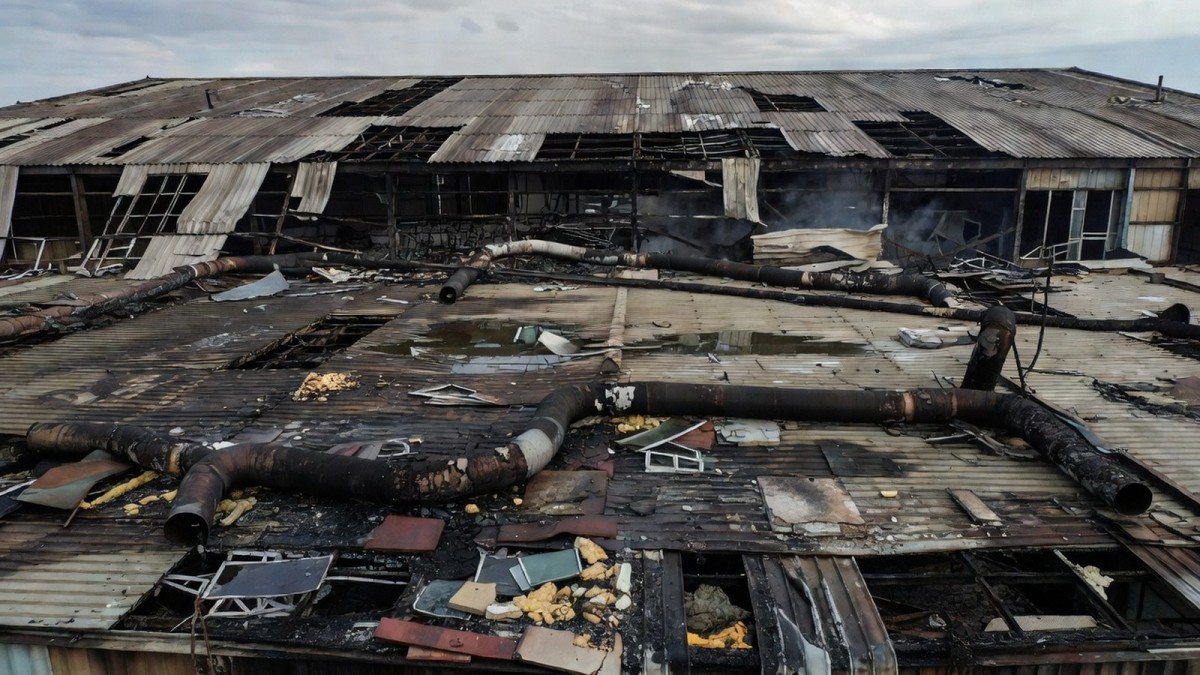
Now, let's talk about the most visually stunning and strategically significant target of the night. A massive warehouse complex belonging to Wildberries—Russia's largest online retailer, often called "Russia's Amazon"—was completely destroyed in Koledino, a town about 25 kilometers, or roughly 15.5 miles, from the center of Moscow. The video coming out of that area is apocalyptic. Huge columns of black smoke rising into the sky, a fast-moving fire raging across the entire complex, and nothing but charred remains left behind.
This wasn't collateral damage. Ukraine is claiming this strike deliberately. And their reasoning? They say the Wildberries logistics network is supporting the Russian military. Think about it. Wildberries isn't just selling you a pair of sneakers or a new blender. It's a massive distribution network that moves goods across the entire country. If the Russian military is using that infrastructure to move supplies, uniforms, equipment, or even just to keep the domestic economy humming while the war machine grinds on, it becomes a legitimate military target in Kyiv's eyes.
And this isn't a one-off. This is part of an ongoing campaign. Back on July 18, 2026, HNGN reported that Ukrainian drone strikes on two Wildberries warehouses and an oil depot killed at least nine people in Russia's Tambov and Moscow regions. That number went up after one of the wounded died in the hospital, and the Moscow region injury toll was revised up to 37. So this is a pattern, folks. Ukraine has been systematically targeting these logistics hubs for weeks. They're not just throwing drones at random. They're going after the arteries of the Russian economy and military supply chain.
The Kremlin, for its part, has not commented directly on the warehouse fire. That silence is deafening. When a building the size of several football fields burns to the ground just miles from the capital, and the government has nothing to say, you know they're trying to figure out how to spin this. Russia calls these attacks terrorism, plain and simple. But Ukraine calls it a necessary response to the near-daily missile and drone strikes that have been hitting their cities since February 2022. One person's terrorism is another person's self-defense, and the truth is somewhere in the smoke.
Airport Chaos: Ten Closures in 24 Hours
Let's talk about the chaos on the ground, because it wasn't just the warehouse that got hit. The Russian Association of Tour Operators reported that airports in Moscow were closed ten times in 24 hours due to the repeated drone strikes. Ten times. Imagine trying to run an airline when the airspace over your hub city keeps shutting down every couple of hours. The numbers are brutal: around 140 flights were cancelled, and another 130 were redirected to other airports. That's hundreds of flights, tens of thousands of passengers, all thrown into disarray because the skies over Moscow were deemed unsafe.
By Sunday, airport operations had returned to normal, according to reports. But the damage was done. The message was sent. If you're a Russian citizen trying to fly into or out of Moscow, you now have to wonder: is this the new normal? Is this what it's like to live in a country that's being attacked from the air? Because that's exactly what Ukraine is trying to achieve. They want the Russian people to feel a fraction of what Ukrainians have felt for four and a half years. They want the war to come home.
And it's not just Moscow. The disruption rippled out. A NATO jet even had to down a drone over Romania, according to Al Jazeera. That's right—the war is spilling over borders. A stray Ukrainian drone, or possibly a Russian one, ended up in Romanian airspace and had to be taken out by a NATO aircraft. That's a dangerous escalation, folks. That's the kind of incident that could drag NATO directly into this conflict if it happens again. The alliance is walking a tightrope, and every drone that crosses into their airspace makes that rope a little thinner.
The Human Toll: It's Not Just Numbers on a Screen
Now, I want to take a moment to talk about the human cost, because it's easy to get lost in the numbers. Eight hundred drones. Two hundred intercepted. One hundred forty flights cancelled. But behind every one of those numbers is a person. And on both sides of this war, people are dying.
In Russia, we've already mentioned the woman killed in Belgorod and the 83-year-old man in the Moscow region. But the attacks on Ukraine continued as well. This isn't a one-way street. While Ukraine was launching its massive drone assault, Russia was still pounding Ukrainian cities. The Guardian reported that two people were killed in the Sumy border region, and three others were killed across the country. In Kryvyi Rih, the hometown of President Volodymyr Zelenskyy, a woman was killed and six people were wounded in a missile and drone attack, according to the regional governor. The Kyiv Independent reported that Russian attacks across Ukraine killed 7 people and injured 51 as a major steel plant was hit in an overnight barrage.
Let me put that in perspective. In a single night, Russia killed at least seven people in Ukraine and wounded 51 more. They hit a steel plant—a massive industrial facility that employs thousands of workers. They hit a city that is the birthplace of the Ukrainian president. This is not a war of attrition. This is a war of annihilation. Both sides are inflicting maximum damage, and the civilians are the ones caught in the middle.
And here's the thing that gets me, folks. The Russian government calls Ukraine's drone strikes terrorism. But what do you call it when you launch missiles at a steel plant in a city of a million people? What do you call it when you strike a civilian bus in Belgorod? The hypocrisy is staggering. Russia has been raining down missiles and drones on Ukrainian cities since the start of the full-scale invasion in early 2022. They've hit hospitals, schools, apartment buildings, maternity wards. And now, when Ukraine finally develops the capability to strike back at Russian soil, Moscow cries foul. You can't have it both ways. You can't bomb a country into rubble for four years and then act shocked when they find a way to hit back.
Ukraine's Strategy: Going for the Kneecaps
So what's the strategy here? Why is Ukraine pouring hundreds of drones into Russian airspace? It's not just about inflicting damage, although that's certainly part of it. It's about economics. It's about psychology. It's about making the war unsustainable for the Russian people.
Kyiv has stepped up its attacks on Russia this year, targeting oil refineries, logistics hubs, and warehouses that it says support the war effort. The Wildberries strike is a perfect example. By destroying that warehouse, Ukraine is hitting the Russian economy directly. Wildberries is a massive employer. It's a critical piece of the Russian retail infrastructure. When that warehouse burns, goods don't get delivered. Prices go up. People get angry. And when people get angry, they start asking questions about why their government started a war that's now coming to their doorstep.
Ukraine has also claimed strikes on Onyx and Zircon missile launchers in occupied Crimea, according to the Kyiv Independent. These are some of Russia's most advanced weapons systems. The Zircon is a hypersonic missile that Russia has touted as unstoppable. If Ukraine is taking out the launchers, they're not just defending themselves—they're degrading Russia's ability to strike Ukrainian cities in the future. It's a proactive defense. You can't shoot a missile at Kyiv if your launcher is a smoking crater in Crimea.
This is a long game, folks. Ukraine knows it can't match Russia's military might in a conventional fight. Russia has more tanks, more planes, more missiles, more everything. But Ukraine has something Russia doesn't: the will to fight. And they're using that will to develop asymmetric tactics. Drones are cheap. Missiles are expensive. A single Zircon missile costs millions of dollars. A Ukrainian drone might cost a few thousand. When Ukraine sends 800 drones at Russia, they're forcing Russia to spend billions on air defense. They're draining the Russian treasury one intercept at a time.
What This Means for the War Going Forward
So where does this leave us? The war continues with no end in sight. That's the grim reality. Russia has maintained near-daily missile and drone strikes across Ukraine since launching its full-scale invasion in early 2022. Ukraine has now demonstrated that it can strike deep into Russian territory with impunity. The question is: what happens next?
Will Russia escalate further? Will they launch even more devastating attacks on Ukrainian cities in retaliation? Will they try to strike at the sources of these drones—perhaps the NATO countries that are supplying Ukraine with technology and intelligence? That's the nightmare scenario. A direct confrontation between Russia and NATO would be catastrophic beyond imagination. And every drone that flies over Moscow brings us one step closer to that possibility.
Or will this finally force Russia to the negotiating table? That seems unlikely, at least in the short term. Putin has staked his legacy on this war. He can't afford to back down now. But the calculus is changing. The Russian people are starting to feel the cost of this war in ways they haven't before. When flights are cancelled, when warehouses burn, when drones fly over the capital, the war stops being an abstract concept on state television and becomes a reality in their daily lives.
And that's the point, folks. Ukraine is fighting for its survival. They're fighting for their homes, their families, their very existence as a nation. They've been doing this for over four years, and they're not going to stop now. They've shown they have the capability to strike Moscow. They've shown they have the will to do it again and again. The question is whether Russia has the stomach to keep taking these hits.
Here's what I want you to take away from this, folks. This is not a stalemate. This is not a frozen conflict. This is an active, escalating war that is now being fought on two fronts: the front lines in eastern Ukraine and the front lines in the skies over Russia. The rules of engagement have changed. The war has come home to Russia, and there's no putting that genie back in the bottle.
We'll keep watching. We'll keep reporting. And we'll keep telling you the truth, no matter how uncomfortable it is. Because that's what you deserve. That's what the people dying on both sides of this conflict deserve. The truth. Stay informed. Stay engaged. And don't let anyone tell you this war is someone else's problem. Because in a world where drones fly over Moscow and NATO jets scramble over Romania, it's everyone's problem.
By Jessica Ali, Staff Writer
This article was produced with AI-assisted research and editorial support. Sources: CNN, The Associated Press, BBC News, The Guardian, Al Jazeera, TIME, LA Times, ABC News, Kyiv Independent, WION.
What's Your Reaction?
 Like
0
Like
0
 Dislike
0
Dislike
0
 Love
0
Love
0
 Funny
0
Funny
0
 Wow
0
Wow
0
 Sad
0
Sad
0
 Angry
0
Angry
0

Editor-in-Chief at Global1.News. Atlanta-based journalist who cuts through the BS and tells it like it is. Lead anchor, host, and the voice you hear when the spin stops and the truth starts.










Comments (0)