
The AI Buildout Just Moved Into the Ocean — and That's Not a Flex, It's a Confession
Ulsan is spending $37M on an underwater data center model, China already runs a wind-powered undersea site off Shanghai, and Thiel-backed Panthalassa raised $140M for wave-powered orbs. A founder on why the ocean is the buildout's escape hatch.
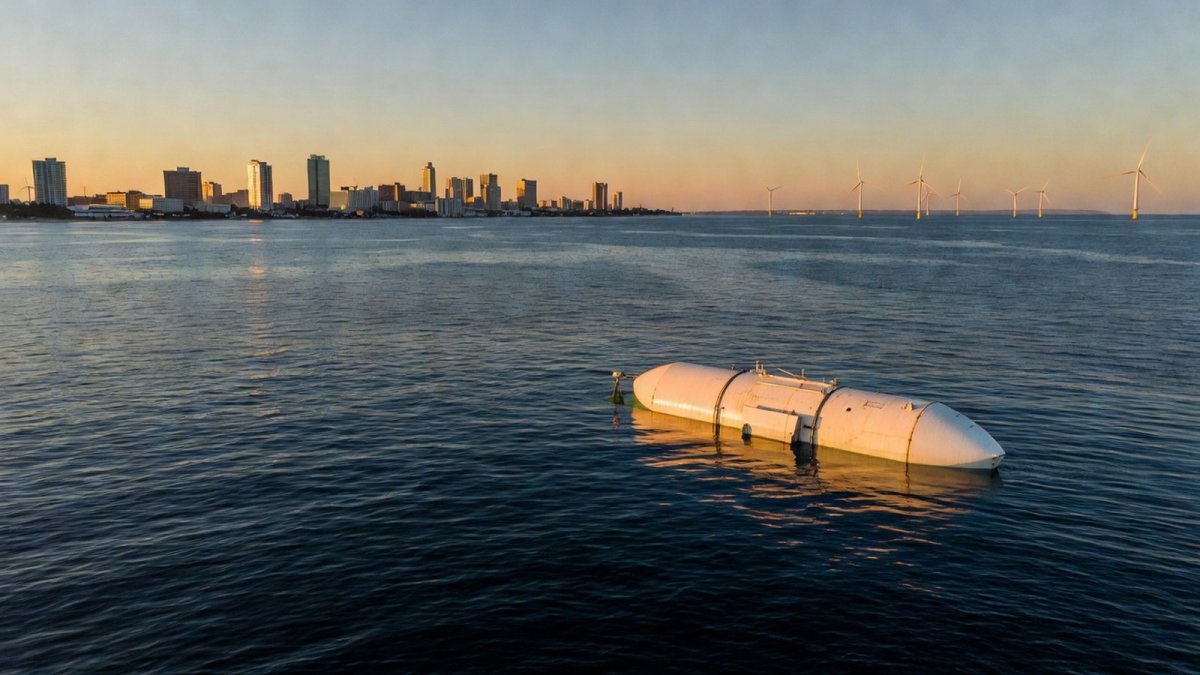
The AI Buildout Just Moved Into the Ocean — and That's Not a Flex, It's a Confession
Let me tell you something that's been sitting with me since Saturday. A city in South Korea announced it's spending $37 million to sink data centers into the sea. China's already running a wind-powered server farm under the water off Shanghai. A Peter Thiel-backed startup raised $140 million to float AI compute on wave-powered orbs in the Pacific. And Microsoft proved the whole concept works eight years ago, then quietly walked away from it.
I've been running hosting infrastructure for over a decade, and I've watched the AI buildout do some desperate things. I've seen hyperscalers build tent data centers in Ohio with gas plants bolted on. I've seen them fight 300-parcel eminent domain battles over transmission lines. I've seen them promise closed-loop cooling in drought country. But the moment an industry starts sinking its most expensive hardware into the ocean, you have to stop and ask what the land side did to make that look like the reasonable option.
Ulsan Is Paying $37 Million to Build the Template
The freshest one landed Saturday. Ulsan, a coastal city in South Korea, is partnering with the Korea Institute of Ocean Science and Technology (KIOST) to design a standardized subsea data center model. The budget is KRW 51.1 billion — about $37 million — through 2030, with KRW 40 billion of that coming straight from the central government.
Here's the plan: complete the standard model by 2030, then start building an underwater data-center complex for commercialization from 2031. The test site sits in waters roughly 20 meters deep off Ulsan's coast, where seawater averages about 13.3°C year-round. No mechanical refrigeration. Target PUE of 1.2. SK Telecom joined the project in January to handle the GPU-based infrastructure and server operations management. And the longer-term vision isn't small: a separate concept discussed by the city carries a KRW 500 billion price tag — roughly $360 million — and capacity for up to 100,000 servers.
Read that again. A city is planning for one hundred thousand AI servers underwater.
Why? Ulsan's own officials say it plainly: AI computing is straining land availability, power grids, and cooling systems nationwide. Land near population centers is scarce and expensive. The ocean, on the other hand, is free real estate that happens to come with a built-in cooling loop.
China's Already Running One — and It's Wind-Powered
South Korea is the plan. China is the proof of concept that's already in the water. The Shanghai Lin-gang undersea data center officially entered operation in May, sitting about 6.2 miles offshore and roughly 33 feet below the surface. It was built by a subsidiary of China Communications Construction, and it carries a planned capacity of 24 megawatts, with the first demonstration phase running at 2.3 MW.
Inside that submerged facility: 192 server racks arranged across four levels, running AI-focused workloads including big-data annotation and development of domestic large language models. The investment, according to China's State Council, was about $226 million.
Here's the number that actually matters. Tsinghua University professor Li Zhen says conventional data centers spend roughly a third of their electricity just on cooling. An undersea site of the same scale can bring that down to about a tenth, because the ocean does the work for free. The Lin-gang project uses seawater through a circulating copper-pipe heat exchange system, with average local sea temperatures around 59°F. It's also wired directly to offshore wind farms through subsea photoelectric composite cables — more than 95% of the facility's electricity comes from renewable sources.
Developers claim the underwater design cuts electricity consumption by 22.8%, eliminates freshwater use for cooling entirely, and reduces land use by more than 90%. PUE around 1.15. At full scale, they say, the facility could save 61 gigawatt-hours of electricity a year.
Peter Thiel Is Funding Floating Orbs
And if you think the underwater stuff is where it stops, Oregon-based Panthalassa raised $140 million in a Series B led by Peter Thiel back in May, pushing its valuation close to $1 billion, per the Financial Times. Their pitch isn't submerged capsules. It's floating orbs that pair wave energy with onboard AI computing, bypassing transmission costs entirely by generating power where the compute sits.
They call the ocean "free supercooling," and they're right about the physics. The prototypes — Ocean-1, Ocean-2, Wavehopper — were proven at sea in 2021 and 2024. This year they're deploying Ocean-3 pilot nodes in the northern Pacific, and they're aiming for commercial deployments in 2027.
Three separate ocean plays, three different business models, all in the span of a few months. That's not a coincidence. That's a signal.
The Natick Problem — Microsoft Proved This Eight Years Ago
Here's the part that should make every sober person in this industry slow down. Microsoft ran Project Natick from 2018 to 2020 — a full-scale data center module with 864 servers, deployed 117 feet deep off Scotland's Orkney Islands, powered by renewable energy, running for two years straight.
The results were genuinely impressive. The submerged servers had a failure rate eight times lower than a replica data center on land, thanks to stable temperatures and no human hands touching the hardware. Natick proved the concept was feasible and energy-efficient.
And then Microsoft... didn't build a fleet of ocean data centers. They published the research, took the win, and went back to land. That's the part nobody talks about when they hype the underwater thing: the tech worked, and the industry still didn't scale it. Why? Because a research module sitting on the seafloor for two years is not the same as 100,000 production servers that need regular maintenance, hardware swaps, and someone to walk the floor when a drive dies.
The Two Readings — Frontier Engineering or Escape Hatch
So how do you read this wave of ocean projects? There are two ways, and they're both true at once.
Reading one: this is frontier engineering. Seawater cooling is real physics. A PUE of 1.15 with zero freshwater use and 90% less land is a legitimate engineering achievement, and the climate case is real. If AI is going to push global data center electricity use to around 945 terawatt-hours by 2030 — the IEA's projection — then anything that cuts the cooling bill deserves a serious look.
Reading two: this is an escape hatch. And escape hatches are what you build when the building is on fire. Every one of these ocean projects is a direct response to a land-side constraint that got too expensive to fight: power queues that run years long, water rights that communities won't hand over, zoning battles that turn into ballot measures, eminent domain fights that make the front page. The ocean doesn't solve those problems. It runs away from them.
The giveaway is the framing. Ulsan says land is scarce and expensive. China says it wants to cut land and water use. Panthalassa says it wants to bypass transmission costs. Every single pitch is a list of land-side failures. Nobody's saying the ocean is better because underwater compute is intrinsically superior — they're saying the ocean is where the constraints aren't. Yet.
The Secondary Bottleneck — the Ocean Is a Symptom, Not a Solution
And that's the part I want independent hosting providers to really sit with. The ocean isn't the story. The resource squeeze is the story. The ocean is just where the squeeze pushed us.
Think about what had to go wrong on land for "sink it in the sea" to become a line item in a government budget. US data center power demand went from 23 gigawatts in 2023 to an estimated 42 gigawatts in 2026. The North American Electric Reliability Corporation issued a rare Level 3 alert in May. FERC ordered six grid operators in June to explain how they'll connect new AI data centers — or rewrite their own rules. Data Center Watch counted 75 projects worth about $130 billion blocked or delayed in Q1 2026 alone. Communities in 42 states have pushed back on data center development, and more than 300 localities have passed restrictions.
Water's the same story. This industry is burning an estimated 264 billion gallons a year, and the "closed-loop cooling" fixes only apply to new builds. When Google tried to quietly expand in The Dalles, the community found out the hard way that the water numbers weren't adding up. You don't need me to tell you what happens when a drought-stricken county learns a 500MW AI campus wants its aquifer.
So yes — the ocean offers free cooling and open water. It also offers saltwater corrosion, marine biology you didn't plan for, subsea cables that need specialized repair vessels, and a maintenance model that requires hauling a pod to the surface every time a drive fails. The report on Lin-gang flags those exact questions. And nobody has answered them at scale, because the only full-scale test in history — Natick — was retired after two years.
What This Means for Independent Hosting Providers
If you're running an independent hosting or colo business, here's what I'd do with this news, and it's not "buy a boat."
First, read the ocean stories as a resource-scarcity index, not a tech trend. Every headline about underwater compute is a headline about land-side constraints tightening. Where those constraints tighten, your customers' costs go up, and their patience with big-cloud pricing goes down. That's your opening. Position yourself as the provider who can deliver without a 10-year power contract or a 200-acre campus.
Second, efficiency is becoming a competitive weapon, not a cost center. The industry is racing to PUE 1.15-1.2 by moving to the ocean. You can get closer to that on land with the boring stuff: hot-aisle containment, better airflow management, ambient cooling in temperate climates, waste-heat reuse. Every kilowatt you don't spend on cooling is margin you keep and pricing you can undercut.
Third, water and power disclosure is coming for everyone. If communities are blocking hundreds of projects and regulators are demanding grid interconnection answers, transparency requirements will follow. Get your WUE and PUE numbers straight now, publish them, and make them a selling point. The hyperscalers are getting dragged into disclosure kicking and screaming. You can be ahead of it for the price of a spreadsheet.
Fourth, don't chase the ocean — but do watch the coastal land market. The second underwater compute looks viable at commercial scale, coastal land near subsea cable landings and offshore wind gets interesting, and so does any facility that can claim marine-adjacent cooling. That's a niche, but niches are where independents live.
Fifth, keep your maintenance story tight. The ocean pitch's hidden weakness is operational — nobody's done this at 100,000 servers. Your advantage as an independent has always been that you can actually touch your hardware. When the shiny ocean pods are waiting on a repair vessel, the customer who needs a drive swapped today is going to remember who can do it.
The Bottom Line
Here's the truth bomb. The AI industry isn't moving into the ocean because the ocean is a better place to compute. It's moving into the ocean because the land is full — full of queues, full of fights, full of dried-up aquifers, and full of people who stopped being impressed by billion-dollar campuses.
The ocean is what desperation looks like when it has a big R&D budget. The physics are real, the engineering is clever, and I genuinely hope it works. But if you're a founder, don't mistake the escape hatch for the destination. The winners in the next phase of this buildout won't be the ones who found new places to hide from the constraints. They'll be the ones who learned to do more with less — less power, less water, less land, less drama.
The sea will still be there. The constraints, meanwhile, are already on land and they're not going anywhere. Plan accordingly.
— Allan Ali, Founder
This article was produced with AI-assisted research and editorial support. Sources: TechRadar, ECOticias, PR Newswire, Business Wire, Microsoft Research, Reuters.
What's Your Reaction?
 Like
0
Like
0
 Dislike
0
Dislike
0
 Love
0
Love
0
 Funny
0
Funny
0
 Wow
0
Wow
0
 Sad
0
Sad
0
 Angry
0
Angry
0

Publisher of Global1.News. Automation architect, systems builder, and the guy making sure the truth gets published.















Comments (0)